Acreage Calculator
Measure your lot size in acres and square feet. Enter dimensions for a quick conversion, or use the methodology below to measure irregular lots from Google Maps, county GIS portals, or a survey.
Lot Size Calculator
How to calculate acreage
Acres are calculated by first finding the total square footage of the lot, then dividing by 43,560 (the number of square feet in one acre).
For a rectangular lot: length × width = square feet. Then ÷ 43,560 = acres. A 200 × 250 ft lot = 50,000 sq ft = 1.15 acres.
For irregular lots: divide the property into rectangles and triangles, calculate each section, sum the areas, then divide by 43,560.
Measuring your lot
If you know the dimensions: use them directly. The deed, plat map, or survey filed with your county will list lot dimensions.
If you don't know the dimensions: free options include your county's GIS portal (most counties offer one online), Google Earth Pro's polygon measurement tool, or county tax-assessor records.
Paid options for legal accuracy: a licensed surveyor ($300-1,500) provides a documented measurement that satisfies banks, courts, and permit offices.
For DIY measurement of moderate-sized lots: a measuring wheel ($25-60) gives ±3% accuracy over a typical suburban lot. Long tape measures (100 ft) are accurate but slow.
Common lot sizes in acres
Reference table of typical lot sizes:
Urban single-family lot: 3,000-5,000 sq ft (0.07-0.11 acres).
Small suburban lot: 5,000-8,000 sq ft (0.11-0.18 acres).
Typical American suburban lot: 7,000-12,000 sq ft (0.16-0.28 acres).
Generous suburban lot: 12,000-22,000 sq ft (0.28-0.5 acres).
Large lot subdivision: 0.5-1 acre.
Rural-edge property: 1-5 acres.
Small farm or homestead: 5-40 acres.
Working farm: 40+ acres.
Measuring lot size from Google Maps
Google Earth Pro (free desktop application) is the most accurate free tool for measuring lots from satellite imagery.
Open Google Earth Pro and navigate to your property. Use the polygon tool to trace your lot boundaries by clicking each corner. The tool displays area in square feet (or square meters, switchable in preferences).
Google Maps web version has limited measurement: right-click → Measure distance, then click to add points. You can trace the lot perimeter and the tool will display area. Less accurate than Earth Pro and only handles simple polygons.
For accuracy: zoom in close before tracing, use property boundaries visible in satellite imagery (fences, walls, hedge lines), and verify against your county's GIS portal if you have one available.
Buildable area vs total acreage
Total acreage is only part of the story. Your buildable area (what you can actually construct on) is usually much smaller.
Setbacks: most zoning requires 10-30 ft between buildings and property lines on each side. A 100 × 150 ft lot with 25 ft setbacks has only 50 × 100 ft = 5,000 sq ft of buildable footprint (33% of total).
Easements: utility, drainage, and access easements further reduce usable area. These don't reduce ownership but restrict what you can build there.
Floor Area Ratio (FAR): regulates total building square footage as a fraction of lot square footage. Typical residential FAR is 0.3-0.5. A 10,000 sq ft lot at 0.4 FAR allows max 4,000 sq ft of total building square footage (which can be multi-story).
Always check zoning, setbacks, and easements before estimating buildable area. The total acreage can be misleading if 60-70% of it is unbuildable.
Acres and zoning density limits
Zoning regulates how many homes can occupy each acre. Common density categories:
Single-family low density: 1-4 homes per acre (lots 0.25-1 acre each).
Single-family standard suburban: 4-6 homes per acre, which works out to lots of 7,300-10,900 sq ft.
Single-family high density / townhouse: 8-15 homes per acre (lots 3,000-5,000 sq ft each).
Multi-family / apartment: 30-200+ units per acre.
Mixed-use / urban: highly variable, often FAR-regulated rather than density-regulated.
Acres for real estate transactions
When buying or selling property, lot size in acres affects valuation:
Per-acre land value varies enormously: rural undeveloped $1,000-10,000/acre, suburban developable $20,000-200,000/acre, urban premium $1-10 million/acre.
MLS listings always include lot size in both acres and square feet. Always verify the number against the county records — listing agents sometimes round up.
Property tax: typically based on improved value (lot + buildings), not raw acreage. But for vacant land, acreage drives the assessment.
Subdivision potential: developers think in lots-per-acre. A 5-acre lot in 6-lots-per-acre zoning could potentially become 30 lots, dramatically affecting value.
Calculating from a county GIS portal
Most US counties offer free public GIS (Geographic Information System) portals that display property boundaries with measurements:
Search '[your county] GIS' or '[your county] property search' to find the portal.
Once you find your property, the portal typically displays: total acreage, total square footage, exact dimensions, zoning classification, tax assessment value, easements, and adjacent property boundaries.
GIS portal data is the same data used for tax assessment — it's authoritative for most purposes short of legal disputes.
Some counties charge a small fee for detailed parcel reports ($1-25), but the basic acreage and dimensions are usually free.
Acres vs hectares (international)
Outside North America, land is typically measured in hectares (ha) instead of acres.
1 hectare = 10,000 square meters = 2.471 acres = 107,639 square feet.
1 acre = 0.4047 hectares.
Quick conversion: multiply acres by 0.405 to get hectares, or hectares by 2.47 to get acres.
International real estate listings: a 'half-hectare' property is 1.24 acres, larger than a typical American suburban lot but smaller than a 'small farm.'
Acreage of standard platted lot sizes
Residential land is subdivided into a small number of recurring lot shapes, and most listings quote the frontage first: a 50 by 100 lot is 50 ft of street frontage and 100 ft deep. Multiply the two, divide by 43,560, and you have the acreage.
Frontage is the expensive dimension. Two lots of identical acreage can be worth very different amounts depending on how much of that area sits on the street, which is why plats favour narrow, deep lots in dense areas and wide, shallow ones further out.
Worked example — a 75 by 150 ft lot. Area is 11,250 sq ft. Divide by 43,560 and you get 0.258 acres, so it would usually be advertised as a quarter-acre lot. That rounding is normal, and it is why the deed area rather than the listing figure governs a transaction.
For parcels that are not rectangles, break them into rectangles and triangles the same way you would a room, and total the pieces. A pie-shaped lot on a cul-de-sac is a trapezoid: average the front and rear widths, then multiply by the depth.
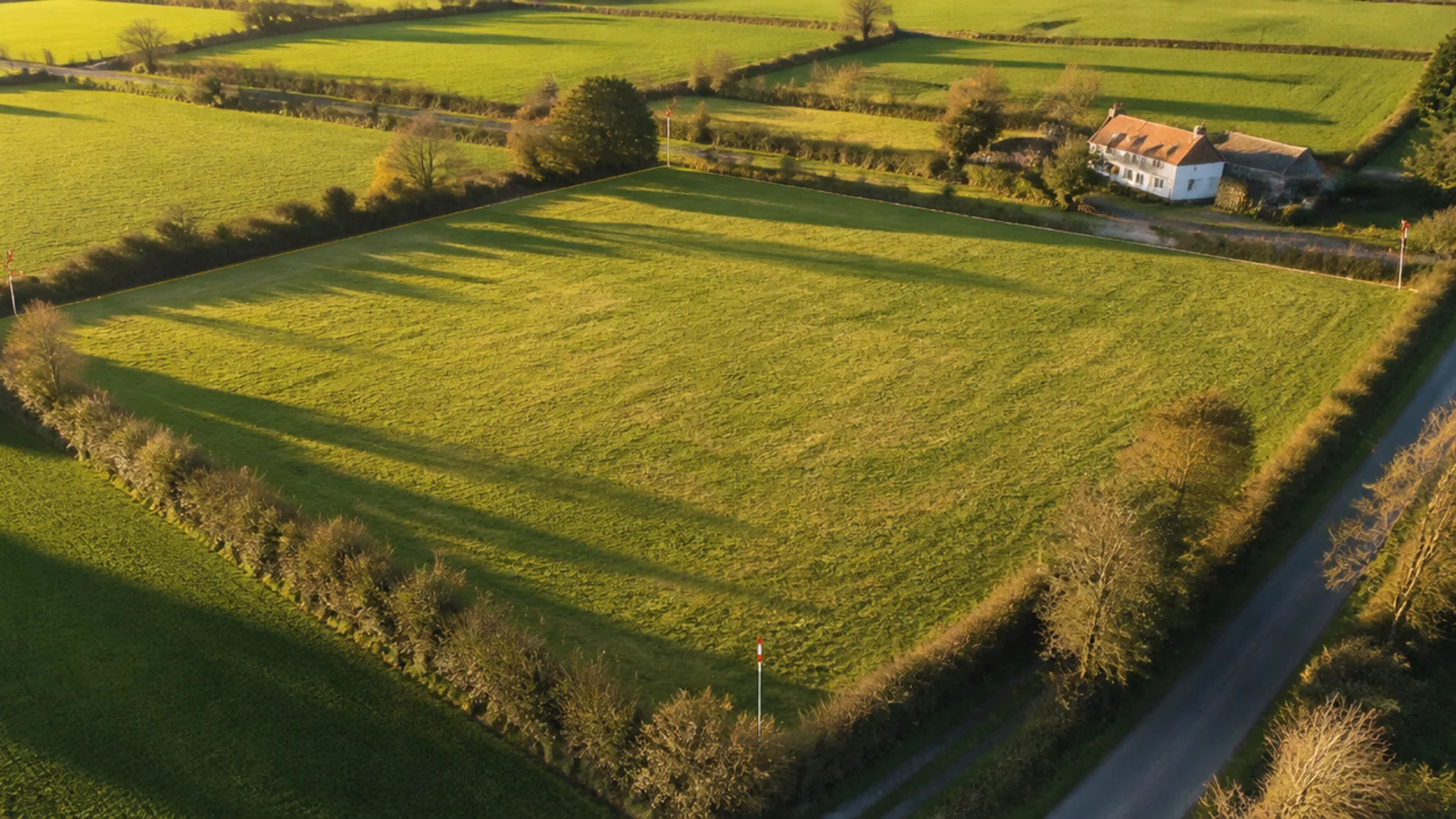
One caution specific to land. Recorded parcel areas come from a survey following the legal boundary, which may not match the fence line, the hedge, or where a neighbour believes the line runs. For anything contractual, use the surveyed figure and treat your own measurement as a check on it.
| Lot dimensions | Square feet | Acres | Usually described as |
|---|---|---|---|
| 50 × 100 ft | 5,000 sq ft | 0.115 acres | city lot |
| 60 × 120 ft | 7,200 sq ft | 0.165 acres | small suburban lot |
| 75 × 150 ft | 11,250 sq ft | 0.258 acres | quarter acre |
| 100 × 150 ft | 15,000 sq ft | 0.344 acres | third of an acre |
| 100 × 200 ft | 20,000 sq ft | 0.459 acres | half acre |
| 150 × 300 ft | 45,000 sq ft | 1.033 acres | one acre |
| 208.7 × 208.7 ft | 43,560 sq ft | 1.000 acre | exactly one acre, square |
Common acreage conversions
Quick reference table:
0.10 acre = 4,356 sq ft. 0.15 acre = 6,534 sq ft. 0.20 acre = 8,712 sq ft. 0.25 acre = 10,890 sq ft.
0.30 acre = 13,068 sq ft. 0.50 acre = 21,780 sq ft. 0.75 acre = 32,670 sq ft. 1 acre = 43,560 sq ft.
1.5 acres = 65,340 sq ft. 2 acres = 87,120 sq ft. 5 acres = 217,800 sq ft. 10 acres = 435,600 sq ft.
20 acres = 871,200 sq ft. 40 acres = 1,742,400 sq ft. 100 acres = 4,356,000 sq ft.
Pro tips
Use GIS first, surveyor last
County GIS portals are free and accurate enough for most decisions. Only pay for a survey if needed for legal or major construction purposes.
Acres in fractions, not just decimals
Properties often listed as '1/3 acre' = 14,520 sq ft. '1/2 acre' = 21,780 sq ft. '5/8 acre' = 27,225 sq ft.
Buildable area ≠ total acreage
Setbacks, easements, and FAR typically reduce buildable footprint to 30-60% of total lot area. Check zoning before buying.
Google Earth Pro is free
Free desktop application from Google. More accurate measurement tools than the web version of Google Maps.