Room Square Footage Calculator
Measure the square footage of any room — bedrooms, living rooms, kitchens, bathrooms, or oddly-shaped spaces. Enter dimensions in feet and inches and see results in real time.
Room Calculator
How to measure a room
For a standard rectangular room, measure the length wall-to-wall along one side, then measure the width wall-to-wall along an adjacent side. Multiply the two together to get square footage.
For accuracy, measure each dimension at two points — once near the front of the room and once near the back. Older homes especially can taper by an inch or more across a single wall, which adds up over a full project.
Always measure to the inside of the wall surface (the finished wall), not to the studs. For flooring projects, measure to where you want the flooring to end — usually under the threshold of any doorway.
How to measure a room accurately
Most rooms are nominally rectangular but slightly off-square due to construction tolerances. The proper measurement approach:
Measure each wall at two points (top and bottom) and use the average. Walls bow slightly with age and settling.
Use a tape measure or laser distance tool. Laser tools are more accurate for distances over 12 ft, where tape sag introduces error.
Measure to the inside face of finished walls — not to the studs, not to the framing.
For rooms with closets, decide whether to include them (yes for material orders, depends on context for square footage reporting).
Verify with the diagonal: a 12 × 14 ft room should have a diagonal of √(144+196) = 18.44 ft. If your diagonal disagrees, one of the wall measurements is off.
Common room sizes and what's typical
Bedroom (small): 10 × 10 ft = 100 sq ft. Child's room or small guest room.
Bedroom (standard): 11 × 12 ft = 132 sq ft or 12 × 12 ft = 144 sq ft. Most US bedrooms.
Bedroom (large): 12 × 14 ft = 168 sq ft or 14 × 16 ft = 224 sq ft.
Master bedroom: 14 × 16 ft = 224 sq ft typical, up to 16 × 20 = 320 sq ft in luxury.
Living room: 12 × 18 ft = 216 sq ft or 15 × 20 ft = 300 sq ft typical.
Family room: 16 × 20 ft = 320 sq ft typical.
Kitchen: 10 × 12 ft = 120 sq ft (small) to 16 × 20 ft = 320 sq ft (large).
Dining room: 12 × 14 ft = 168 sq ft.
Full bath: 5 × 8 ft = 40 sq ft (minimum) to 10 × 12 ft = 120 sq ft (luxury).
Half bath / powder room: 4 × 5 ft = 20 sq ft.
Walk-in closet: 5 × 7 ft = 35 sq ft (small) to 10 × 12 ft = 120 sq ft (large).
Typical room sizes and what they measure
Rooms cluster around a handful of sizes, because they are built around furniture and code minimums rather than round numbers. Knowing the usual range is a useful sanity check: if you measure a bedroom at 90 sq ft, either it is genuinely small or the tape slipped.
The table gives the common range for each room type in a US home, with the square footage that follows. Treat it as a reference for checking your own measurement, not a substitute for it — the whole reason to measure is that your house is not average.
Bedrooms carry a code floor worth knowing: most US jurisdictions require at least 70 sq ft of floor area and a minimum horizontal dimension of 7 ft for a room to be called a bedroom, plus a window that meets egress requirements. A 6 × 12 ft room is 72 sq ft but fails the 7 ft rule, which is why box rooms get listed as studies.
Worked example — a standard bedroom at 11 ft 6 in by 13 ft 3 in. Convert the inches first: 11.5 ft by 13.25 ft. Multiply: 152.4 sq ft. That sits in the middle of the standard-bedroom band, which tells you the measurement is plausible before you order anything against it.
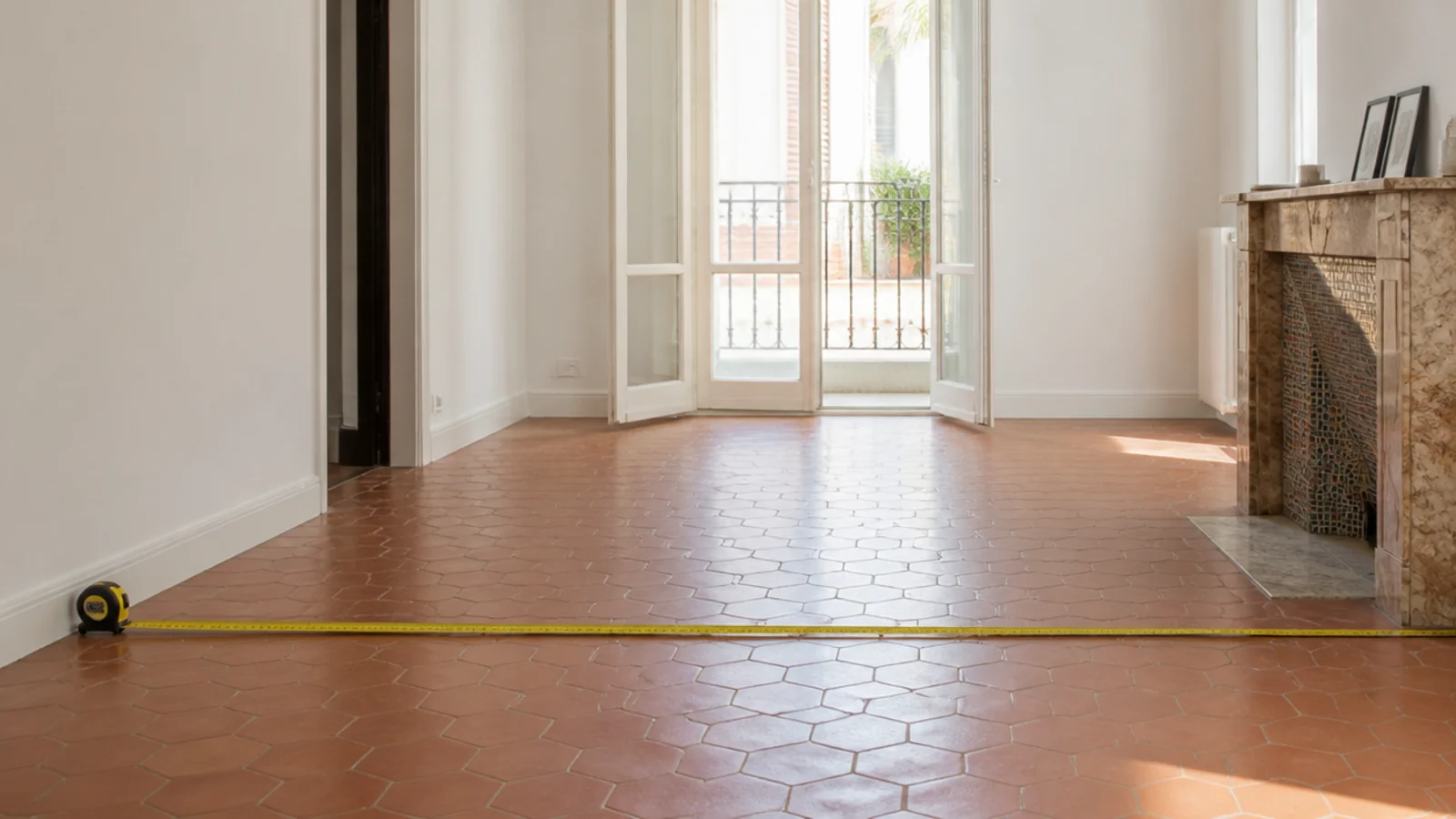
Measure at floor level, along the skirting, not at waist height across furniture. Walls are rarely parallel in an older house, so take each dimension at both ends of the room and use the larger figure for material orders — you can trim material, but you cannot stretch it.
| Room type | Typical dimensions | Typical area | Note |
|---|---|---|---|
| Small bedroom | 10 × 10 to 11 × 12 ft | 100–132 sq ft | Code floor is 70 sq ft |
| Standard bedroom | 11 × 12 to 12 × 14 ft | 132–168 sq ft | Fits a queen plus dresser |
| Primary bedroom | 14 × 16 to 16 × 20 ft | 224–320 sq ft | King plus walking room |
| Living room | 12 × 18 to 16 × 24 ft | 216–384 sq ft | Largest room in most homes |
| Kitchen | 10 × 12 to 14 × 16 ft | 120–224 sq ft | Measure around the cabinets |
| Dining room | 10 × 12 to 14 × 16 ft | 120–224 sq ft | Allow 36 in behind chairs |
| Full bathroom | 5 × 8 to 8 × 10 ft | 40–80 sq ft | 5 × 8 is the classic three-piece |
| Home office | 8 × 10 to 12 × 12 ft | 80–144 sq ft | Often a converted small bedroom |
Common room dimensions in square feet
These are the room sizes people look up most often. Each is simply length times width — the same calculation the tool above runs — but having them listed saves you typing when your room happens to be a standard size.
Click any dimension to load it straight into the calculator, then adjust from there. The link carries the numbers as URL parameters, so you can bookmark or share a specific room size and it will come back pre-filled.
The square metre and square yard columns are there because material quotes do not always arrive in square feet. Carpet is commonly priced by the square yard, and imported tile and flooring specs are usually metric.
If your room is not on this list, or it is not a plain rectangle, use the calculator itself. Anything with an alcove, a bay or a notch needs to be split into pieces and added, which is what the multi-area builder on the homepage is for.
| Dimensions | Square feet | Square metres | Square yards |
|---|---|---|---|
| 10 × 16 ft | 160 sq ft | 14.9 m² | 17.8 sq yd |
| 12 × 13 ft | 156 sq ft | 14.5 m² | 17.3 sq yd |
| 12 × 20 ft | 240 sq ft | 22.3 m² | 26.7 sq yd |
| 14 × 12 ft | 168 sq ft | 15.6 m² | 18.7 sq yd |
| 14 × 14 ft | 196 sq ft | 18.2 m² | 21.8 sq yd |
| 20 × 10 ft | 200 sq ft | 18.6 m² | 22.2 sq yd |
| 20 × 15 ft | 300 sq ft | 27.9 m² | 33.3 sq yd |
| 20 × 70 ft | 1,400 sq ft | 130.1 m² | 155.6 sq yd |
| 40 × 8 ft | 320 sq ft | 29.7 m² | 35.6 sq yd |
| 50 × 20 ft | 1,000 sq ft | 92.9 m² | 111.1 sq yd |
Room area for different project types
Same room can need different square footage numbers depending on the project:
Flooring: room dimensions inside walls. Include closets if you want flooring in them.
Paint: wall area (perimeter × ceiling height) minus openings, not floor area.
Wallpaper: same as paint, plus pattern repeat waste.
Ceiling paint or wallpaper: equal to floor area, since ceilings match floors.
Tile (wall-tiled bathroom): wall area for the tiled portion only.
Crown molding: linear feet of perimeter, not square footage.
Baseboard: linear feet of perimeter minus doorways, not square footage.
Drywall: floor area + wall area + ceiling area, since drywall covers all of these.
Insulation: depends on what type — ceiling insulation = floor area, wall insulation = wall area.
Rooms are rarely square, and it changes the number
Step 03 above says to measure at the widest point, and that is the right instruction for ordering material. It is not the right number to write down as the room's square footage, and the difference between those two uses is worth understanding before you quote a figure to anyone.
Measure the width at both ends of the room rather than once in the middle. On older houses a discrepancy of two to four inches across a wall is ordinary — framing moves, plaster builds up unevenly, and additions rarely meet the original structure square.
Worked example. A room measures 12 ft 0 in at one end and 12 ft 4 in at the other, over a 14 ft length. Multiplying the widest point gives 12.333 × 14 = 172.67 sq ft. The room's actual area is a trapezoid: (12 + 12.333) ÷ 2 × 14 = 170.33 sq ft. Multiplying the narrowest gives 168.00. The true figure sits between the two, 2.33 sq ft — about 1.4 percent — below the widest-point answer.
Order against 172.67 and record 170.33. Ordering off the widest point is deliberate, because planks and tiles run the full length of the room and the taper is absorbed in the cut at one wall; you need material for the widest line, not the average one. But 172.67 is a purchasing figure, not a measurement, and putting it on a floor plan or in a listing overstates the room.
Measure at floor level, against the finished wall, with the baseboard accounted for. A tape run at waist height drifts, and a tape run against fitted skirting stops short of the wall by the thickness of the trim. Both errors are small individually and both point the same way — under-measuring — which is how they compound.
Step-by-step measurement guide
Clear the perimeter
Move furniture away from the walls so your tape measure can run flush. Even a couple of inches of obstruction can throw off your reading.
Measure the length
Hook your tape on one wall, run it straight to the opposite wall. Note the measurement in feet and inches.
Measure the width
Repeat perpendicular to the length. Take the measurement at the widest point if the walls aren’t perfectly parallel.
Multiply
Length × Width = Square Footage. Or just type your numbers into the calculator above and skip the math.
Add a waste factor
If you’re ordering material, add 5–15% on top depending on the project type. The calculator does this for you when you select a material.
Pro tips
Measure feet AND inches
Don’t round 12 ft 7 in down to 12 ft. Even small rounding errors add up across a whole room.
Sketch as you go
Draw the room shape and label each wall’s measurement directly on the sketch. You’ll catch mistakes faster.
Closets count for flooring
If you’re buying flooring, include closets and any small alcoves — they need flooring too.
Subtract immovable obstacles
Built-ins, fireplaces, and floor-to-ceiling cabinets reduce the floorable area. Measure and subtract them.