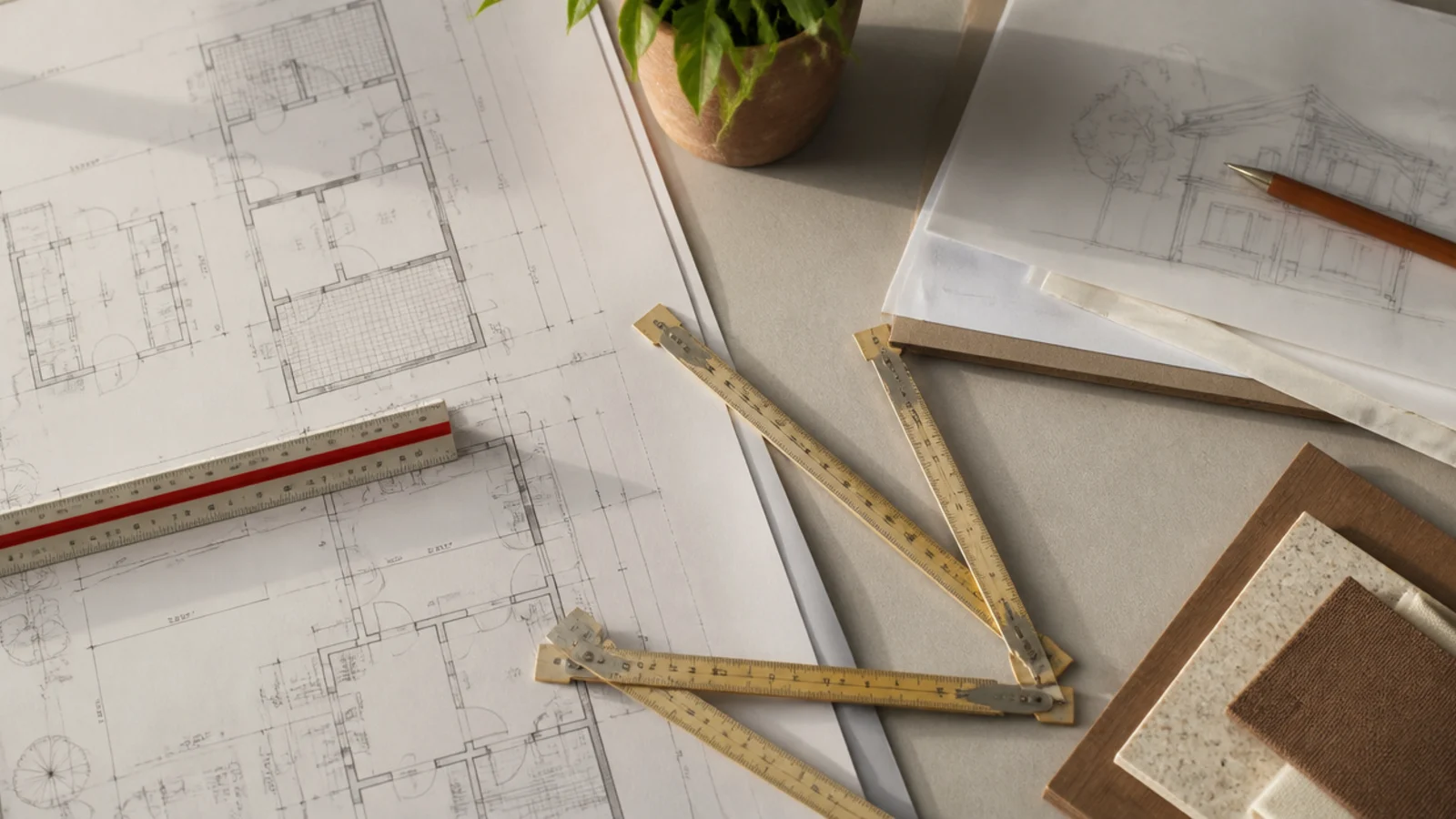
A — D
- ·Above-Grade — Any portion of a building that is at or above ground level. Real estate appraisals typically count only above-grade square footage as part of the official Gross Living Area (GLA). Finished basements are reported separately even if heated and habitable.
- ·Acre — A unit of land area equal to 43,560 square feet, 4,840 square yards, or about 4,047 square meters. Used primarily for lots, farms, and commercial parcels. A standard American football field (without end zones) is roughly 1.1 acres.
- ·ANSI Z765 — The American National Standards Institute standard for measuring single-family residential properties. Defines how appraisers and real estate agents calculate finished square footage in detached homes. Measure to exterior walls, count only finished and heated above-grade areas, and exclude open-to-below spaces.
- ·Annulus — A ring-shaped region between two concentric circles. Used to calculate the area of doughnut-shaped spaces like circular walkways around a pool. Formula: π × (R² − r²), where R is the outer radius and r is the inner radius.
- ·Area — A two-dimensional measurement of the surface a shape covers, expressed in square units (sq ft, sq m, etc.). Square footage is one specific way of expressing area. Distinct from perimeter (which is one-dimensional) and volume (three-dimensional).
- ·Base — In a triangle, the side chosen as the reference for measuring height. Any side of a triangle can serve as the base, but height must always be measured perpendicular to whichever base you choose. Triangle area = (Base × Height) ÷ 2.
- ·Below-Grade — Any level of a building where part of the floor sits below the surrounding ground. Under ANSI Z765 it is reported separately from above-grade living area, so a finished basement is quoted as finished below-grade area rather than added to the headline figure.
- ·Blueprint — A detailed scaled drawing showing the layout, dimensions, and construction details of a building or space. Modern blueprints typically include a square footage summary on the title sheet listing finished, unfinished, and total areas separately.
- ·BOMA — Building Owners and Managers Association. Publishes the BOMA standard for measuring office and commercial space, which differs from residential ANSI Z765. BOMA defines Usable Area, Rentable Area, and Common Area Load Factor for commercial leases.
- ·Bullnose — A tile with one glazed, rounded edge, used to finish an exposed tile edge. Counted in linear feet of edge and converted to pieces by the width of the trim, never in square feet. Rectified porcelain often has no matching bullnose made for it, in which case a metal or PVC profile is used instead.
- ·Butt Joint — Where two cut ends of drywall meet. Unlike the factory long edges, a cut end has no taper, so the compound has no recess to sit in and has to be feathered wide to hide the bump. Hanging board horizontally puts the tapered edges on the long seam and leaves only short butt joints.
- ·Course — One continuous row of a material — shingles, siding, tile or block — run across the surface. Material is often ordered and installed by the course, so the number of courses times the length of a course is a useful cross-check on an area figure.
- ·Coverage Rate — How much surface area a given quantity of material covers. Examples: 1 gallon of paint covers 350-400 sq ft on one coat; one bundle of asphalt shingles covers ~33 sq ft. Coverage rates are listed by manufacturers and used to convert square footage into material quantities.
- ·Diameter — A straight line passing through the center of a circle, touching both edges. Equal to twice the radius. Often easier to measure on real-world circles (like pools or tanks) than the radius, since you can pull a tape across the widest point.
- ·Dimension — A single measured extent (length, width, height, radius). Square footage calculations require two dimensions for most shapes, three for an annulus or trapezoid.
- ·Drop — In carpet installation, the length of a single piece of carpet rolled out from a 12-ft-wide bolt. Calculating drops accurately is more important than raw square footage when ordering carpet, because seams and pile direction matter.
- ·Dye Lot — The production batch a run of material was coloured in. Two boxes of the same product from different dye lots can differ visibly, which is why a whole job is ordered at once and a spare box is kept from the same lot for future repairs.

E — L
- ·Exterior Square Footage — The total square footage of a building measured to the outside of exterior walls. Larger than interior square footage by the wall thickness on all sides (typically 4-8% more). Used in ANSI Z765 residential appraisals and most real estate listings.
- ·Footprint — The ground-level outline of a building or structure, measured to its outermost walls. Footprint is the area a building covers on the lot but does not include upper floors. A 2-story house with a 1,200 sq ft footprint typically has 2,400 sq ft of total above-grade living area.
- ·Formula — A mathematical rule for calculating area from one or more dimensions. Different shapes use different formulas: rectangle (L × W), circle (πr²), triangle ((B × H) ÷ 2), trapezoid (((B₁ + B₂) ÷ 2) × H).
- ·GBA — Gross Building Area. The total floor area of a building including all enclosed spaces, measured to the outside of the exterior walls. Includes finished and unfinished space, basements, and mechanical rooms. Used in commercial appraisals and tax assessments.
- ·GLA — Gross Living Area. The finished, heated, above-grade square footage of a residential property used in real estate appraisal. Excludes garages, unfinished basements, and open-to-below areas. The number that appears on most listings.
- ·Heated Square Footage — Floor area served by a permanent heating system (forced air, radiant, baseboard). Most real estate definitions of livable square footage require the space to be heated. Sunrooms or screened porches are typically excluded.
- ·Heron's Formula — A method for calculating the area of a triangle when you know all three side lengths but not the height. Formula: Area = √(s × (s−a) × (s−b) × (s−c)), where s = (a + b + c) ÷ 2 is the semi-perimeter.
- ·Hectare — A metric unit of land area equal to 10,000 square meters or about 2.47 acres or 107,639 sq ft. Used internationally for agricultural and large-parcel measurements.
- ·Height — The vertical or perpendicular dimension of a shape. In a triangle, height is measured perpendicular from the base to the opposite vertex - not along a side. In wall-area calculations, height is the floor-to-ceiling distance.
- ·Interior Square Footage — The floor area measured between interior wall surfaces. Smaller than exterior square footage by the thickness of the exterior walls. Used for flooring, paint, and material estimates - not typically for real estate listings.
- ·Length — The longer of the two main dimensions of a rectangle (width is the shorter). When the rectangle is a wall, length usually refers to its horizontal extent. Always measure length and width perpendicular to each other.
- ·Linear Foot — A one-dimensional unit of length equal to 12 inches. Used for trim, baseboards, fencing, countertop edges, and railings - anything sold by length rather than area. Distinct from square feet (area) and cubic feet (volume).
- ·Livable Square Footage — Real estate term for the finished, heated, above-grade space inside a home. Synonymous with Gross Living Area in most markets. Excludes garages, open porches, attics with limited ceiling height, and unfinished spaces.
M — R
- ·Material Estimator — A calculation that converts square footage plus a coverage rate or unit size into the quantity of material needed (gallons, boxes, bundles, rolls). Most calculators on this site include a material estimator.
- ·MGA — Mean Ground Area, the average ground-level footprint of a multi-story building. Less common than GLA or GBA. Mostly used in zoning and planning documents.
- ·Material Takeoff — The itemised list of every material a job needs, derived from the measured areas: quantities, coverage rates, waste allowance and purchase units. A contractor’s takeoff is why two quotes for the same room differ — they can be pricing different quantities, not just different rates. Ask which areas and what waste percentage a quote was built from.
- ·Overage — Material bought beyond the measured area to cover cuts, offcuts, pattern matching and a repair reserve. Used interchangeably with waste factor, though the two are worth separating: waste is what the installation consumes, and a repair reserve is material you deliberately keep.
- ·Purchase Unit — The unit a material is actually sold in — carton, box, roll, pallet, bundle, sheet or gallon — as opposed to the square feet you measured. Purchase units force rounding up, which is why an order is never exactly the calculated area.
- ·Module — The repeating dimension a material is actually laid on: the tile plus its grout joint, or the plank plus its gap. A tile sold as 12 in usually measures about 11⅞, and the missing eighth is the joint, so the module is 12 in even though the tile is not.
- ·Net Area — The square footage of a surface after subtracting non-paintable, non-floorable, or non-livable openings (doors, windows, fireplaces, stairs). Always smaller than gross area. Net area is what you actually need to cover with material.
- ·Net Clear Opening — The unobstructed area of a window opening when it is fully open, measured through the opening rather than to the frame. Emergency escape openings are specified by net clear opening area, height and width, and a window can meet the height and width minimums while failing the area.
- ·Obstruction — Any feature that interrupts a flat surface and reduces usable square footage. Common obstructions: doors, windows, fireplaces, columns, kitchen islands, built-in cabinetry. Subtract obstructions for paint and wallpaper but include them in floor area for material orders (you'll cut around them but still pay for the cuts).
- ·Open-to-Below — A floor area on an upper level that overlooks a lower level (typically a foyer or great room). Open-to-below areas are NOT counted in upper-floor square footage under ANSI Z765 - they are part of the lower floor only.
- ·Parallelogram — A four-sided shape with both pairs of opposite sides parallel. Includes rectangles, squares, and rhombuses as special cases. Area formula: Base × Height (where height is the perpendicular distance between the two base sides).
- ·Perimeter — The total length around the boundary of a shape, expressed in linear feet (not square feet). Used to calculate baseboard, fencing, or trim. A 10 ft × 12 ft rectangle has a perimeter of 44 linear feet but an area of 120 sq ft.
- ·π (Pi) — The mathematical constant equal to approximately 3.14159265. Appears in every circle and circular-segment formula. Most calculators use 3.14159 or 3.1416, which is accurate enough for any construction or DIY purpose.
- ·Pitch Multiplier — The factor converting a roof’s horizontal footprint into its true sloped surface area: √(1 + (rise ÷ 12)²). A 6/12 roof multiplies by 1.118 and a 12/12 by 1.414, so the same footprint carries 11.8% or 41.4% more roof.
- ·Plan View — A drawing that shows a space as if viewed from directly above, with all walls and features projected to a flat plane. The standard view used for square footage calculation. Distinct from elevation (side view) or section (cutaway view).
- ·Pythagorean Theorem — a² + b² = c². Used to find the diagonal of a rectangle or to calculate triangle dimensions when only two sides are known. Useful when one wall in a room is missing and you need to back-calculate from the diagonal.
- ·Quadrilateral — Any four-sided shape. Includes squares, rectangles, parallelograms, rhombuses, trapezoids, and irregular four-sided shapes. Each subtype has its own area formula.
- ·Radius — The distance from the center of a circle to any point on its edge. Equal to half the diameter. The radius is the input most circle area formulas (πr²) require. To measure radius on a real-world circle, find the center first, then measure outward.
- ·Rectangle — A four-sided shape with four right angles and opposite sides of equal length. Most rooms approximate rectangles. Area = Length × Width.
- ·Rentable Area — In commercial real estate (BOMA standard), the total area for which a tenant pays rent. Includes the tenant's usable square footage plus a pro-rata share of common areas (lobbies, hallways, restrooms). Always larger than the actual occupied space.
S — Z
- ·Sector — A pie-slice-shaped region of a circle bounded by two radii and an arc. Area = (θ ÷ 360) × π × r², where θ is the central angle in degrees. Used for curved patios, garden beds, and circular building extensions.
- ·Segment — A portion of an irregular shape that has been broken down into a simpler geometric form for calculation. The standard approach for irregular rooms is to divide them into rectangles, triangles, and circular segments, calculate each, and sum the results.
- ·Slope — The angle or pitch of a roof or floor. Affects the actual surface area of a roof: a 1,500 sq ft footprint with a steep 12/12 pitch has a roof surface area of about 2,121 sq ft. Always factor in slope for roofing material estimates.
- ·Square — A four-sided shape with four equal sides and four right angles. A special type of rectangle. Area = Side × Side (or Side²).
- ·Square (Roofing) — A unit of roofing area equal to 100 square feet. Roofing materials (shingles, underlayment, ice-and-water shield) are often sold by the square. A 2,200 sq ft roof requires 22 squares of material.
- ·Square Foot (sq ft, ft²) — The most common unit of area in U.S. construction and real estate. Equals the area of a square that measures one foot on each side. 144 square inches in 1 sq ft. 9 sq ft in 1 sq yd. 43,560 sq ft in 1 acre.
- ·Square Inch (sq in, in²) — A small unit of area equal to a 1-inch square. 144 sq in in 1 sq ft. Used for very small surfaces like tile patterns or cabinet hardware.
- ·Square Meter (sq m, m²) — The metric standard for area. 1 sq m = 10.7639 sq ft. Used in international real estate listings and metric construction. Convert sq ft to sq m by dividing by 10.7639.
- ·Square Yard (sq yd, yd²) — A unit of area equal to 9 square feet (a 3 ft × 3 ft square). Carpet was traditionally sold by the square yard but is now more commonly priced by the square foot in the U.S. Still standard for some landscaping and concrete materials.
- ·Starter Strip — The first course at the eaves, laid before the visible field courses to seal the bottom edge. Ordered separately from field shingles and easy to leave off a takeoff calculated purely from area.
- ·Subbase — The compacted layer of granular fill beneath a slab or paving. Ordered by volume like the concrete above it, and at the same depth over the same area it is the same number of cubic yards.
- ·Trapezoid — A four-sided shape with one pair of parallel sides (called bases) and two non-parallel sides. Area = ((Base₁ + Base₂) ÷ 2) × Height. Used for tapered rooms, sloped lots, and architectural alcoves.
- ·Triangle — A three-sided shape. Area = (Base × Height) ÷ 2 if you know base and perpendicular height, or use Heron's Formula if you know all three sides. The most common shape for gable walls, attics, and triangular garden beds.
- ·Unit Conversion — The process of changing a measurement from one unit to another (e.g., square feet to square meters). Always convert at the end of the calculation, not during, to minimize rounding errors.
- ·Substrate — The surface a material is installed on: subfloor, wall sheathing, roof deck or compacted base. Its condition changes the quantity and the price more often than the area does, and it is the most common source of a change order after work starts.
- ·Usable Area — In commercial real estate (BOMA), the actual floor area a tenant can occupy with furniture and people. Excludes structural columns, vertical penetrations (elevators, stairwells), and corridors that serve other tenants. Smaller than rentable area.
- ·Vertex — A corner point of a polygon. Triangles have 3 vertices, rectangles have 4, an L-shape has 6. Counting vertices is a quick way to sanity-check that you've measured every wall in an irregular room.
- ·Volume — A three-dimensional measurement (length × width × height), expressed in cubic units (cu ft, cu m). Distinct from area. Used for HVAC sizing, mulch ordering, and concrete pours - not for typical square footage calculations.
- ·Waste Factor — An additional percentage of material added to the calculated square footage to account for cuts, breakage, mistakes, and future repairs. Typical values: 5% for paint, 10% for tile and laminate, 15% for diagonal tile or carpet, 20%+ for natural stone or pattern-matched flooring.
- ·Width — The shorter of the two main dimensions of a rectangle (length is the longer). When the rectangle is a wall, width usually refers to vertical extent. Always measured perpendicular to length.
- ·Yard (yd) — A linear unit equal to 3 feet or 36 inches. Distinct from a square yard (area) or cubic yard (volume).
Abbreviations and notation
- ·ft² — Square feet, also written as sq ft, sq. ft., or ft2 (when superscript isn't available). All four notations mean exactly the same thing. The superscript 2 indicates that the unit is squared (a two-dimensional area), not multiplied by 2.
- ·sq ft — Same as ft². Most common written form in US construction, real estate, and home improvement.
- ·ft2 — Same as ft². Common in text-only contexts where the superscript can't render (search queries, file names, plain-text emails). The '2' is NOT a multiplier — it's a shorthand for the superscript.
- ·m² — Square meters, also written as sq m, sqm, m2, or 'meters squared'. The terms 'meters squared' and 'square meters' are interchangeable in English. The metric SI standard for area.
- ·Meters squared vs square meters — These mean the same thing. 'Meters squared' is just the spoken form of m² (read out as 'meters... squared'). Both equal 10.7639 sq ft.
- ·yd² — Square yards, also written as sq yd or yd2. 1 yd² = 9 ft². Used for carpet and some landscaping.
- ·in² — Square inches, also written as sq in. 144 in² = 1 ft².
- ·ac — Acres. 1 ac = 43,560 ft². Used in real estate and land measurement.
- ·ha — Hectares. 1 ha = 10,000 m² = 2.47 acres. International SI unit for large land areas.
- ·GSF — Gross Square Footage. Commercial real estate term for total enclosed area including walls, columns, and mechanical spaces.
- ·RSF — Rentable Square Footage. Commercial real estate term for the area used to calculate rent, typically larger than usable square footage because it includes a share of common areas.
- ·USF — Usable Square Footage. The actual occupiable area within a commercial space, excluding shared corridors and structural elements.
Industry standards referenced on this site
When this site references a measurement standard, here is what we mean. These are the published references that contractors, appraisers, and architects use day-to-day.
| Standard | Issued by | Used for |
|---|---|---|
| ANSI Z765-2021 | American National Standards Institute | Single-family residential square footage |
| BOMA Z65.1-2017 | Building Owners and Managers Association | Office buildings - rentable and usable area |
| BOMA Z65.4-2010 | BOMA International | Multi-unit residential and apartment buildings |
| IBC | International Code Council | Commercial building codes and area limits |
| IRC | International Code Council | Residential building codes and minimum room areas |
| IRMS | International Right of Measurement Standards | International commercial property measurement |
| RICS Code | Royal Institution of Chartered Surveyors | International real estate (esp. UK and Europe) |
If you're working with an appraiser, real estate agent, or contractor, ask which standard they use before measuring. Numbers can vary by 5-10% across standards, especially when basements, garages, and patios are involved.
Apply what you've learned
Calculators that use these techniques
Frequently asked questions
What is the difference between square footage and gross living area?+
Square footage is any measured area. Gross living area is a defined subset used in appraisal: finished, heated, above-grade space measured to the outside of the exterior walls. A finished basement is square footage but not gross living area, which is why a listing and an appraisal can disagree on the same house.
What does a waste factor mean on a material order?+
It is the percentage added to your measured area to cover cuts, offcuts and pattern matching. It runs from 5% for a simple straight lay up to 20% for herringbone or a cut-up room. It is added when you order, not when you measure, so the measured area stays honest.
What is a roofing square?+
A roofing square is 100 square feet of roof surface. Roofers quote and order in squares rather than square feet, and shingles are usually packed three bundles to the square. A 1,677 sq ft roof is 16.8 squares.
What does linear foot mean compared with square foot?+
A linear foot measures length in one dimension only; a square foot measures area in two. Trim, fencing and countertop runs are sold by the linear foot, while flooring and paint are sold by the square foot. Converting between them always needs a second dimension, such as width or depth.
Related guides
Ready to calculate?
Open the calculator