The five common area units
These five units cover virtually every situation. Hectares (ha) appear occasionally in international real estate - 1 hectare = 10,000 m² = 2.47 acres.
| Unit | Abbreviation | Use Case |
|---|---|---|
| Square inch | sq in / in² | Tile, fabric, small objects |
| Square foot | sq ft / ft² | US standard for rooms, homes, materials |
| Square yard | sq yd / yd² | Carpet (legacy), some landscaping |
| Square meter | sq m / m² | International standard for buildings |
| Acre | ac | Land area, real estate, agriculture |
Conversion factors (most useful)
| From → To | Multiply / Divide by | Notes |
|---|---|---|
| Square inches → Square feet | ÷ 144 | 12 × 12 = 144 |
| Square feet → Square inches | × 144 | |
| Square feet → Square yards | ÷ 9 | 3 × 3 = 9 |
| Square yards → Square feet | × 9 | |
| Square feet → Square meters | ÷ 10.764 | Roughly ÷ 10.76 |
| Square meters → Square feet | × 10.764 | |
| Square feet → Acres | ÷ 43,560 | |
| Acres → Square feet | × 43,560 | |
| Square meters → Square yards | × 1.196 | |
| Hectares → Acres | × 2.471 |
Square feet ↔ square meters
1 square meter = 10.764 square feet, exactly (since 1 m = 3.281 ft, and 3.281² = 10.764). To convert sq ft to sq m, divide by 10.764. To convert sq m to sq ft, multiply by 10.764.
Quick mental conversion: a sq m is roughly 10% more than a sq yd (which is 9 sq ft). So a sq m ≈ 11 sq ft for rough estimates.
- ·100 sq ft ≈ 9.29 sq m
- ·500 sq ft ≈ 46.45 sq m
- ·1,000 sq ft ≈ 92.9 sq m
- ·100 sq m ≈ 1,076 sq ft
- ·500 sq m ≈ 5,382 sq ft
Square feet ↔ acres
1 acre = 43,560 sq ft, exactly. This precise number comes from historic surveying: an acre was originally a chain (66 ft) by a furlong (660 ft).
- ·0.10 acre = 4,356 sq ft (small urban lot)
- ·0.25 acre = 10,890 sq ft (typical suburban quarter-acre)
- ·0.50 acre = 21,780 sq ft (large suburban)
- ·1.00 acre = 43,560 sq ft (one acre)
- ·5.00 acres = 217,800 sq ft (small farm or rural homestead)
An acre isn't a fixed shape. It can be 100 × 435.6 ft, 209 × 209 ft, 50 × 871 ft, or any other dimensions whose product equals 43,560.
Square inches ↔ square feet
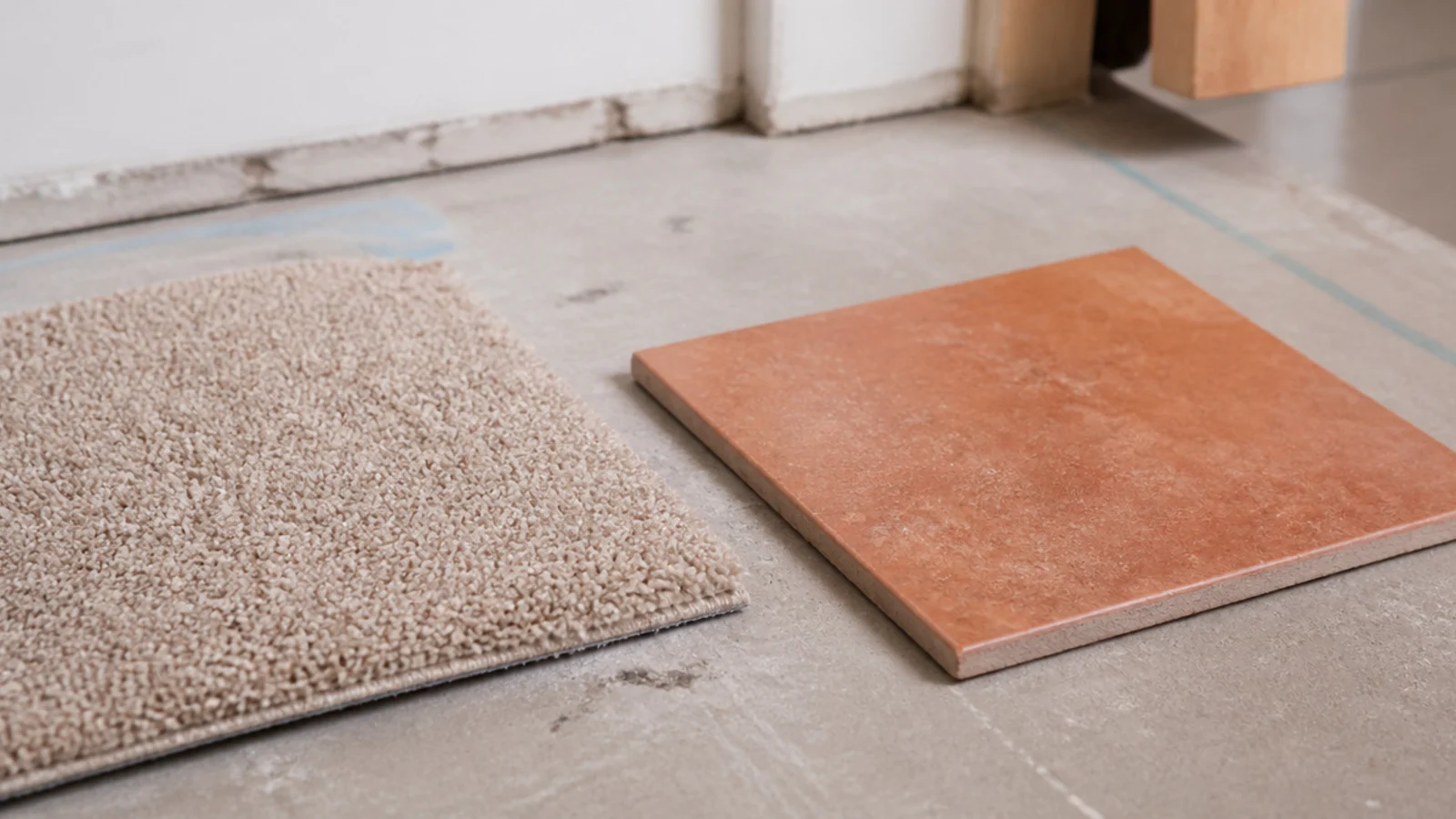
1 square foot = 144 square inches (because 1 ft = 12 in, and 12 × 12 = 144). To convert sq in to sq ft, divide by 144. This conversion comes up constantly with tile dimensions.
A common mistake: multiplying inch dimensions and reporting in 'square feet' without dividing by 144. A 24 × 18 in tile is 432 sq IN (not sq ft) - which is 3 sq ft.
- ·12 × 12 in tile = 144 sq in = 1 sq ft
- ·18 × 18 in tile = 324 sq in = 2.25 sq ft
- ·24 × 24 in tile = 576 sq in = 4 sq ft
Square yards (carpet)
Carpet was historically sold by the square yard, especially before the 1990s. Most US suppliers now sell by square foot, but you'll still see square yards listed - especially for commercial carpet and remnants.
1 sq yd = 9 sq ft. To convert sq ft to sq yd, divide by 9. A 200 sq ft room is 22.2 sq yd of carpet.
How to convert in mixed-unit measurements
If you measure one dimension in feet and another in inches, convert the inches to feet (or feet to inches) BEFORE multiplying.
Example: a kitchen counter is 8 ft 6 in × 25 in deep. Convert: 8 ft 6 in = 8.5 ft, and 25 in = 2.083 ft. Multiply: 8.5 × 2.083 = 17.7 sq ft.
The wrong way: 8.5 × 25 = 212.5 (this is sq feet × inches, a meaningless mixed unit). Always work in one consistent unit.
The calculator on the home page accepts feet AND inches as separate inputs and handles the conversion automatically. No mental math required.
The conversion that goes wrong most often
There is one mistake in this subject that costs more than all the others combined: using a length conversion factor on an area. One metre is 3.28084 feet, so people reach for 3.28 when converting square metres — and get a number that is three and a bit times too small.
Area factors are the square of length factors. If 1 m = 3.28084 ft, then 1 m² = 3.28084² = 10.7639 sq ft. The same rule governs every pair: a yard is 3 ft, so a square yard is 3² = 9 sq ft. An inch is 1/12 ft, so a square inch is 1/144 sq ft.
Worked example — a European tile spec quotes 45 m² for a floor. Multiply by 10.7639 and you get 484.4 sq ft. Multiply by 3.28084 instead and you get 147.6 sq ft, roughly a third of the real figure, and you order a third of the tile you need. The error is always in the same direction and always about 3.28 times.
The sanity check takes five seconds. A square metre is a bit larger than a square yard, and a square yard is 9 sq ft, so any square-metre figure should convert to somewhere near ten times as many square feet. If your answer is only three times bigger, you used the length factor.
The same trap sits inside imperial units. Twelve inches make a foot, so people divide square inches by 12 instead of 144. A 30 by 24 inch panel is 720 square inches, which is 5 sq ft — not 60. Whenever you convert an area, ask yourself whether you squared the factor.
International notes
The metric world uses square meters for buildings and hectares for land. The UK uses meters for new construction but still references acres for property ads.
Real estate listings should use the unit appropriate to the market: square feet for the US, square meters for most of Europe and Asia, and tsubo (3.3058 m²) for Japan. Always specify the unit explicitly to avoid confusion.
Which factors are exact, and which never terminate
Conversion tables print rounded numbers, which hides something worth knowing: some of these factors are exact definitions and some are decimals that run forever. Knowing which is which tells you when rounding is free and when it costs you.
The imperial relationships are all exact by definition — 144 square inches in a square foot, 9 square feet in a square yard, 43,560 square feet in an acre. Nothing is being approximated there. The bridge to metric is exact too, because a foot has been defined as exactly 0.3048 metres since 1959: squaring that gives exactly 0.09290304 square metres per square foot, and an acre works out to exactly 4,046.8564224 square metres.
What does not terminate is the reverse direction. One square metre is 10.763910416… square feet, and one hectare is 2.471053814… acres. Those are reciprocals of exact numbers, and reciprocals of exact numbers are usually not exact.
In practice this only bites on large areas. Converting a room with the rounded 10.7639 is wrong by about 1.4 parts per million — a fortieth of a square inch on a 200 sq ft room, which no tape measure could find. Converting 100 acres the same way is wrong by roughly 6 square feet. Use the exact factor where you have it, and round the answer rather than the factor.
These values are published in NIST Special Publication 811, the US guide to the SI units.
| Conversion | Factor | Exact? |
|---|---|---|
| 1 sq ft → sq in | 144 | exact |
| 1 sq yd → sq ft | 9 | exact |
| 1 acre → sq ft | 43,560 | exact |
| 1 sq ft → sq m | 0.09290304 | exact |
| 1 acre → sq m | 4,046.8564224 | exact |
| 1 sq m → sq ft | 10.763910416… | no |
| 1 hectare → acres | 2.471053814… | no |
The foot changed definition, and the acre went with it
Every conversion on this page uses 1 ft = 0.3048 m exactly. That has not always been the only foot in American use, and the second one is why some older land figures do not reconcile with new ones.
NIST records two definitions. The 1866 statute, restated in 1893, set 1 ft = 1200/3937 m exactly — about 0.3048006096 m — and that became known as the US survey foot. In 1959 the foot was redefined as 0.3048 m exactly, the international foot, but surveying and mapping kept the older value. Both were legal, and they differ by 2 parts per million.
Two parts per million in length is 4 in area, because area is a length squared. On an acre that is 0.1742 sq ft — about 25 square inches, which no flooring order will ever notice. NIST notes that before the change the acre, along with the chain, furlong, rod and link, was defined only in terms of the US survey foot: 1 acre is 4,046.8564224 m² on the international foot and 4,046.8726 m² on the survey foot.
Where it does bite is distance. Two parts per million over a mile is about an eighth of an inch, but state plane coordinates run to seven figures, and at 1,000,000 ft the two feet differ by very nearly 2 ft — 2.000004, to be precise about a difference that is itself a rounding. A survey plotted in one and interpreted in the other lands in the wrong place by a couple of feet — enough to move a boundary.
NIST deprecated the US survey foot on 1 January 2023: it should now be avoided except for historic and legacy applications, superseded by the international foot in all uses. For anything on this site the distinction is history rather than arithmetic — but if you are reconciling an old plat against a new one, it is the first thing to check.
Calculators that use these techniques
Frequently asked questions
How many square feet are in a square meter?+
How do you convert square feet to square yards?+
How many square feet are in an acre?+
How do you convert square inches to square feet?+
Why is the area conversion factor different from the length factor?+
What is the US survey foot, and does it change my square footage?+
Related guides
Ready to calculate?
Use the calculator (auto-converts)