Circle area calculator: square feet from radius or diameter
Find the area of a circle in square feet from either the radius or the diameter. The formula is pi times the radius squared, and if you only have the diameter, halve it first. Useful for round patios, fire pits, above-ground pools and circular garden beds.
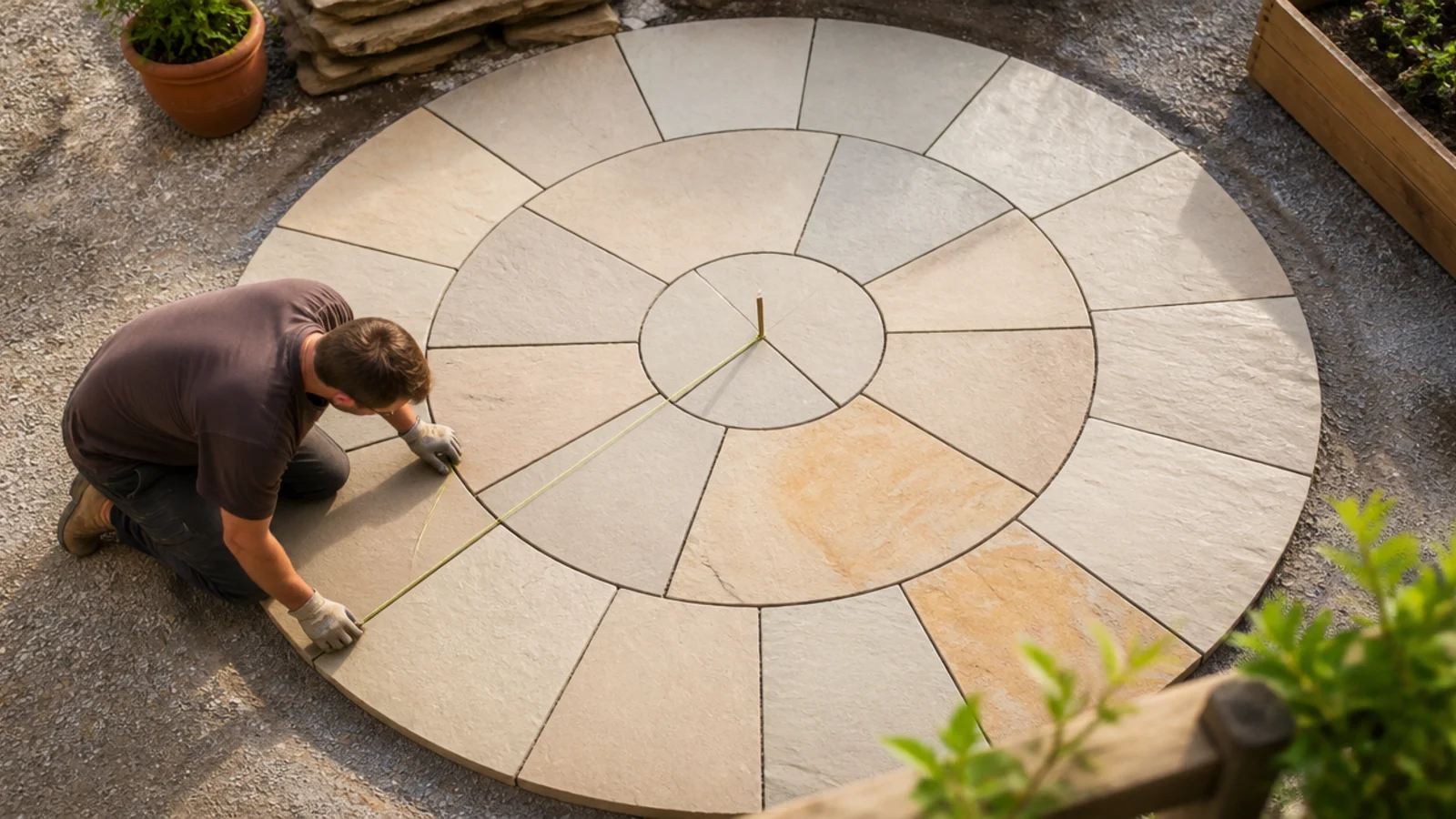
Circle Area Calculator
The formula and quick examples
Circle area = π × radius². π (pi) ≈ 3.14159. Multiply π by the radius squared.
Quick examples: a 10-ft diameter circle has a 5-ft radius and an area of 78.5 sq ft. A 20-ft diameter circle has a 10-ft radius and an area of 314 sq ft. A 30-ft diameter has a 15-ft radius and an area of 707 sq ft.
Doubling the diameter quadruples the area. A 20-ft circle has 4× the area of a 10-ft circle, not 2×.
Measuring a real circle
In the field, measure diameter (across the widest part of the circle through the center) - it's easier than measuring radius. Then divide by 2 for the radius.
For a circular patio: measure across at multiple angles to confirm it's actually a circle (not slightly oval). If diameters vary by more than a few inches, treat it as an ellipse - approximate with two semicircle ends or just average the diameter.
Where circle area calculations come up
Round patios and concrete pads: a 12-ft-diameter circular patio = π × 6² = 113 sq ft. Above-ground pools (round): a 24-ft pool = 452 sq ft. Garden beds, tree rings, fire pit pads, hot tub pads, gazebo footprints, spiral stair landings.
The formula is π × r². Measure across the widest point of the circle to get the diameter, divide by 2 to get the radius, then square it and multiply by π (3.14159).
If the center is inaccessible (a tree, a pond), measure the circumference with a flexible tape, divide by π to get diameter, then divide by 2 for radius.
Common circle sizes in square feet
Most people measure a circle across, not from the middle, so the table is keyed on diameter. Halve the diameter to get the radius, square it, then multiply by 3.1416. Every figure below is that calculation carried to one decimal.
The last two columns cover the shapes that actually turn up on a job. A semicircular patio off a straight wall is half the circle. A quarter-round bed tucked into a corner is a quarter. For a three-quarter circle, take the full area and multiply by 0.75.
Watch how fast the numbers climb. Going from a 10 ft circle to a 20 ft circle does not double the area, it quadruples it: 78.5 sq ft becomes 314.2. Area scales with the square of the diameter, which is why a modest-sounding upsize on a patio blows up the paver order.
| Diameter | Radius | Full circle | Semicircle | Quarter circle |
|---|---|---|---|---|
| 4 ft | 2 ft | 12.6 sq ft | 6.3 sq ft | 3.1 sq ft |
| 6 ft | 3 ft | 28.3 sq ft | 14.1 sq ft | 7.1 sq ft |
| 8 ft | 4 ft | 50.3 sq ft | 25.1 sq ft | 12.6 sq ft |
| 10 ft | 5 ft | 78.5 sq ft | 39.3 sq ft | 19.6 sq ft |
| 12 ft | 6 ft | 113.1 sq ft | 56.5 sq ft | 28.3 sq ft |
| 14 ft | 7 ft | 153.9 sq ft | 77.0 sq ft | 38.5 sq ft |
| 15 ft | 7.5 ft | 176.7 sq ft | 88.4 sq ft | 44.2 sq ft |
| 18 ft | 9 ft | 254.5 sq ft | 127.2 sq ft | 63.6 sq ft |
| 20 ft | 10 ft | 314.2 sq ft | 157.1 sq ft | 78.5 sq ft |
| 24 ft | 12 ft | 452.4 sq ft | 226.2 sq ft | 113.1 sq ft |
| 30 ft | 15 ft | 706.9 sq ft | 353.4 sq ft | 176.7 sq ft |
Measuring imperfect circles
Real-world circles are rarely perfect. To check whether your shape is actually circular: mark the apparent center and measure to the edge at 4-8 points around the perimeter. If all measurements fall within 5% of each other, treat as a circle. If they vary more, treat the shape as an irregular polygon — segment it into rectangles and triangles, calculate each, and sum.
For elliptical or oval shapes (longer in one direction): use π × long-radius × short-radius. A 16 × 32 ft oval pool = π × 16 × 8 = 402 sq ft.
Pro tips
Measure diameter, not radius
The center of a circle isn't marked in the real world. Measure across (diameter) and divide by 2.
Half a circle uses half the formula
A semicircle area = (π × r²) ÷ 2. A quarter circle = (π × r²) ÷ 4. Useful for round-end patios and garden beds.
Annulus = ring shape
For a ring (donut shape), area = π × (R² - r²) where R is the outer radius and r is the inner. Use the Annulus mode on the multi-shape calculator.
Use 3.14159 for >1% accuracy
Using 3.14 introduces ~0.05% error. For most projects that's fine. For large patios or pools, use 3.14159 or the calculator's built-in π.