Pool size in square feet
A 16 by 32 ft rectangular pool has a 512 square foot surface, and a 15 ft round pool has 177. Multiply length by width for a rectangle, or use pi times the radius squared for a round one. Surface area is what covers, liners and chemical dosing are all sized from.
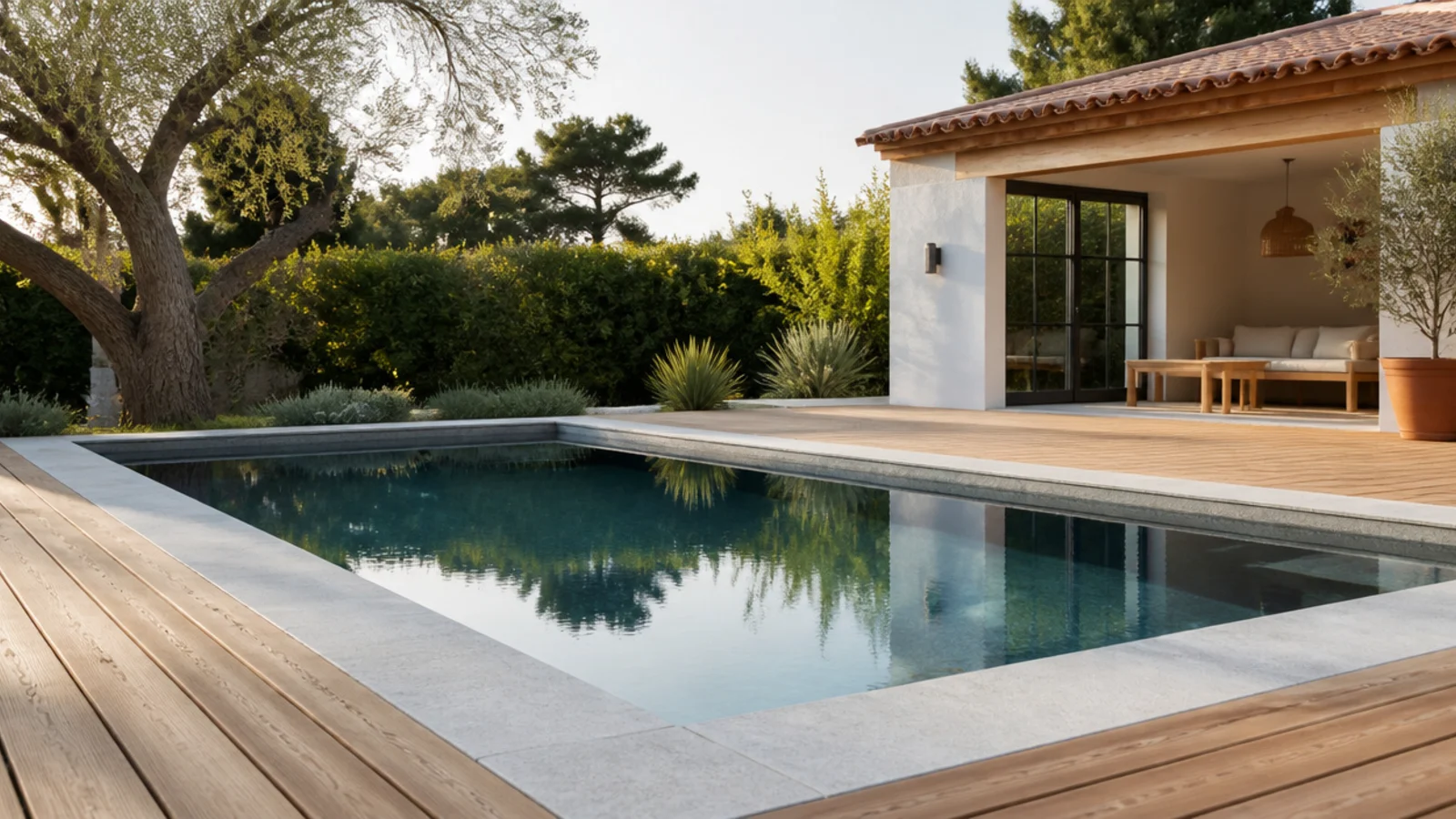
Pool Area Calculator
Pool shape formulas
Rectangular pool: length × width. A 16 × 32 ft pool has a 512 sq ft surface area.
Round pool: π × radius². A 24-ft round pool has radius 12 ft, area = 3.14 × 144 = 452 sq ft.
Oval pool: rectangle (length × width) + circle (π × radius²) where the radius is half the pool width. A 15 × 30 ft oval = (15 × 15 rectangle) + (3.14 × 7.5²) = 225 + 177 = 402 sq ft.
Liner vs. surface area
Surface area is the top of the water. Liner area includes the pool floor (the surface area) PLUS the walls (perimeter × wall depth). For a 16 × 32 × 4 ft pool: floor = 512 sq ft + walls (96 × 4) = 384 sq ft, total liner area ~ 896 sq ft.
Pool covers (winter or solar) match the surface area plus a few feet of overhang. Order a cover sized for the next pool size up if you want generous overlap.
Pool surface area by shape
Pool surface area is calculated by pool shape, with the most common backyard pools being rectangular or rectangular with rounded corners.
Rectangular: length × width. A 16 × 32 ft pool = 512 sq ft.
Rectangular with rounded corners (Roman end, Grecian end): take 5-10% off the rectangular calculation. A 16 × 32 with rounded corners ≈ 460-490 sq ft.
Kidney shape: approximate as 80-85% of the bounding rectangle. A 16 × 32 ft kidney ≈ 410-435 sq ft.
Oval/elliptical: π × (long radius) × (short radius). A 16 × 32 ft oval = π × 16 × 8 = 402 sq ft.
Free-form: divide into rectangles, semicircles, and triangles. Sum the areas.
L-shape: two rectangles, add together. A 20 × 40 L with a 20 × 20 ft wing = 800 + 400 = 1,200 sq ft.
Pool deck and coping calculations
Pool projects involve more than just the pool surface. The deck and coping around the pool typically add 30-100% to the total project area:
Coping (the edge around the pool): typically 12-18 inches wide. For a 16 × 32 ft rectangular pool with 18-inch coping: 32 × 18/12 + 2 × (16 + 18/12 × 2) × 18/12 = 100 sq ft of coping.
Standard pool deck width: 4 ft minimum (code in most areas), 6-10 ft typical, 10-15 ft for entertainment-focused decks.
Pool + deck area for 16 × 32 ft pool with 6 ft deck on all sides: 28 × 44 - 16 × 32 = 1,232 - 512 = 720 sq ft of deck area, plus 512 sq ft of pool = 1,232 sq ft total project footprint.
Deck materials: concrete $5-10 per sq ft, pavers $15-30, travertine $20-40, composite decking $35-70.
Pool surface area for common pool sizes
Pool sizes are sold as nominal dimensions, so most people already know the number they need to convert — a 15 ft round, an 18 by 36 rectangle. The table gives the water surface area for the sizes that actually get installed, so you can skip the arithmetic.
Round pools use π × radius². A 15 ft round pool is 3.1416 × 7.5² = 176.7 sq ft of water surface. Rectangular pools are length × width, so an 18 by 36 is 648 sq ft. Those are the two shapes that cover almost every residential pool.
Surface area is the number for covers, solar blankets and chemical dosing, because all three work off the water surface. It is not the number for liners or interior finishes: those follow the wetted surface, which adds the walls and floor and runs substantially larger than the figures below.
For heating and evaporation, surface area is the whole story — a pool loses heat across its top, not its sides. Doubling a pool from a 15 ft round to a 21 ft round is not a modest upgrade: 176.7 sq ft becomes 346.4, nearly double the surface losing heat every night.
| Round pool | Surface area | Rectangular pool | Surface area |
|---|---|---|---|
| 12 ft round | 113.1 sq ft | 12 × 24 ft | 288 sq ft |
| 15 ft round | 176.7 sq ft | 14 × 28 ft | 392 sq ft |
| 18 ft round | 254.5 sq ft | 15 × 30 ft | 450 sq ft |
| 21 ft round | 346.4 sq ft | 16 × 32 ft | 512 sq ft |
| 24 ft round | 452.4 sq ft | 18 × 36 ft | 648 sq ft |
| 27 ft round | 572.6 sq ft | 20 × 40 ft | 800 sq ft |
| 30 ft round | 706.9 sq ft | — | — |
Pool covers, liners, and water volume
Pool surface area drives several materials and equipment sizing:
Pool covers (solar covers, safety covers, mesh covers): priced per sq ft of pool surface. Solar bubble covers: $0.50-1.50 per sq ft. Safety covers (winter): $2-5 per sq ft.
Pool liners (vinyl liner pools): priced for the specific pool size. A 16 × 32 ft rectangular liner: $700-1,500.
Water volume (gallons): pool surface area × average depth × 7.5. A 512 sq ft pool averaging 5 ft deep: 19,200 gallons. Drives chlorine, pump sizing, heater sizing.
Pool heater sizing: 0.5-1 BTU per gallon per °F desired temperature rise. A 20,000 gallon pool wanting 10°F increase: 100,000-200,000 BTU heater.
Pool pump sizing: turn over pool water every 8 hours = pool volume ÷ 8 hours = gallons per hour. 20,000 gallon pool: 2,500 gph pump (or 42 gpm).
Two areas that are not the pool: the waterline band and the surround
A pool project has three square footages and only one of them is the water. The other two get missed because they are ordered from different trades.
The waterline band is the strip of tile that runs around the inside of the pool at water level, typically six inches tall. It is a perimeter calculation rather than an area one: perimeter × band height. A 16 × 32 ft rectangular pool has a 96 ft perimeter, so a 6 in band is 96 × 0.5 = 48 sq ft of tile. Order it separately from anything else — it is usually a different tile from the deck, and it is small enough that a single box shortfall stops the job.
The surround is the deck around the pool, and it is the ring shape this calculator's border option is for. Take the outer edge of the paving, take the pool, subtract. A uniform 4 ft surround around that same 16 × 32 pool gives an outer rectangle of 24 × 40 = 960 sq ft; less the 512 sq ft of pool, the surround is 448 sq ft. Note that the deck is nearly as large as the pool — on a small pool it is usually larger, and it is the part people forget to budget.
Two adjustments. Coping — the capping course at the pool edge — is bought in linear feet along that same 96 ft perimeter, not in square feet, so it is a third order again. And a surround that is wider on one side for loungers is no longer a uniform border: measure it as separate rectangles and add them, rather than averaging the width.
Pro tips
Use diameter, not radius, when ordering
Round pools are typically advertised by diameter (24 ft, 27 ft, 30 ft). Cover and liner suppliers list by diameter, not radius. Convert to radius only for the area formula.
Free-form pools are tricky
For kidney-shaped or true free-form pools, divide into multiple rectangles and circle segments. Add 5% to your final number to account for irregular boundaries.
Chemical dosing uses gallons, not square footage
Pool chemical doses are based on water volume (gallons). Volume = length × width × average depth × 7.48. A 16 × 32 × 5 ft pool holds about 19,000 gallons.
Decking is calculated separately
Pool deck square footage is the deck area minus the pool. For a 20 × 40 ft deck around a 16 × 32 ft pool: 800 - 512 = 288 sq ft of decking.