1. Mixing units in the same calculation
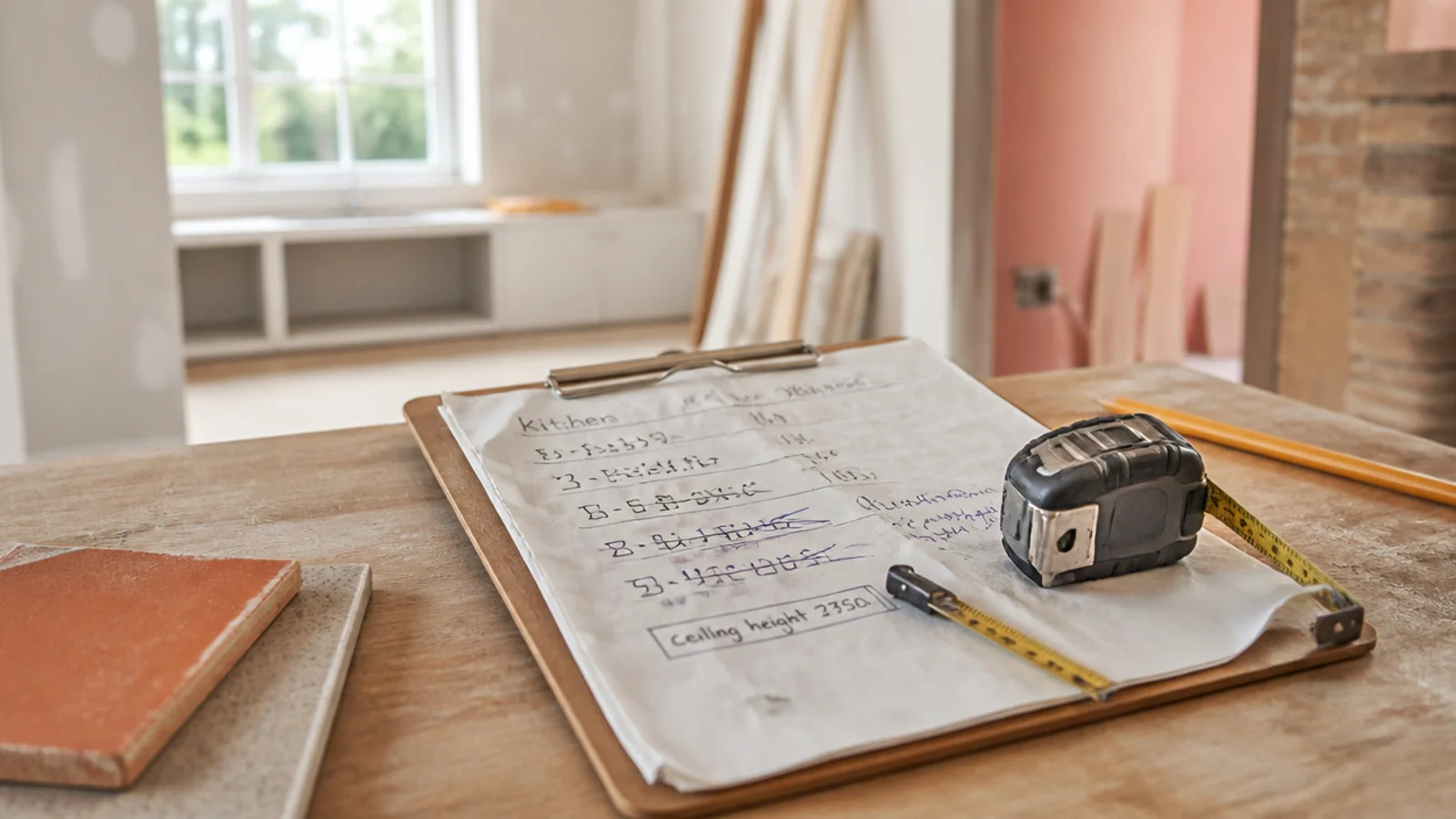
Pulling a tape measure that reads 12 ft 6 in and writing it as '12.6 ft' is wrong. 6 inches isn't 0.6 feet - it's 0.5 feet. Mixing inches with feet (or treating inches as a decimal of feet) is the single most common square footage error.
Always convert inches to feet by dividing by 12. 6 in ÷ 12 = 0.5 ft. 9 in ÷ 12 = 0.75 ft. The calculator on this site accepts feet and inches as separate fields, so you don't need to do the conversion mentally.
Stick to one unit (all feet or all inches) for the entire project. The fewer conversions you do, the fewer errors you make.
2. Forgetting the waste factor
Calculating a perfect 200 sq ft floor and ordering exactly 200 sq ft of tile is a guaranteed second trip to the store. Add 10% for standard tile, 15% for diagonal patterns, 20% for herringbone or hex.
Without waste factor, you cover edges, cuts, and the inevitable broken tile from the same calculated number - meaning you run short by 5-15% before you finish.
3. Treating L-shapes as rectangles
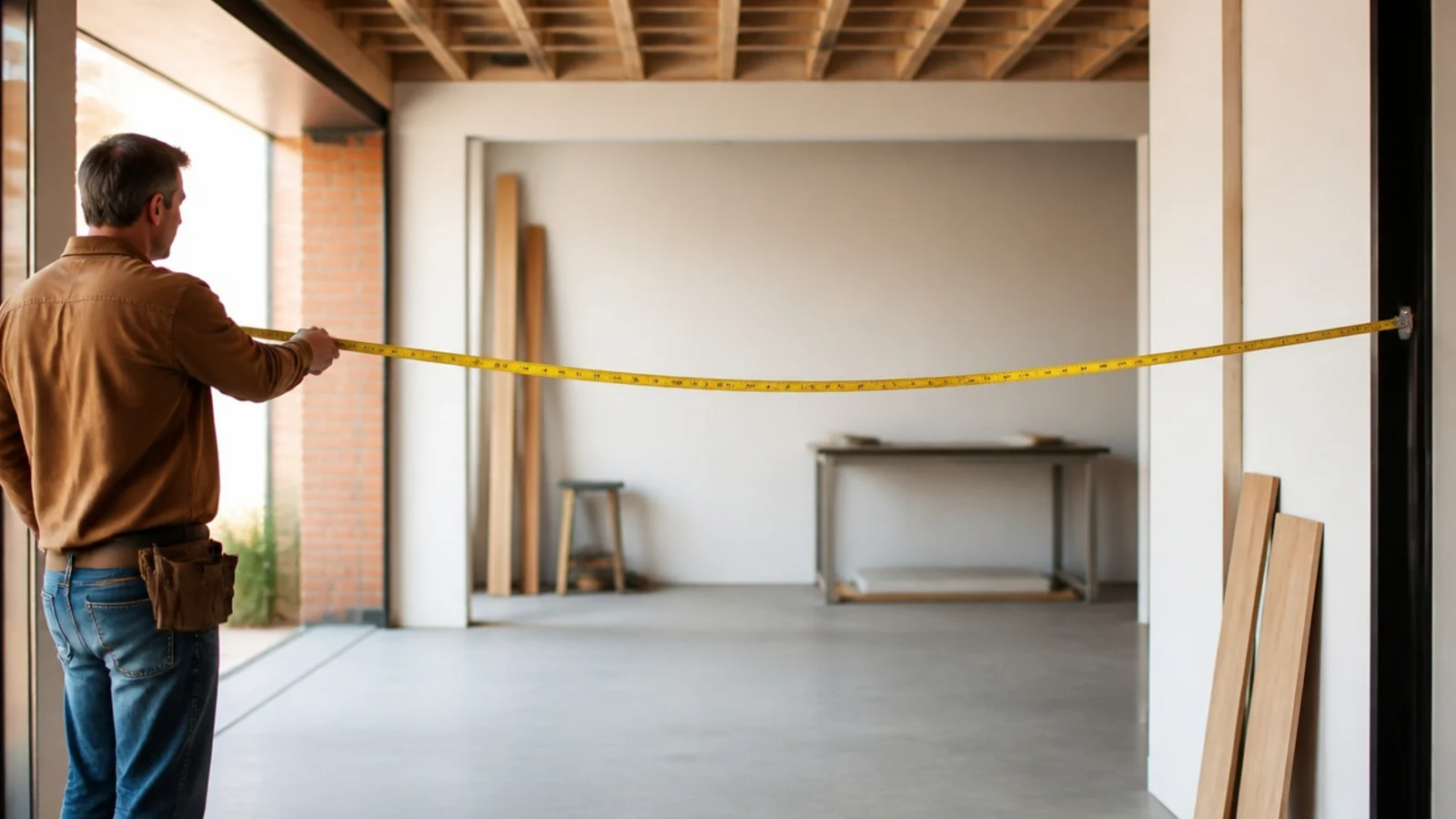
L-shaped or T-shaped rooms aren't single rectangles. Measuring the longest length and longest width and multiplying gives a wildly wrong answer that includes the empty space the L is missing.
Always split irregular shapes into multiple simple shapes (rectangles, triangles, circles). Calculate each separately and add. The multi-shape calculator on this site does this automatically.
4. Forgetting to subtract openings (paint and wallpaper)
For paint and wallpaper, you don't paint over doors and windows. Calculate gross wall area (perimeter × ceiling height) and SUBTRACT each door (~21 sq ft) and each window (~15 sq ft).
The exception: outlets, switches, and small features under 1 sq ft. The waste factor handles those. Don't subtract them individually.
5. Rounding too early
Rounding 12 ft 7 in to 13 ft, then multiplying by a similarly rounded width, accumulates error fast. A 13 × 11 calculation gives 143 sq ft; the actual 12.58 × 10.42 gives 131.1 sq ft - an 8% overestimate.
Carry one decimal place per dimension. Round only at the very end, after all calculations and waste factor are applied.
6. Using the wrong formula
Plugging dimensions into the wrong shape formula is surprisingly common. Calculating a circle as if it were a square (multiplying diameter by diameter) overestimates by ~27%.
- ·Rectangle = Length × Width
- ·Circle = π × Radius² (NOT diameter × diameter)
- ·Triangle = (Base × Height) ÷ 2 (NOT Base × Height)
- ·Trapezoid = ((Base₁ + Base₂) ÷ 2) × Height
Always identify the shape correctly before calculating. The calculator on this site enforces the right formula by shape selection.
7. Measuring once, not twice
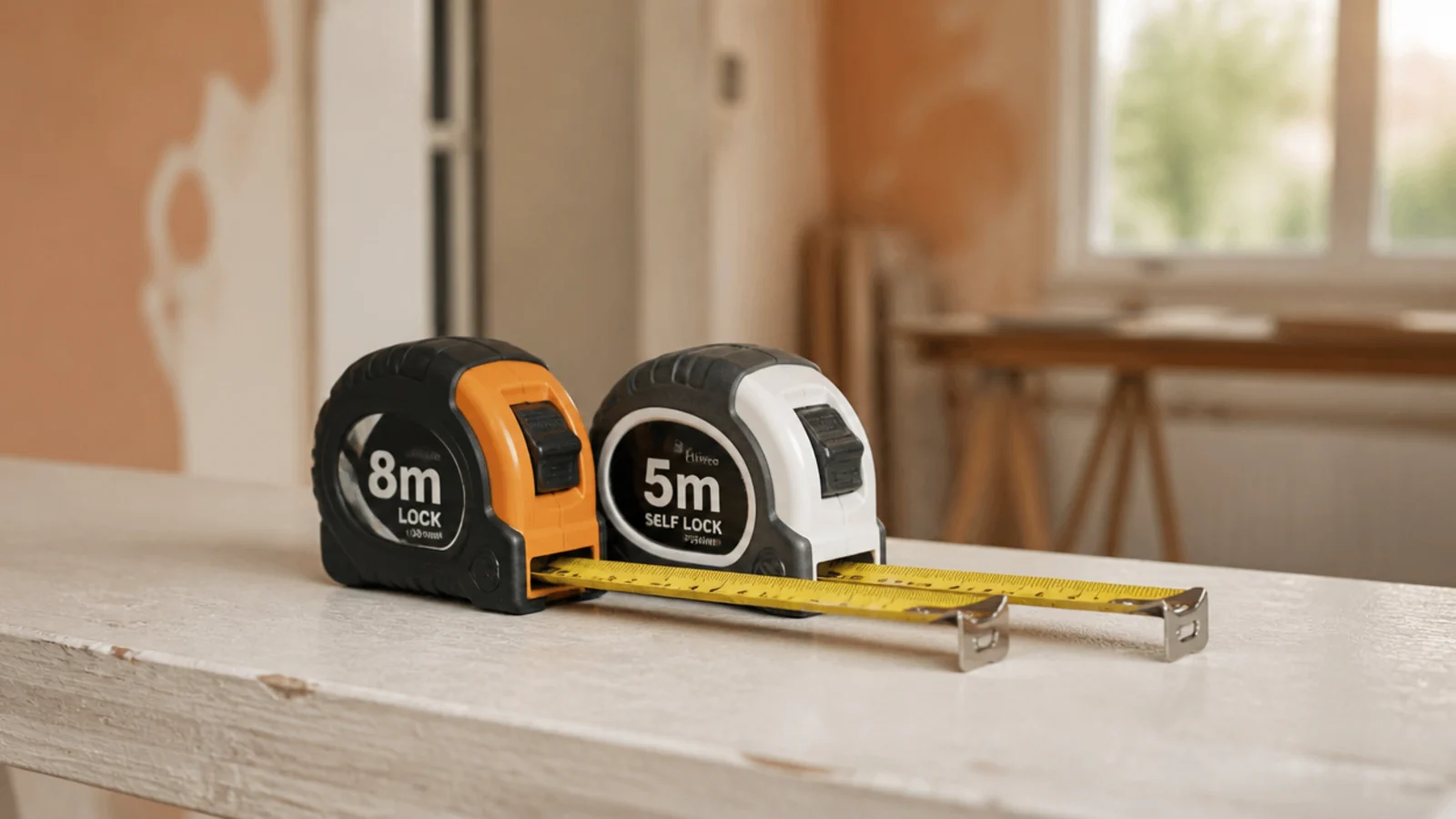
A single measurement can be off by 1-3 inches if the tape sags, the laser hits a chair leg, or you miscount the foot marks. Always measure twice on each dimension and verify the readings match.
For long dimensions (over 20 ft), use a laser distance measure rather than a tape - tapes droop and stretch on long pulls. If you don't have a laser, have a second person hold the dumb end of the tape tight against the wall.
8. Not sketching before measuring
Without a sketch, you'll forget walls, mismatch dimensions, or miscount segments. A simple hand-drawn floor plan on paper - with each wall labeled with its dimension as you measure - prevents most large errors.
Take a photo of the sketch when you're done. Save it for the contractor or for next year's project. The sketch is often more valuable than the calculator output.
Five minutes of sketching saves an hour of remeasurement. Always sketch before pulling out the tape.
What each mistake actually costs
These errors are not equally expensive, and knowing which ones bite hardest tells you where to spend your attention. The table puts a number on each using a 400 sq ft room as the reference, so the sizes are comparable.
The pattern worth noticing is that the errors compound in one direction. Almost every mistake on this list makes the measured area too small — rounding down, missing an alcove, forgetting waste, treating an L-shape as a rectangle. Running short is the default failure mode, which is why the fix is always to measure honestly and add the allowance separately.
The one error that goes the other way is measuring a room's outline instead of its floor, which overstates an L-shaped room badly. Overstating costs money too, but it costs it once, at the till. Understating costs a second trip, a second delivery fee and often a dye-lot mismatch that shows in the finished floor forever.
Worked comparison — a 400 sq ft floor in laminate at roughly $3.50 per sq ft. Forgetting the 10% waste allowance leaves you 40 sq ft short, which is two extra cartons and a return trip. Mixing feet and inches on a 12 ft 6 in dimension loses 4% of the room, about 16 sq ft. Missing a 5 × 4 ft alcove loses 20 sq ft. Any one of them stops the job on a Saturday.
The defence is the same for all of them and takes five minutes: sketch the room, label each rectangle, write the dimensions on the sketch in inches, convert once, and add waste as a separate line at the end. Nothing on this list survives that routine.
| Mistake | Effect on the number | Typical shortfall | Consequence |
|---|---|---|---|
| Forgetting waste allowance | Too small by 5-20% | 20-80 sq ft | Return trip, possible dye-lot mismatch |
| Treating an L-shape as a rectangle | Too large | Overstates by 20-30% | Money wasted on unused material |
| Mixing feet and inches | Too small by 2-6% | 8-24 sq ft | Short by one or two cartons |
| Rounding partial feet down | Too small by 3-8% | 12-32 sq ft | Short, and the error compounds both ways |
| Missing an alcove or bay | Too small | 15-25 sq ft | Short by a carton, found mid-install |
| Not subtracting openings (paint) | Too large by 10-15% | 40-60 sq ft | An extra gallon you did not need |
Bonus: assuming tax records are accurate
County tax records often disagree with reality by 10% or more. Older homes, additions, finished basements, and bonus rooms are commonly mis-recorded. Never use tax records for a real estate listing or appraisal.
Always re-measure for any high-stakes calculation. Tax records are a starting point, not a final answer.
Not all of these mistakes are the same size
The errors on this page are worth ranking, because they are not remotely equivalent. Two of them will cost you a percent or so and are worth fixing for tidiness. Two others will leave you ordering roughly a third of what the job needs, and one of those is invisible until the material runs out.
Reading inches as tenths is the small one. A wall measured 12 ft 7 in and written as 12.7 ft is 12.5833 recorded as 12.7, which across a 14 ft room turns 176.17 sq ft into 177.80 — under one percent. Forgetting a single doorway is bigger but still modest: 21 sq ft off a 468 sq ft wall is 4.5 percent, comfortably inside a 10 percent waste allowance.
Ignoring roof pitch is where it stops being modest. A 1,600 sq ft footprint under a 6/12 roof carries 1,788.85 sq ft of roof surface, so ordering to the footprint leaves you 10.6 percent short of the roof. At 12/12 the surface is 2,262.74 sq ft and the footprint is 29.3 percent short. Note that this is not the same number as the multiplier: the roof is 11.8 percent larger than the footprint at 6/12, and the footprint is 10.6 percent smaller than the roof. Both are correct and they answer different questions.
Calculating the wrong surface is the largest error available. A 12 × 14 ft room has 168 sq ft of floor and, at a 9 ft ceiling, 468 sq ft of wall — the walls are 2.8 times the floor. Using the floor figure to buy wall paint leaves you 64 percent short, and no waste allowance in existence absorbs that.
The practical lesson is where to spend your care. Measuring to the nearest sixteenth of an inch is worth doing and will not save a job that used the wrong surface or forgot the pitch. Decide what you are covering first, get the geometry of it right, and only then worry about precision.
| Mistake | Worked example | Size of the error |
|---|---|---|
| Reading inches as tenths | 12 ft 7 in written as 12.7 ft, over a 14 ft room | 0.9% over |
| Forgetting one doorway | 21 sq ft off a 468 sq ft wall | 4.5% over |
| Ignoring pitch, 6/12 roof | 1,600 sq ft footprint vs 1,788.85 sq ft of roof | 10.6% short |
| Ignoring pitch, 12/12 roof | 1,600 sq ft footprint vs 2,262.74 sq ft of roof | 29.3% short |
| Using floor area for walls | 168 sq ft of floor vs 468 sq ft of wall | 64.1% short |
Calculators that use these techniques
Frequently asked questions
What is the most common square footage mistake?+
Why does mixing feet and inches cause errors?+
Should I round measurements up or down?+
How do I avoid missing part of an irregular room?+
Which square footage mistake costs the most?+
Related guides
Ready to calculate?
Use the calculator (no math errors)