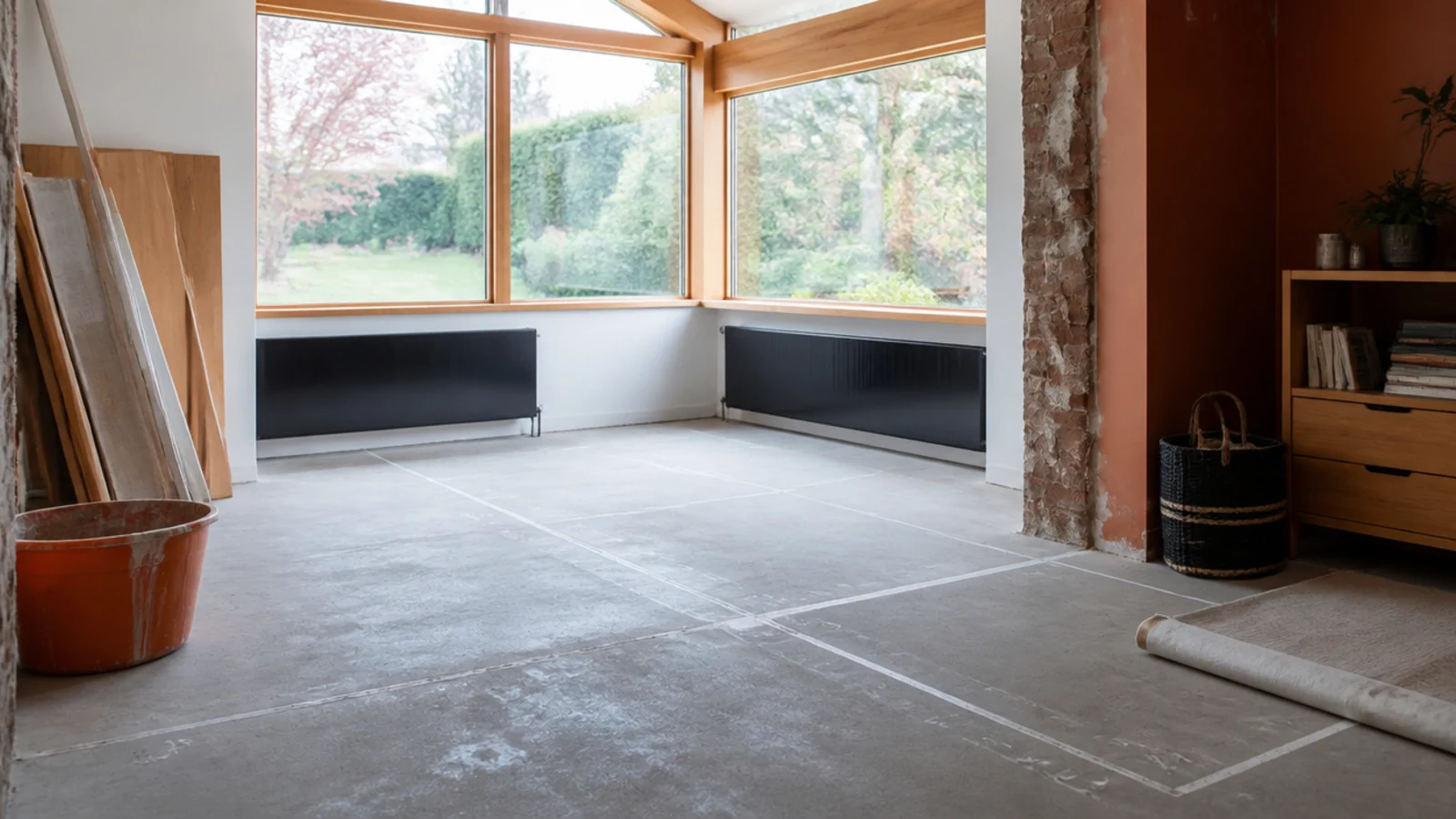
The divide-and-conquer principle
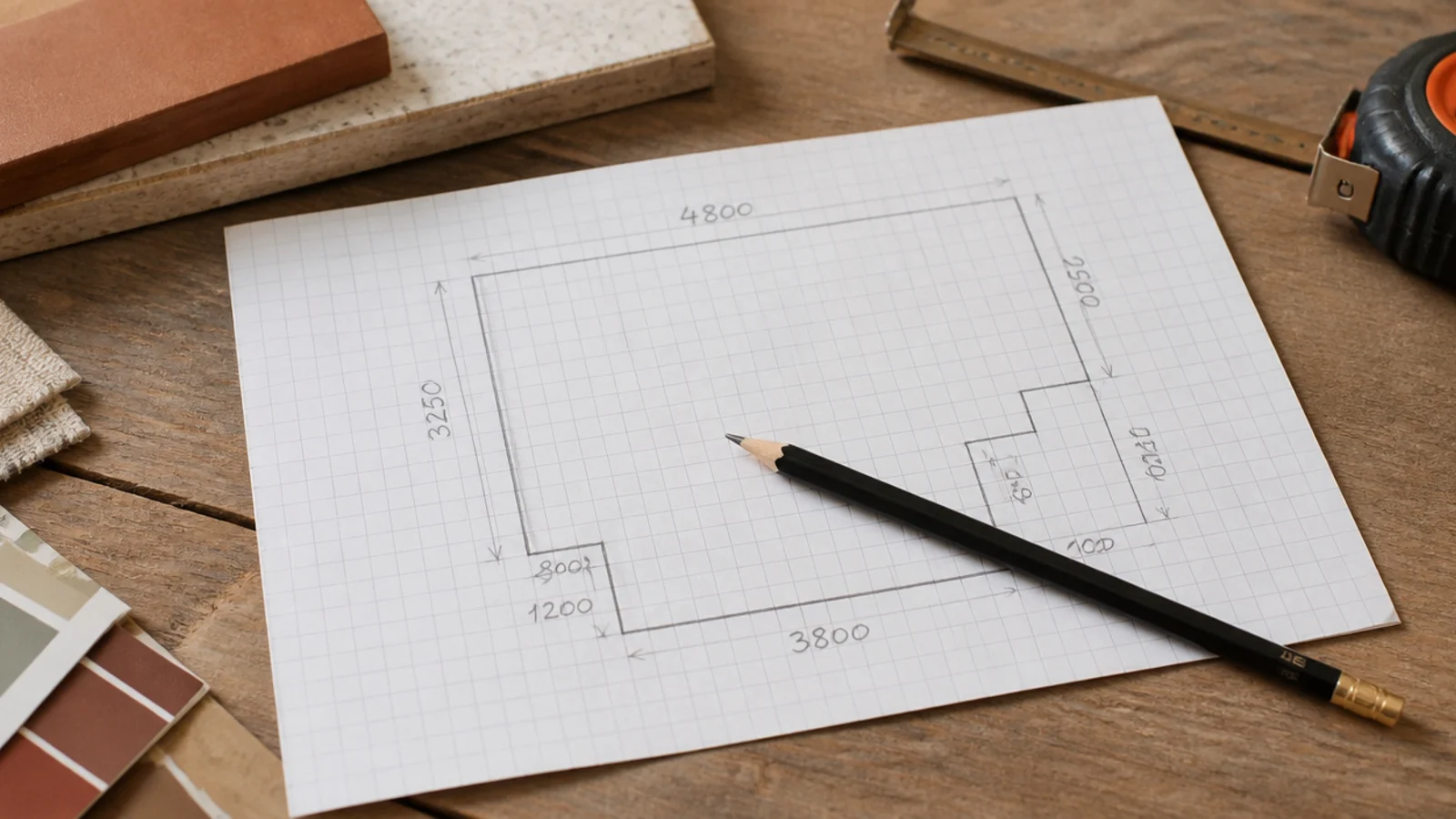
Any irregular shape can be approximated by combining rectangles, triangles, and circle segments. The trick is sketching the layout first, then breaking it into simple pieces with no overlaps and no gaps.
Most irregular rooms only need 2-3 simple rectangles. Even a complex floor plan rarely needs more than 5-6 sections. The math stays simple - you're just adding up small calculations.
Always sketch first. Drawing the floor plan before measuring helps you spot natural section breaks and prevents missed areas.
L-shaped rooms (the most common)
An L-shape is two rectangles joined at a corner. To split: draw a line extending one of the inside walls until it hits the outside wall. This divides the L into two perfect rectangles.
Example: a great room is 20 ft × 15 ft on the long arm, with a 12 ft × 8 ft kitchen alcove jutting off one end. Two rectangles: 20 × 15 = 300 sq ft, plus 12 × 8 = 96 sq ft. Total = 396 sq ft.
- ·Always extend the SHORTER inside wall to make your split. This gives you cleaner section dimensions.
- ·Make sure your two rectangles together exactly match the room outline - no overlap, no gap.
- ·The line you draw doesn't need to be a real wall - it's just a calculation boundary.
T-shaped rooms
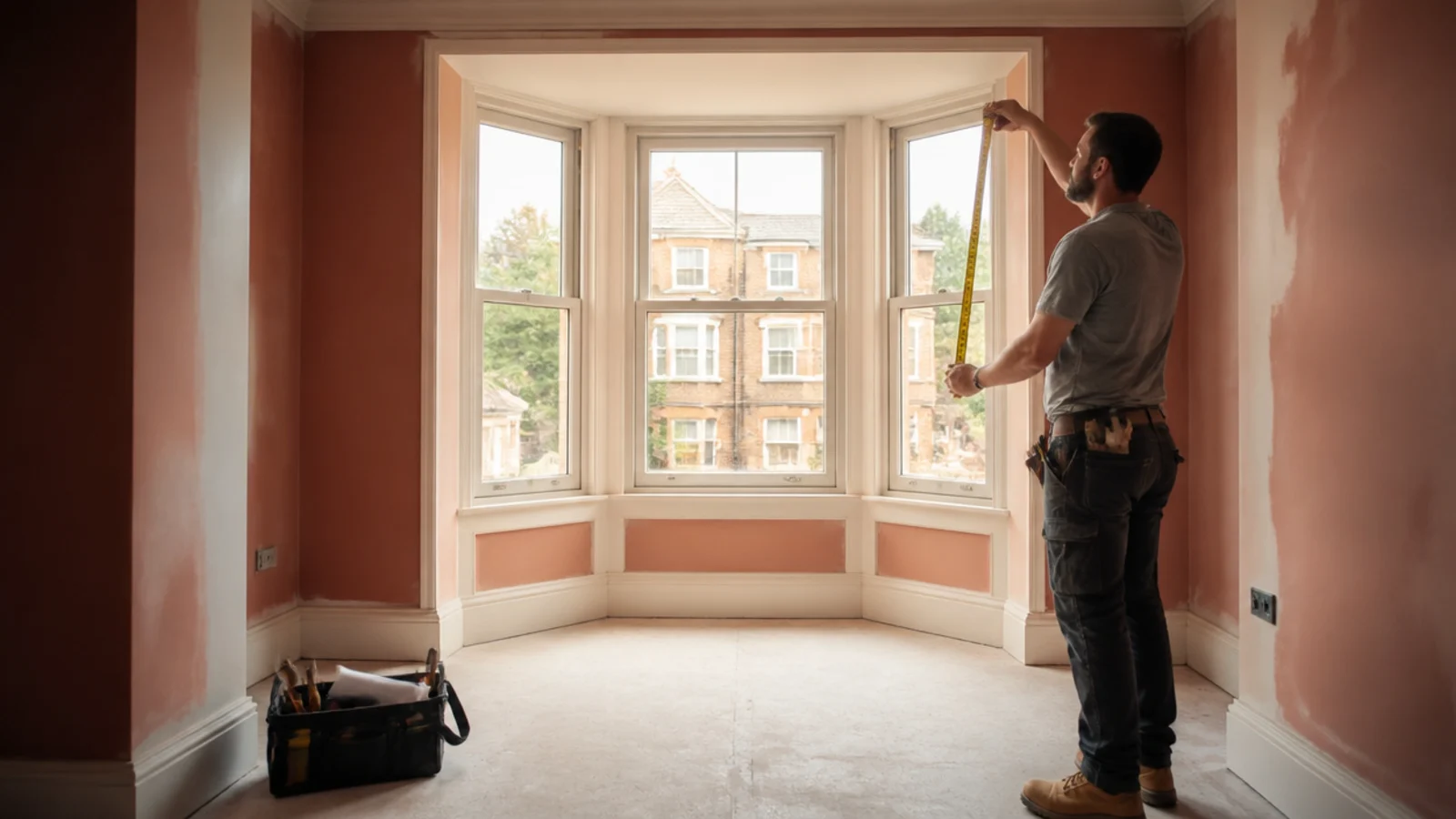
A T-shape splits into two rectangles the same way an L does. The horizontal bar of the T is one rectangle; the vertical stem is another.
Watch for the overlap zone. Where the two rectangles meet, you only count that area once. The cleanest method: split so the two rectangles don't overlap at all - one rectangle stops where the other begins.
Alcoves and bump-outs
An alcove is a small rectangular addition to a larger room. Treat the main room as one rectangle and the alcove as a second smaller rectangle. Add their areas.
Closets typically count as alcoves attached to bedrooms. For carpet or flooring, include them. For real estate measurements, follow ANSI Z765 - closets attached to a heated living space typically count.
Bay windows
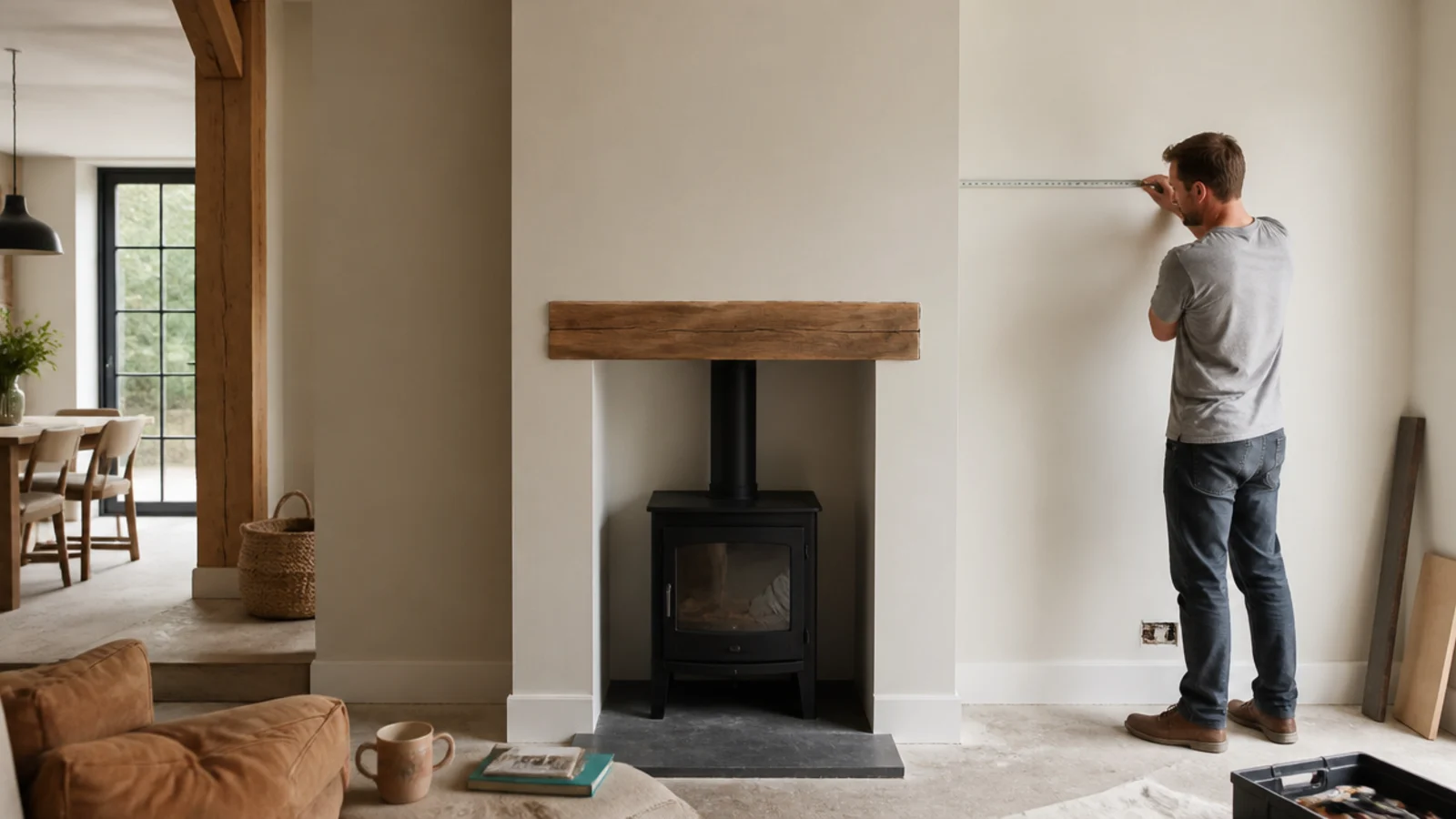
A bay window protrudes from a wall, usually in a trapezoid or angled shape. The simplest approach: measure the bay as a separate trapezoid using the formula ((Base₁ + Base₂) ÷ 2) × Height, where Base₁ is the wall opening, Base₂ is the front of the bay, and Height is how far it protrudes.
Example: a bay window with a 6 ft opening, 4 ft front face, protruding 2 ft. Trapezoid area = ((6 + 4) ÷ 2) × 2 = 10 sq ft of additional floor area.
For a 90-degree (square) bay, just treat it as a rectangle. For a curved bay, approximate with two triangles plus a small rectangle.
Curved walls and round-end rooms
Truly curved walls are rare in residential construction but common in commercial space. For a round-end rectangle (like a stadium shape): one central rectangle plus two semicircles at the ends. Total = (length × width) + (π × radius²) where the radius equals half the rectangle's width.
For free-form curves (organic garden beds, curving patios), approximate with 3-5 rectangles that average the curve. Most projects need accuracy within 5%, and rectangle approximation easily achieves that.
For irregular spaces, your goal is good-enough accuracy for material ordering, not engineering precision. 95% accurate plus a 10% waste factor still leaves you with enough material.
Angled walls (non-90° corners)
Walls at angles other than 90° usually create triangles or trapezoids when you split them. A diagonal closet wall in the corner of a bedroom creates a triangle that you subtract from the bedroom rectangle.
Example: a 12 × 14 bedroom (168 sq ft) with a diagonal closet wall cutting off the corner forms a triangle. If the triangle has 4 ft legs (right triangle), its area = (4 × 4) ÷ 2 = 8 sq ft. Subtract that from 168 to get 160 sq ft of usable bedroom floor.
Multi-segment calculation method
For complex spaces, use the multi-segment calculator on the home page. Add a segment for each rectangle, triangle, or circle in your sketch. The calculator sums them automatically and applies any waste factor to the total.
Tips for clean multi-segment work:
- ·Number each section on your sketch. Match the numbers to the calculator segment order.
- ·Use consistent units throughout. If you start in feet, stay in feet.
- ·Sanity-check: the perimeter of your sections together should match the room's actual perimeter.
- ·Print the results page for your records - useful when comparing contractor bids.
Four techniques, and when each one earns its keep
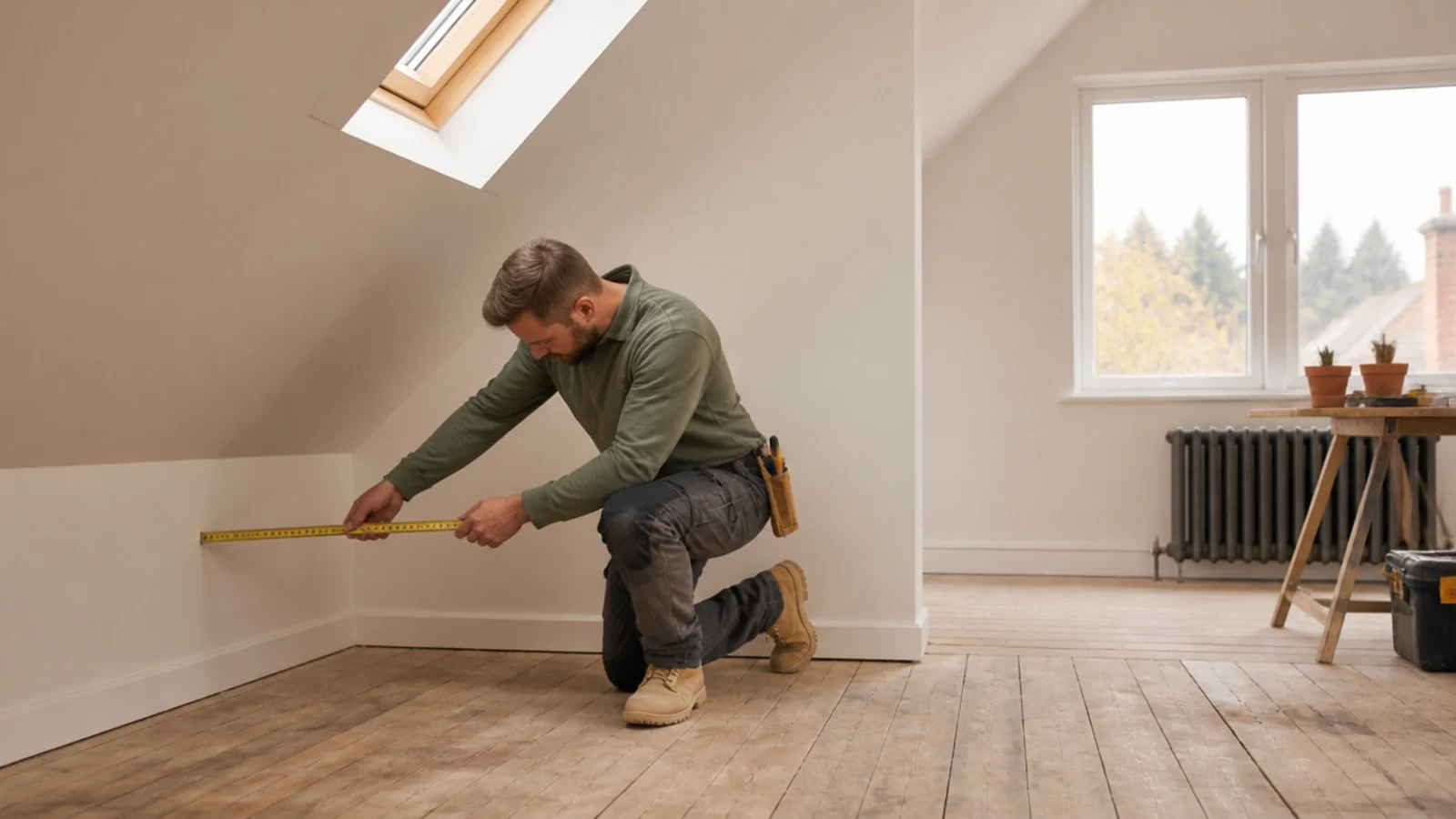
There is more than one way to measure an awkward room, and the right choice depends on what makes it awkward. A room with square corners and a bump-out needs a different approach from one with a curved bay or walls that are visibly out of square.
Rectangle decomposition handles the great majority of rooms and should be your default. Split at every notch, measure each piece, add. It fails only when the room has no square corners to work from, which is rarer than people assume — most rooms that feel irregular are two or three rectangles wearing a disguise.
Triangulation is the answer for genuinely non-square rooms, the ones in old houses where no two walls are parallel. Divide the floor into triangles by measuring the diagonals as well as the walls, then apply Heron's formula to each triangle. It takes longer and needs more measurements, but it is the only method that stays accurate when the corners are not 90 degrees.
The offset method suits curved and bowed walls. Run a straight baseline along the room, then measure the perpendicular distance from that line to the wall at fixed intervals — every foot works well. Each strip becomes a narrow trapezoid, and the sum approximates the curve closely. Halve the interval and the accuracy roughly doubles.
Worked example of the offset method — a bay measured at 1 ft intervals with depths of 0, 8, 14, 16, 14, 8 and 0 inches. Convert to feet, average each adjacent pair, and sum: that gives about 5.7 sq ft of bay area. Measuring the bay as a rectangle at its deepest point would have given 16 in × 6 ft = 8 sq ft, overstating it by 40%.
Whichever method you use, the sketch matters more than the technique. Draw the room, mark every piece, and write dimensions on the drawing as you take them. The measurements are rarely what goes wrong; keeping track of them is.
| Technique | Best for | How it works | Trade-off |
|---|---|---|---|
| Rectangle decomposition | Most rooms: L-shapes, alcoves, bump-outs | Split at each notch, measure each rectangle, add | Needs square corners to be accurate |
| Triangulation | Rooms with no square corners | Divide into triangles, measure sides, apply Heron's formula | More measurements, slower |
| Offset from a baseline | Curved or bowed walls, bays | Perpendicular depths at fixed intervals along a straight line | Accuracy depends on interval spacing |
| Scaled floor plan | Large, occupied or unbuilt spaces | Measure on the drawing, convert by the scale | Plan may differ from as-built |
Rooms with multiple obstacles
For a flooring project, you typically don't subtract small obstacles like cabinets, columns, or fireplaces - the waste factor handles those cuts. For paint or wallpaper, you DO subtract major openings (doors, windows) but not switches and outlets.
Built-in cabinetry (kitchen islands, peninsula bases): subtract for flooring (no floor goes under permanent cabinets). For paint and lighting calculations, treat the obstacle as part of the room layout but not as area to be covered.
Calculators that use these techniques
Frequently asked questions
How do you measure a room that is not square?+
How do you measure a curved or bay window wall?+
Do I measure shared walls twice in an L-shaped room?+
Related guides
Ready to calculate?
Try the multi-shape calculator