Wall Square Footage Calculator
To calculate wall square footage, add every wall length for the room perimeter, then multiply by ceiling height. Subtract 21 sq ft per door and 15 sq ft per window. A 12 by 14 ft room with 8 ft ceilings is 52 x 8 = 416 sq ft gross, 365 sq ft net.
Wall Area Calculator
How to calculate wall square footage
Add up the length of every wall in the room (the perimeter). Multiply that total by the ceiling height to get gross wall area.
A 12 ft × 14 ft room with 8 ft ceilings has a perimeter of 52 ft. Multiplied by 8 ft, that’s 416 sq ft of gross wall area.
Then subtract openings: a standard door is roughly 21 sq ft (3×7), a standard window is around 15 sq ft (3×5). Subtract each opening from your gross to get net wall area for paint or wallpaper.
Wall square footage by room size and ceiling height
Gross wall area is room perimeter times ceiling height, so it climbs with both. The table below runs that calculation for common room sizes at the three ceiling heights you actually meet: the 8 ft standard, the 9 ft common in newer builds, and the 10 ft of an older house or an addition.
These are gross figures. Take your own openings off the total afterwards, at 21 sq ft per door and 15 sq ft per window, because opening counts vary far more between rooms than dimensions do.
Notice what ceiling height does to a budget. The same 12 by 14 ft room is 416 sq ft of wall at 8 ft and 520 sq ft at 10 ft — a quarter more paint, wallpaper and drywall for an identical floor plan. When a quote surprises you, ceiling height is usually the reason.
| Room size | Perimeter | 8 ft ceiling | 9 ft ceiling | 10 ft ceiling |
|---|---|---|---|---|
| 10 × 12 ft | 44 ft | 352 sq ft | 396 sq ft | 440 sq ft |
| 12 × 12 ft | 48 ft | 384 sq ft | 432 sq ft | 480 sq ft |
| 12 × 14 ft | 52 ft | 416 sq ft | 468 sq ft | 520 sq ft |
| 14 × 16 ft | 60 ft | 480 sq ft | 540 sq ft | 600 sq ft |
| 16 × 20 ft | 72 ft | 576 sq ft | 648 sq ft | 720 sq ft |
| 20 × 24 ft | 88 ft | 704 sq ft | 792 sq ft | 880 sq ft |
Paint coverage rules of thumb
One gallon of quality interior paint covers about 350 sq ft in one coat on smooth, primed drywall. Most projects need two coats for full hide, so a gallon really covers about 175 sq ft of finished wall.
Textured walls (orange peel, knockdown) drop coverage by 15–20%. Heavily textured surfaces or first-coat-on-bare-drywall can drop coverage by 30%. Always check the can label for the manufacturer’s rated coverage on your specific product.
Door and window deductions, exactly
Most homeowners under-deduct openings and over-buy paint. The standard rule of thumb is a door = 21 sq ft and a window = 15 sq ft, but real-world dimensions vary considerably.
Standard door sizes: interior passage 30×80 (16.7 sq ft), interior bedroom 32×80 (17.8 sq ft), interior bath 28×80 (15.6 sq ft), exterior entry 36×80 (20 sq ft), patio sliding 60×80 (33.3 sq ft), French double 60×80 (33.3 sq ft).
Standard window sizes: small bathroom 24×24 (4 sq ft), bedroom 36×48 (12 sq ft), large bedroom 36×60 (15 sq ft), picture window 60×48 (20 sq ft), sliding patio 72×48 (24 sq ft).
For a typical 12 × 14 ft room with 8 ft ceilings, one 32×80 interior door and two 36×48 bedroom windows: gross wall area = 416 sq ft, minus 17.8 (door) and 24 (two windows) = 374.2 sq ft of net paintable area. That is about 9 sq ft more than the 365 sq ft the 21-and-15 rule of thumb gives for the same room — the rule of thumb over-deducts on purpose, which makes it safe for ordering paint and wrong for pricing a job.
Wallpaper math is different from paint math
Wallpaper isn't sold by square footage — it's sold by the roll, and rolls don't map to a clean number of square feet because pattern repeat creates waste. Knowing the difference saves real money.
A standard US single roll covers about 35 sq ft, but practical coverage (after pattern matching) is 27 sq ft. European rolls are larger (56 sq ft, 50 sq ft practical). Always use practical coverage in your calculation, not the rated coverage on the bolt.
Worked example: 374 sq ft of paintable wall area. With US rolls at 27 sq ft practical coverage: 374 ÷ 27 = 13.9 rolls. Round up to 14. With European rolls at 50 sq ft: 374 ÷ 50 = 7.5 rolls. Round up to 8.
Large pattern repeats (anything over 18 inches) need 20-25% more wallpaper than this calculation. Solid colors or small repeats are fine at the standard rate.
Drywall and wainscoting from wall area
Wall square footage drives several other materials beyond just paint.
Drywall sheets: 4×8 sheets = 32 sq ft, 4×12 = 48 sq ft. For 416 sq ft of wall: 416 ÷ 32 = 13 sheets of 4×8, or 416 ÷ 48 = 8.7 sheets of 4×12. Always order 10% extra for cuts. Don't subtract for doors and windows when ordering drywall — you'll need full sheets to cut the openings out of.
Wainscoting (typical 36-inch height): use perimeter × 3 ft instead of perimeter × full ceiling height. For a 52 ft perimeter: 52 × 3 = 156 sq ft of wainscoting, plus the upper 5 ft of wall (52 × 5 = 260 sq ft) painted normally.
Acoustic / soundproofing panels: typically sold in 24×48 inch panels (8 sq ft each). For a 416 sq ft wall: 52 panels.
Gable walls: a rectangle plus a triangle
A gable end is the wall that rises into a point under a pitched roof, and it is the one wall people habitually under-measure — they take the width and the ceiling height and stop, leaving the whole triangle out of the order.
Split it in two. The rectangle is width × wall height, exactly as any other wall. The triangle above is width × gable rise ÷ 2, where the gable rise is the height from the top of the wall to the ridge. If you know the roof pitch rather than the rise, the rise is half the width × the pitch: a 6/12 roof over a 24 ft span rises 12 × 6/12 = 6 ft.
Worked example, a 24 ft wide gable end with 9 ft walls under a 6/12 roof. Rectangle: 24 × 9 = 216 sq ft. Triangle: 24 × 6 ÷ 2 = 72 sq ft. Total 288 sq ft — the triangle alone adds a third again to the wall, and on a steeper roof it adds far more.
This matters more for some trades than others. Drywall and siding need the whole 288 sq ft. Paint needs it too, and a gable end is usually the hardest part of a house to reach, so it is worth knowing the area before agreeing a price. Insulation follows the wall, not the triangle, where the ceiling is flat and the gable space is attic.
| Roof pitch | Gable rise | Triangle | Wall total | Added |
|---|---|---|---|---|
| 4/12 | 4 ft | 48 sq ft | 264 sq ft | +22% |
| 6/12 | 6 ft | 72 sq ft | 288 sq ft | +33% |
| 8/12 | 8 ft | 96 sq ft | 312 sq ft | +44% |
| 12/12 | 12 ft | 144 sq ft | 360 sq ft | +67% |
Before you sand: what the wall was painted with
Every wall calculation on this page ends with someone preparing a surface, and preparation is where a measurement job turns into a health question. The area you just worked out is also the area you are about to sand, scrape or strip.
The US EPA states that the federal ban on lead-based paint for homes came in 1978, and that roughly three-quarters of US homes built before then still contain some. Paint in sound condition is generally not the problem; disturbing it is. Sanding and dry-scraping are exactly the activities that turn intact paint into airborne dust.
The EPA's Renovation, Repair and Painting rule certifies anyone paid to disturb painted surfaces in pre-1978 homes, childcare facilities and preschools. It does not generally reach a homeowner working on their own home — but it does reach you if the property is rented out, if a childcare business runs from it, or if you are renovating to sell.
Where it becomes a measuring question is the exemption, because it is written as an area. Under 40 CFR 745.83, minor repair and maintenance means work disturbing 6 square feet or less of painted surface per room for interior activities, or 20 square feet or less for exterior. Above those figures the exemption stops applying.
Two clauses stop that being a loophole, and both are about how the area is counted. Removing a painted component counts its entire surface area as disturbed, not just the part you worked on — taking off a door casing is the whole casing. And jobs performed in the same room within the same 30 days count as one job, so a wall cannot be done in six-square-foot instalments across a month. Window replacement and demolition of painted surfaces sit outside the exemption altogether.
Several states run their own authorised programmes and can be stricter than the federal rule, so confirm what applies where the property is.
None of this changes the square footage. It changes what the number commits you to: the 374.2 sq ft of net paintable wall worked out above, in a house built in 1962, is 374.2 sq ft of surface to test or treat as though it contains lead — and that belongs in the plan before the paint is priced.
Step-by-step measurement guide
Measure every wall and add them up
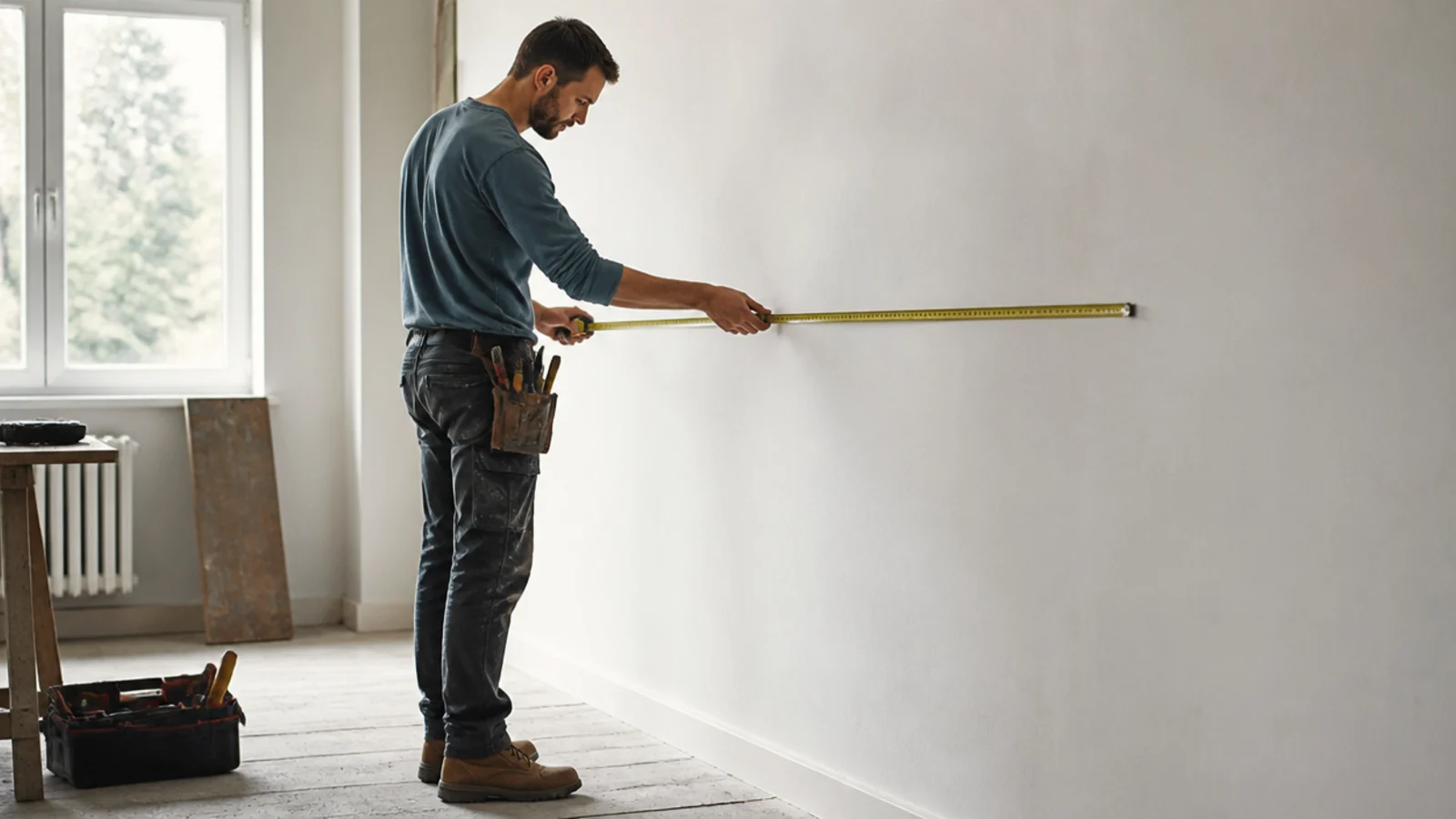
Run the tape along each wall at about waist height and write the lengths down as you go, then add them for the room perimeter. A 12 by 14 ft room is 12 + 14 + 12 + 14 = 52 ft.
Measure the ceiling height
Measure floor to ceiling in two corners, not one. Older houses settle and a half-inch difference across a room is normal. Use the taller reading so you do not come up short.
Multiply perimeter by height
52 ft of perimeter at an 8 ft ceiling gives 52 x 8 = 416 sq ft. That is gross wall area, before anything is taken out.
Subtract the openings
Deduct 21 sq ft per standard door (3 x 7 ft) and 15 sq ft per average window (3 x 5 ft). One door and two windows removes 51 sq ft, leaving 365 sq ft of paintable wall.
Add waste only when you order
Keep the measured area honest and add the allowance separately: about 10% for paint, 15% for wallpaper because it has to be pattern-matched. Folding waste into the measurement is how the number drifts.
Pro tips
Skip ceiling-only doors
Don’t subtract for very small openings like outlets and switches — they’re negligible.
Add 5% for cuts and edges
Paint trim, edges, and touch-ups add up. A 5% paint waste factor protects your project.
Wallpaper needs more
Wallpaper has pattern repeat waste — add 15–20%, especially for large repeats.
Buy paint by the gallon
Even if you need 2.3 gallons, buy 3. Color matching from a fresh batch is hard.