Triangle Sq Ft Calculator: Square Footage of a Triangle
The square footage of a triangle is base times height divided by two, with the height measured perpendicular to the base — not along the slanted side. This triangle sq ft calculator handles both that formula and the three-sides case using Heron's formula, for gable ends, angled closets and triangular lots.
Triangle Area Calculator
Two formulas, two situations
Standard formula: area = (base × height) ÷ 2. The height MUST be measured perpendicular (90°) from the base to the opposite point. For a triangle with a 12-ft base and 8-ft perpendicular height: (12 × 8) ÷ 2 = 48 sq ft.
Heron's formula (when you only know the three sides): s = (a + b + c) ÷ 2. Then area = √(s(s-a)(s-b)(s-c)). The multi-shape calculator handles this automatically when you select “Triangle (3 sides)”.
Real-world triangles
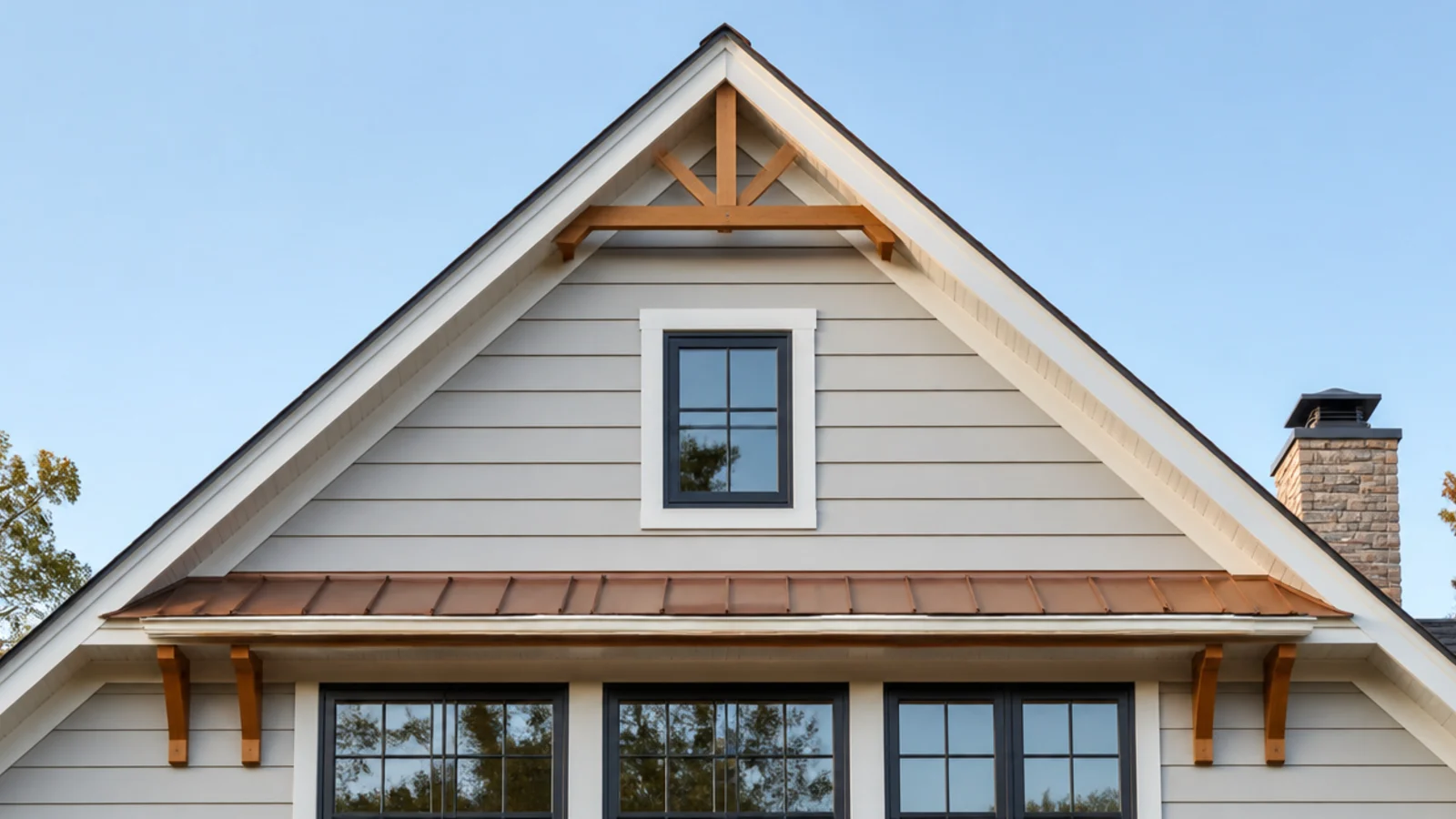
Roof gables are triangles. For a 30-ft-wide gable end with a roof peak 8.75 ft above the wall plate: (30 × 8.75) ÷ 2 = 131 sq ft of gable.
Attic floor cross-sections are triangles. The walkable floor in an unfinished attic with 8-ft trusses is a triangle - useful for estimating insulation or floor area for “knee-wall” build-outs.
Three formulas for three situations
Base-and-height (most common): (base × height) ÷ 2. Use when you have a clear base and can measure the perpendicular height to the opposite vertex.
Heron's formula (three sides known): s = (a + b + c) ÷ 2, then area = √(s(s-a)(s-b)(s-c)). Use when you can measure all three sides but can't easily get perpendicular height — common for irregular lots and gable ends.
Right triangle shortcut: (leg 1 × leg 2) ÷ 2. The two legs of a right triangle are automatically perpendicular, so they serve as base and height.
Worked Heron example: triangular yard with sides 30, 40, 50 ft. s = 60. Area = √(60 × 30 × 20 × 10) = √360,000 = 600 sq ft. (This is a 3-4-5 right triangle, so 30 × 40 ÷ 2 = 600 confirms it.)
Where triangle area shows up
Gable ends for siding or paint: a 30-ft-wide gable with 6 ft peak height = (30 × 6) ÷ 2 = 90 sq ft per gable. Most houses have 2 gables = 180 sq ft total of triangular wall area.
Vaulted ceilings: the triangular portion above the standard wall height. A 14-ft wide wall vaulting from 8 to 14 ft adds (14 × 6) ÷ 2 = 42 sq ft of paint or wallpaper area.
Triangular yard sections: where a driveway angles, where a lot corner is cut off. Break the lot into rectangles plus triangles, calculate each, sum.
Roof valleys and hips: the triangular flashing areas around valleys contribute to roofing material calculations.
Custom shower seats, niches with angled corners, and decorative wall features.
Gable end area by wall width and roof pitch
The triangle most people actually need to measure is a gable end — the wall triangle under a pitched roof. You rarely have its height written down, but you always have the wall width and the roof pitch, and those two give you the height without climbing anything.
Roof pitch is rise over 12 inches of run. A 6/12 roof climbs 6 inches for every horizontal foot. The gable peak sits above the centre of the wall, so height = (wall width ÷ 2) × (pitch ÷ 12). Feed that into base × height ÷ 2 and the whole triangle collapses to width² × pitch ÷ 48.
Worked example — a 32 ft wide gable on a 6/12 roof. Half the width is 16 ft. At 6/12 the rise is 16 × 0.5 = 8 ft. Area = (32 × 8) ÷ 2 = 128 sq ft. That is the siding, sheathing or paint area for one gable end; a simple gabled house has two.
Measure the pitch from inside the attic if you can: hold a level 12 inches out horizontally and measure down to the rafter. Guessing pitch is the second-biggest source of gable error after using the rafter length as the height.
| Wall width | 4/12 pitch | 6/12 pitch | 8/12 pitch | 12/12 pitch |
|---|---|---|---|---|
| 20 ft | 33 sq ft | 50 sq ft | 67 sq ft | 100 sq ft |
| 24 ft | 48 sq ft | 72 sq ft | 96 sq ft | 144 sq ft |
| 28 ft | 65 sq ft | 98 sq ft | 131 sq ft | 196 sq ft |
| 32 ft | 85 sq ft | 128 sq ft | 171 sq ft | 256 sq ft |
| 36 ft | 108 sq ft | 162 sq ft | 216 sq ft | 324 sq ft |
| 40 ft | 133 sq ft | 200 sq ft | 267 sq ft | 400 sq ft |
The perpendicular-height mistake
The most common triangle calculation error is using the slope length (the side) instead of perpendicular height. Perpendicular height is the straight vertical (or straight perpendicular) distance from the base to the opposite vertex — not the distance along the angled side.
Worked illustration: a roof gable has a 30-ft horizontal base and slants up at 30 degrees. The slope length (along the rafter) is 17.3 ft. But perpendicular height is only 8.7 ft. Using slope length instead of height would give (30 × 17.3) ÷ 2 = 259 sq ft. Using actual perpendicular height: (30 × 8.7) ÷ 2 = 131 sq ft — half the wrong answer.
When measuring real gables: measure the wall width along the eave line (base), and measure the vertical distance from the eave line to the peak (height). Don't measure along the slanting rafter.
Pro tips
Height is perpendicular, not slanted
For a triangle leaning to the right, the “height” isn't the right slanted edge - it's the straight-up distance from the base to the top point.
Use Heron's when you can't measure height
Triangular property corners are easier to measure as three side lengths than to find a perpendicular height. Use Heron's formula on the multi-shape calculator.
Right triangles are easiest
A right triangle has one 90° angle - the two legs adjoining that angle ARE the base and height. Just multiply legs and divide by 2.
Equilateral shortcut
For an equilateral triangle (all sides equal): area = (side² × √3) ÷ 4. A 10-ft equilateral triangle has area = (100 × 1.732) ÷ 4 = 43.3 sq ft.