Floor plan area calculator
Work out the square footage of a floor plan by measuring each room separately and adding the totals. This floor plan area calculator handles multi-room plans, L-shapes and bump-outs in one calculation, and gives the result in square feet, square meters and square yards.
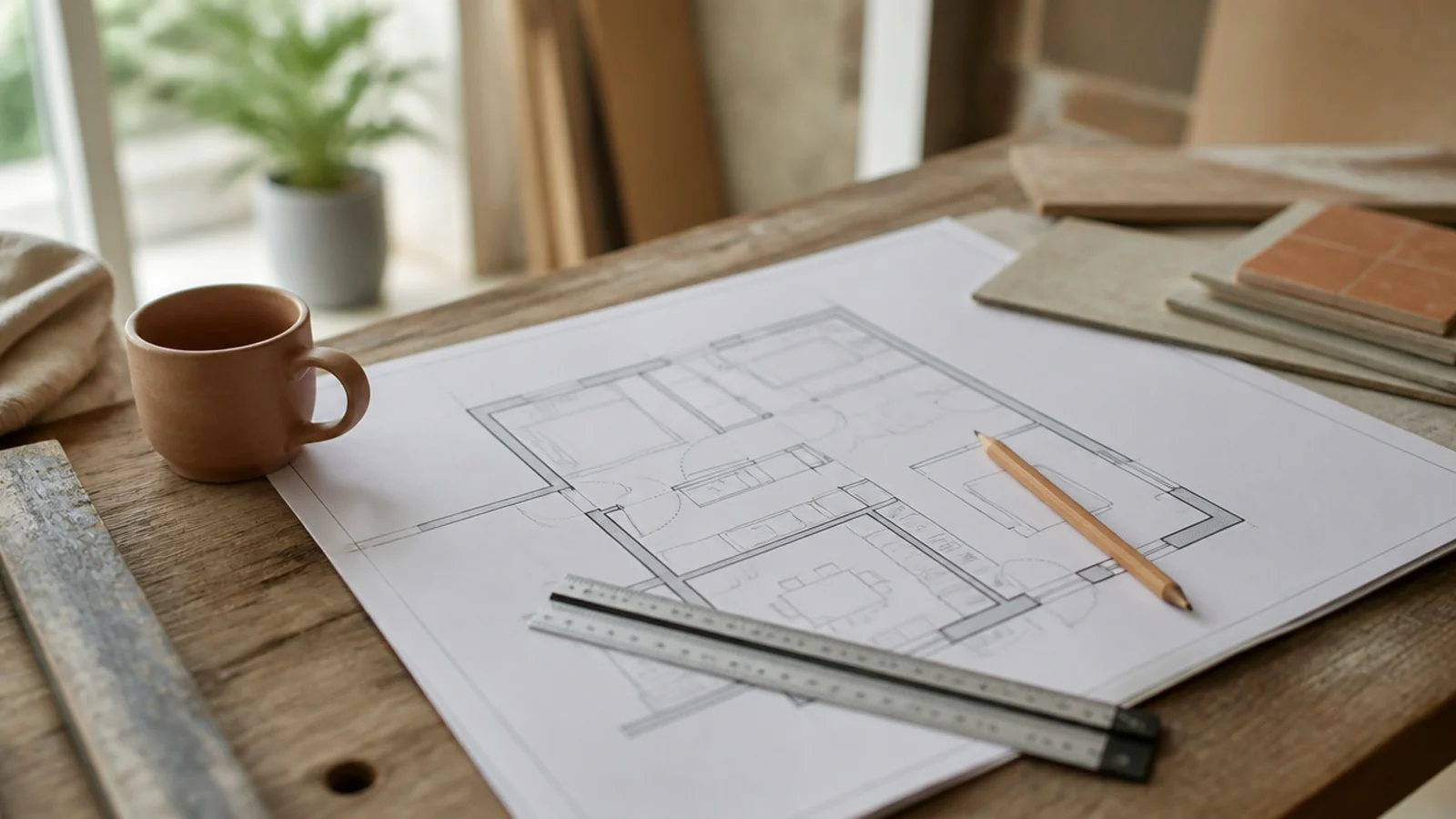
Floor Plan Calculator
Room-by-room measuring
For an existing home: measure each room's interior dimensions and label them on a floor plan sketch. Sum all rooms, then add hallway and stair landing areas.
A typical 3-bedroom 2-bath ranch has: living room (~250 sq ft), kitchen (~200), dining (~150), 3 bedrooms (~150 each), 2 bathrooms (~50 each), hallways (~80) = roughly 1,330 sq ft of interior + walls = 1,500-1,600 sq ft gross.
Interior vs. gross floor area
Adding up interior room dimensions gives you “carpetable” or net floor area. The official ANSI Z765 square footage measures to the exterior wall surface and includes the walls themselves.
The difference between interior-only and gross-with-walls is typically 10-12% for residential construction. A house with 1,500 sq ft of net interior space usually has 1,650-1,700 sq ft of ANSI gross.
Reading dimensions from a floor plan
Floor plans use different dimension conventions and you need to know which one to read.
Inside dimensions (room only, finished wall to finished wall): the smaller number. Used for room labels like '12-0 × 14-0' meaning 12 ft 0 in by 14 ft 0 in of usable floor.
Center-line dimensions (centerline of one wall to centerline of another): used in architectural drawings for overall house perimeter.
Outside dimensions (exterior face to exterior face): the largest number. Used for site planning.
For ANSI Z765 residential square footage: use outside dimensions, then subtract typical wall thicknesses (6 inches per exterior wall, 4 inches per interior wall) to get usable interior space.
Room-by-room calculation from a plan
Most accurate approach: list every room on the floor plan with its dimensions, calculate each room's area, sum the rooms, add hallways and circulation, compare to the floor plan's labeled total.
Worked example, 3-bedroom 2-bath: master bedroom 14 × 16 = 224. Bed 2: 12 × 12 = 144. Bed 3: 11 × 12 = 132. Master bath: 8 × 10 = 80. Bath 2: 5 × 8 = 40. Kitchen: 12 × 14 = 168. Living room: 15 × 20 = 300. Dining: 12 × 12 = 144. Hallway/foyer: ~80. Closets: ~60. Total: 1,372 sq ft.
Compare to the floor plan's listed total. They should agree within 5%. If not, you've missed a room or there's a measurement issue with the plan.
Working from a scaled plan: the four-step method
A drawing is only as good as its scale, so establish that before you measure anything. Architectural plans in the US are usually drawn at 1/4 inch = 1 foot, meaning a quarter-inch on paper is a foot in the building. A 1/8 inch scale is common for whole-floor plans of larger houses.
Step one, confirm the scale against a printed dimension. Find a wall with its length written on it, measure that wall on the page with a ruler, and check the two agree. Plans get rescaled when they are printed or photocopied, and a plan that says 1/4 inch but prints at 87% will hand you a floor that is 13% too small.
Step two, check it a second time on a different wall. One agreeing dimension can be a coincidence; two rarely are. Step three, break each room into rectangles at every notch and bay, exactly as you would on site. Step four, measure each piece on the page, convert with the scale, and total the room.
Worked example at 1/4 inch = 1 ft. A room measures 3.5 inches by 2.75 inches on the page. Divide each by 0.25 to get feet: 14 ft by 11 ft. Area is 154 sq ft. At 1/8 inch scale the same drawing would be 28 ft by 22 ft and 616 sq ft — four times the area, which is why confirming the scale is not optional.
One caution that catches people transferring plans to material orders: plans show design intent, not what got built. Framing drifts, walls thicken with finishes, and additions rarely match the drawing. Verify anything critical with a tape before ordering, and treat the plan total as a close estimate rather than a measurement.
| Scale | 1 inch on the plan | Page measurement | Real dimension |
|---|---|---|---|
| 1/4 in = 1 ft | 4 ft | 3.5 × 2.75 in | 14 × 11 ft = 154 sq ft |
| 1/8 in = 1 ft | 8 ft | 3.5 × 2.75 in | 28 × 22 ft = 616 sq ft |
| 1/2 in = 1 ft | 2 ft | 3.5 × 2.75 in | 7 × 5.5 ft = 38.5 sq ft |
| 3/16 in = 1 ft | 5.33 ft | 3 × 2 in | 16 × 10.7 ft = 171 sq ft |
| 1:50 metric | — | 70 × 55 mm | 3.5 × 2.75 m = 9.6 sq m |
Floor plans vs as-built reality
Designed dimensions on drawings are typically accurate to ±1 inch. As-built construction varies 1-3% from drawings due to framing tolerances.
When buying from a floor plan (new construction): the actual house may be 50-100 sq ft different from the plan. This is normal. Verify after framing if it affects your purchase decision.
Trim and crown molding aren't shown on most floor plans but slightly reduce usable space. Door swings are hatched on plans but the swing area is still usable floor (a closet floor doesn't shrink because a door opens into it).
Stairs are shown as triangles with arrows indicating up/down. The floor space directly under the stair counts toward the lower floor.
One sketch per level, and a check that catches the usual error
A plan for a two-storey house is two drawings, and the totals should be worked out that way too. Putting both levels on one sketch is where rooms get counted twice, missed entirely, or attributed to the wrong floor — and none of those show up as an obviously wrong number at the end.
The check that catches most of it is a comparison rather than a sum. An upper floor cannot be larger than the footprint it stands on. If your ground floor measures 1,200 sq ft and the first floor comes out at 1,320, either you have an overhang you have not accounted for or one of the two numbers is wrong — and the second is far more likely.
The commonest cause is measuring one level to the outside and the other to the inside. A single-storey exterior measurement includes the wall thickness; an upper floor is usually measured internally and the wall thickness added back, because the outside is not reachable. Mix the two conventions across levels and the upper floor gains several percent it does not have.
The second commonest is the stairwell. The opening is counted once, on the lower floor, so the same volume is not claimed twice. Worked example on a 30 × 40 ft footprint with a 3 × 10 ft stair opening: the ground floor is 1,200 sq ft, the upper floor is 1,200 − 30 = 1,170, and the house is 2,370. Count the stairwell on both levels and you report 2,400 — 30 sq ft too much, about 1.3 percent, which is small enough to survive a glance and large enough to matter in a price per square foot.
A genuine overhang is the exception that proves the rule. A cantilevered bay, an oversailing upper storey or a bump-out really does put upper-floor area outside the ground-floor footprint, so the comparison fails legitimately. Mark those on the sketch as you measure, because six months later nobody remembers which was which.
Pro tips
Use blueprints if available
Architectural drawings list room dimensions and total square footage. Cross-check the blueprint number against your physical measurement.
Don't double count walls
When adding room areas to get a total, you're measuring interior area only. Don't also add the wall thickness - that comes out automatically when measuring exterior to exterior.
Stairs count once
A staircase counts as floor area on the lower floor only - the upper-floor “open to below” doesn't count.
Closets are part of the room
For interior measurement, closets are usually included with the bedroom. For ANSI gross, they're part of the building footprint.