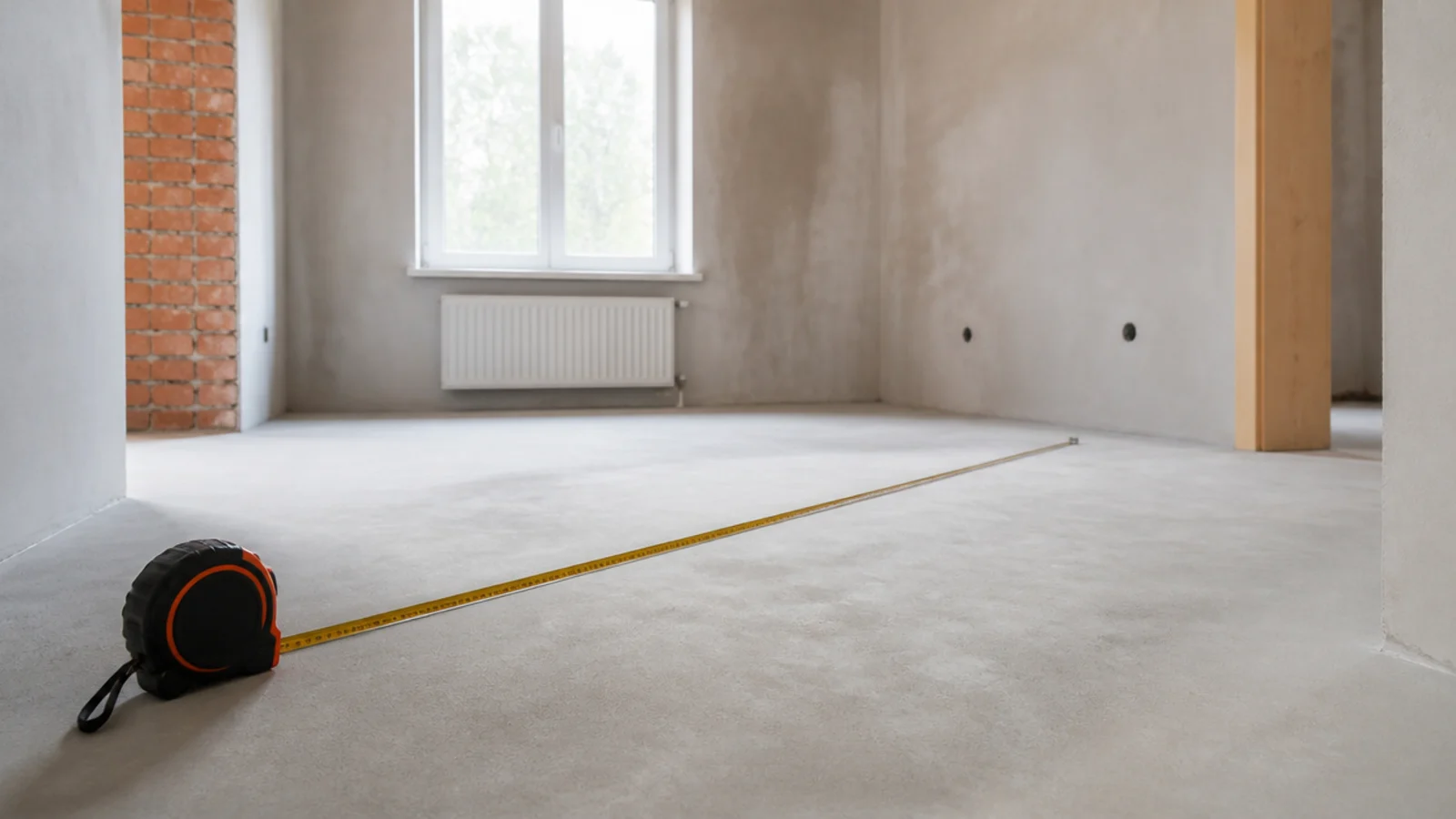
The steps, in order
The short version — each step is explained in full below.
- Choose the shape of the space
Identify whether the area is a rectangle, square, circle, triangle, L-shaped room, wall, or irregular shape. The shape determines which formula you'll apply.
- Measure the required dimensions
Measure length and width for rectangles; the radius for circles; the base and perpendicular height for triangles. Use consistent units (feet or inches throughout) and measure at multiple points to catch tapered walls.
- Apply the correct area formula
Use length × width for rectangles, side² for squares, π × r² for circles, (base × height) / 2 for triangles, and ((a + b) / 2) × h for trapezoids. Mixing the wrong formula with the wrong shape is the most common error.
- Combine areas for multi-segment spaces
For L-shapes, U-shapes, and irregular rooms, divide the floor plan into simple rectangles or triangles, calculate each area separately, and sum the results.
- Add a material waste factor
For flooring, tile, roofing, sod, wallpaper, or drywall, add 5–20% on top of the calculated area to cover cuts, breakage, and pattern matching. The exact percentage depends on the project type.
What is square footage?
Square footage is the measurement of a two-dimensional area expressed in square feet (ft²). One square foot is a square that's exactly 12 inches on each side - the area of a standard floor tile. Square footage tells you how much surface a flat space covers.
Linear measurements (length, width, height) are one-dimensional - they tell you how far. Square measurements are two-dimensional - they tell you how much surface. Cubic measurements (cubic feet, cubic yards) are three-dimensional - they tell you how much volume.
Most home improvement and real estate work happens in two dimensions. Flooring, paint, drywall, roofing, landscaping, and property listings all rely on square footage as the base unit.
The basic formula: length × width
For any rectangular space - which covers most rooms, walls, and lots - square footage equals length multiplied by width. A room that's 12 feet long and 10 feet wide has an area of 12 × 10 = 120 square feet.
Both measurements need to be in the same unit. If you measure length in feet and width in inches, you have to convert one before multiplying. Convert inches to feet by dividing by 12: 30 inches ÷ 12 = 2.5 feet.
Squares are a special case of rectangles where length equals width. A 10 × 10 ft room is 100 sq ft - it's both a square and a 100 sq ft rectangle.
Always confirm both dimensions are in the same unit before multiplying. The single most common square footage mistake is mixing feet and inches in the same calculation.
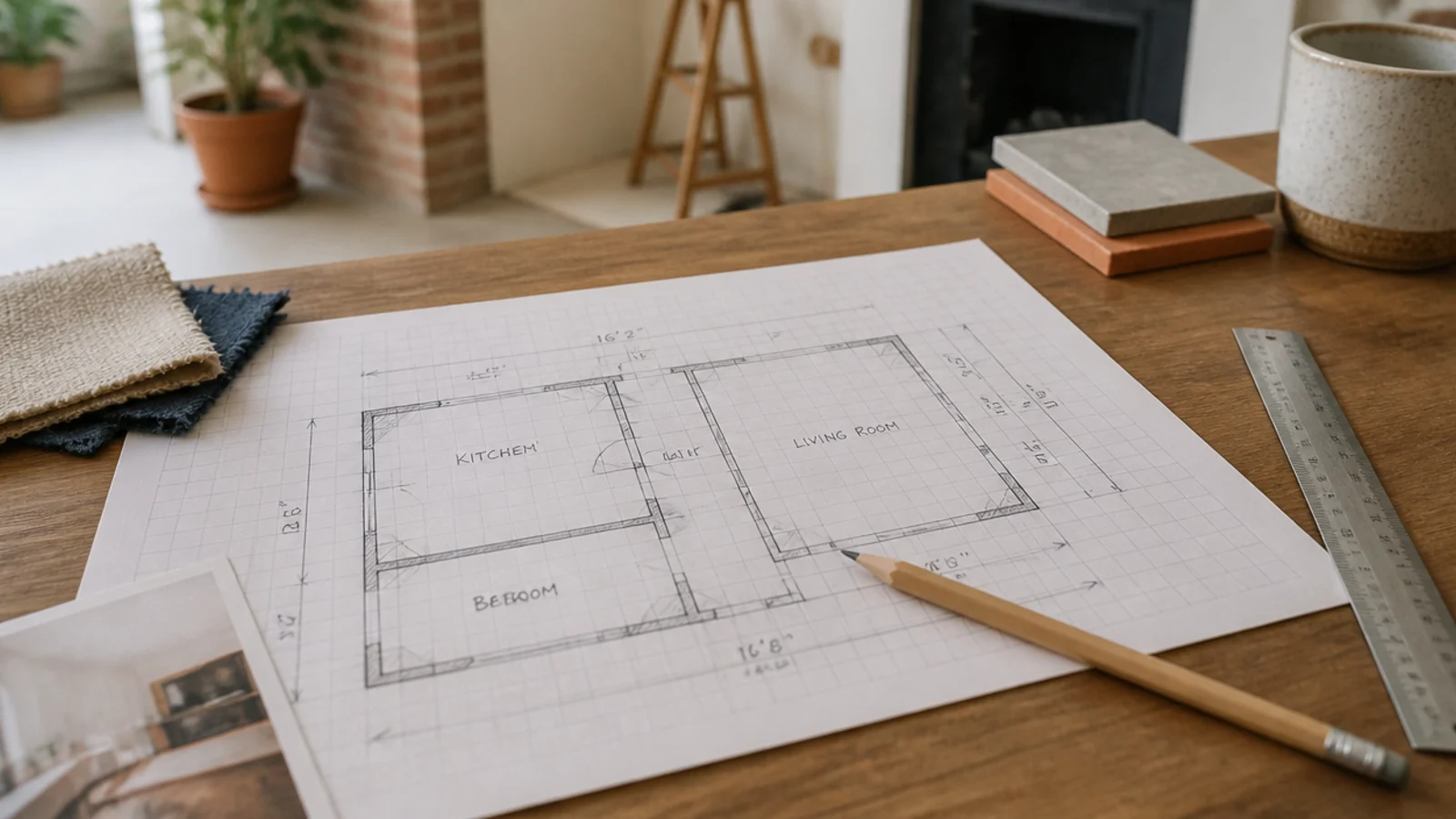
Step-by-step: measuring a rectangular room
Start at one corner with a tape measure or laser distance tool. Pull the tape along one wall and read the dimension at the opposite wall. Write it down. Don't trust memory.
Move 90 degrees and measure the perpendicular wall. Write that dimension down. You now have length and width.
Multiply the two numbers. The result is the square footage of that rectangular section.
- ·Measure to the wall surface, not to the baseboard or trim - those add about 1 inch each.
- ·If the room is irregular (corners aren't perfect right angles), measure the longest length and longest width separately at multiple points.
- ·Sketch the room before measuring. Label each wall with its dimension as you go.
- ·Double-check by measuring each wall twice - errors of even 6 inches accumulate over a large area.
Formulas for other common shapes
These six formulas cover almost every real-world space you'll measure. The trick is choosing the right shape - for a circle, the radius is half the diameter; for a triangle, height is the perpendicular distance from base to opposite point (not the slanted edge).
| Shape | Formula | Example |
|---|---|---|
| Rectangle / Square | Length × Width | 12 × 10 = 120 sq ft |
| Circle | π × radius² | π × 5² = 78.5 sq ft |
| Triangle (base + height) | (Base × Height) ÷ 2 | (10 × 8) ÷ 2 = 40 sq ft |
| Trapezoid | ((Base₁ + Base₂) ÷ 2) × Height | ((8 + 12) ÷ 2) × 6 = 60 sq ft |
| Annulus (ring) | π × (R² - r²) | π × (10² - 6²) = 201 sq ft |
| Parallelogram | Base × Height | 10 × 7 = 70 sq ft |
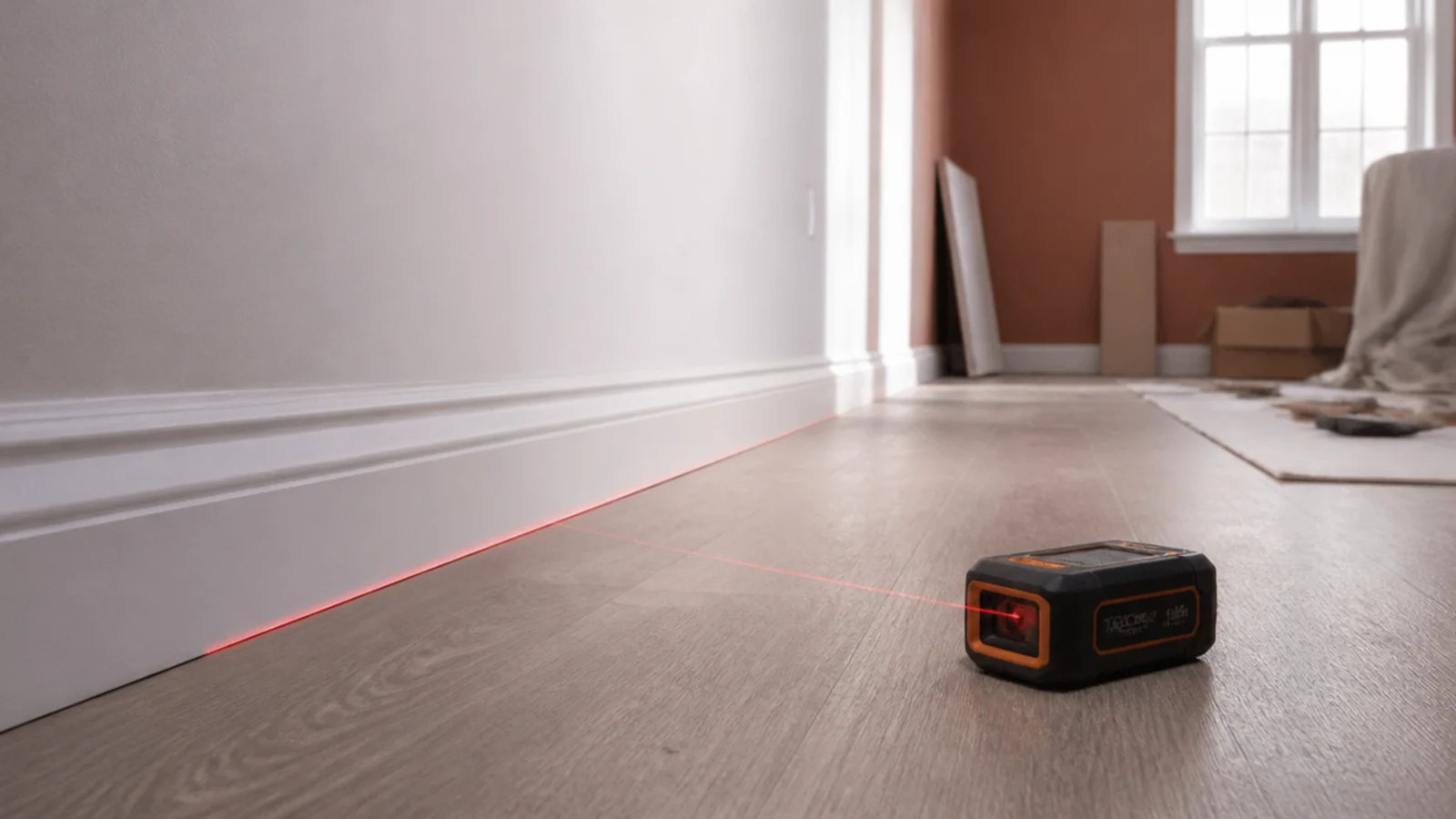
Handling irregular shapes
Most rooms aren't perfect rectangles. L-shapes, T-shapes, alcoves, bay windows, and angled walls are everywhere. The universal strategy is to break the irregular shape into simple shapes you already know how to calculate.
For an L-shaped room: draw a line that splits the L into two rectangles. Calculate each rectangle separately, then add them together. For a T-shape: same approach, two rectangles. For a bay window: a main rectangle plus a small rectangle (or trapezoid) for the bay protrusion.
For curved spaces, approximate with rectangles or trapezoids. A curved bed line can be split into 3-4 rectangles that average the curve - your accuracy will be within 5%, which is fine for most material estimates.
Multi-room and whole-house calculations
For a whole floor or whole house, measure each room individually and sum the areas. Don't try to measure the entire perimeter and multiply - irregular floor plans don't work that way.
Hallways and stairwells count as floor area on the floor where they exist. A staircase counts on the lower floor only - the upper-floor opening is subtracted.
For real estate listings in the US, the ANSI Z765 standard governs how square footage is measured. It includes finished, heated living space measured to the exterior wall surface. It excludes garages, unheated porches, and unfinished basements.
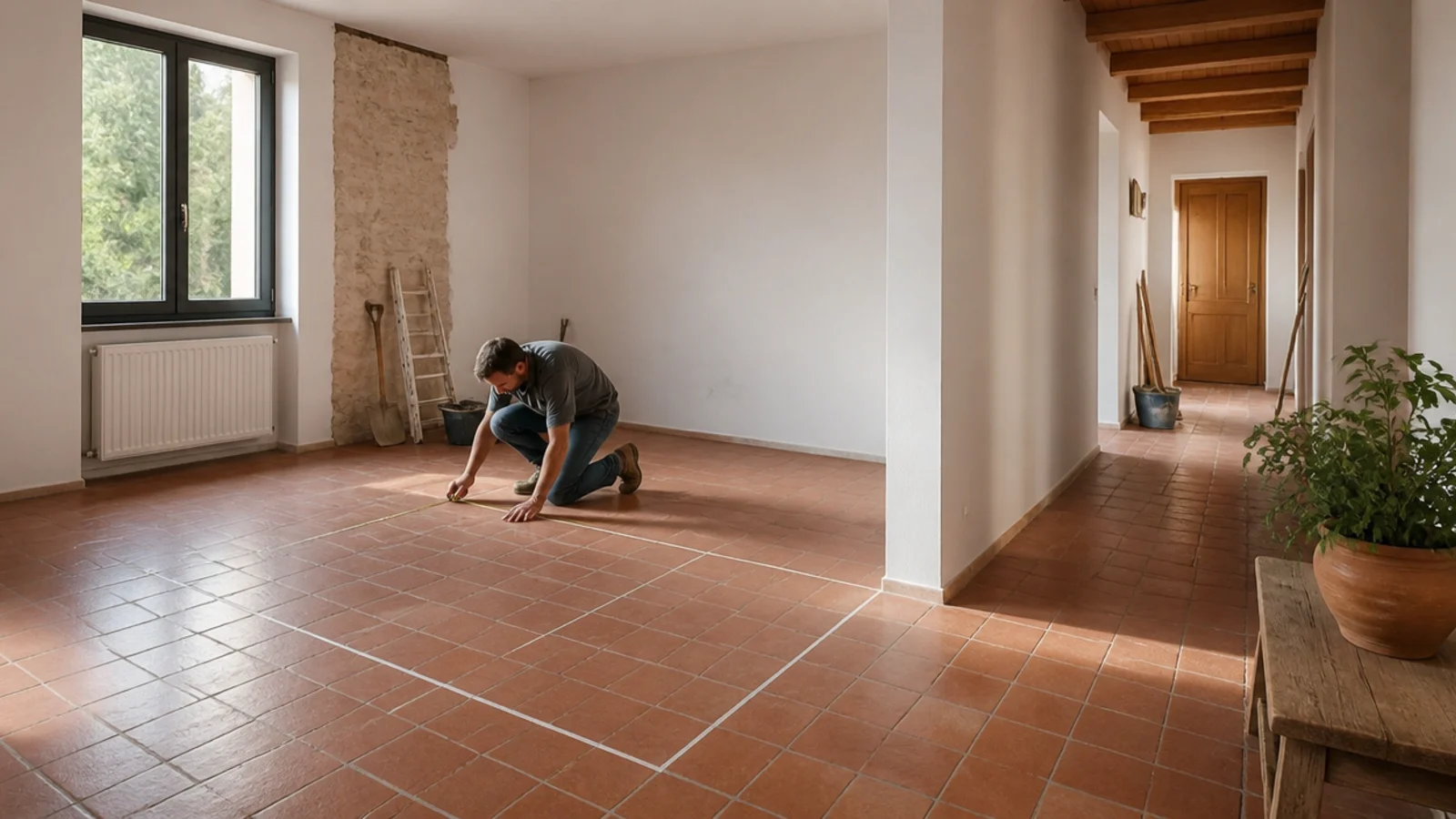
Adding waste factor for materials
Calculated square footage is the bare minimum. Real material orders need extra to cover cuts, mistakes, and future repairs. The amount depends on the material:
- ·Paint: 5% extra (mostly for two-coat coverage)
- ·Carpet and laminate: 10% extra
- ·Standard tile or hardwood: 10% extra
- ·Diagonal tile patterns or herringbone wood: 15-20% extra
- ·Complex layouts, multiple rooms, hex tile: 20-25% extra
Order an extra 5-10% on top of waste for tile and stone projects to ensure you have replacement material from the same dye lot if a tile breaks years later.
A whole worked example, start to finish
Formulas make sense in isolation and fall apart on a real floor plan, so here is one house measured end to end. The house is an L-shaped single storey with a bay window in the living room and a stair opening to a loft.
Start with the main rectangle: 32 ft by 24 ft gives 768 sq ft. The L returns a section that is 12 ft by 10 ft, so add 120 sq ft. Running total 888 sq ft. Measure the two legs separately at the notch; do not run the tape along the outside walls and multiply, which measures the outline rather than the floor.
The bay window is a trapezoid: the wall opening is 8 ft, the outer face is 5 ft, and it projects 2 ft. Average the parallel sides and multiply by the projection: ((8 + 5) ÷ 2) × 2 = 13 sq ft. Running total 901 sq ft.
Now subtract what is not floor. The stair opening is 3 ft by 9 ft, so 27 sq ft comes out. A chimney breast takes another 2 ft by 1.5 ft, or 3 sq ft. That leaves 871 sq ft of measured floor area — the honest number, before any waste allowance.
Finally, decide what the number is for. For a flooring order, add waste to 871: at 10% that is 959 sq ft to buy. For a listing, the 871 figure is interior area and would be reported differently again, because listings use gross exterior dimensions. Same house, three legitimate numbers, and confusing them is the single most expensive mistake in this whole subject.
Write every piece down as you measure it rather than keeping a running total in your head. A sketch with each rectangle labelled and its dimensions written on it takes two minutes and is the only reliable defence against measuring a room twice or missing one entirely.
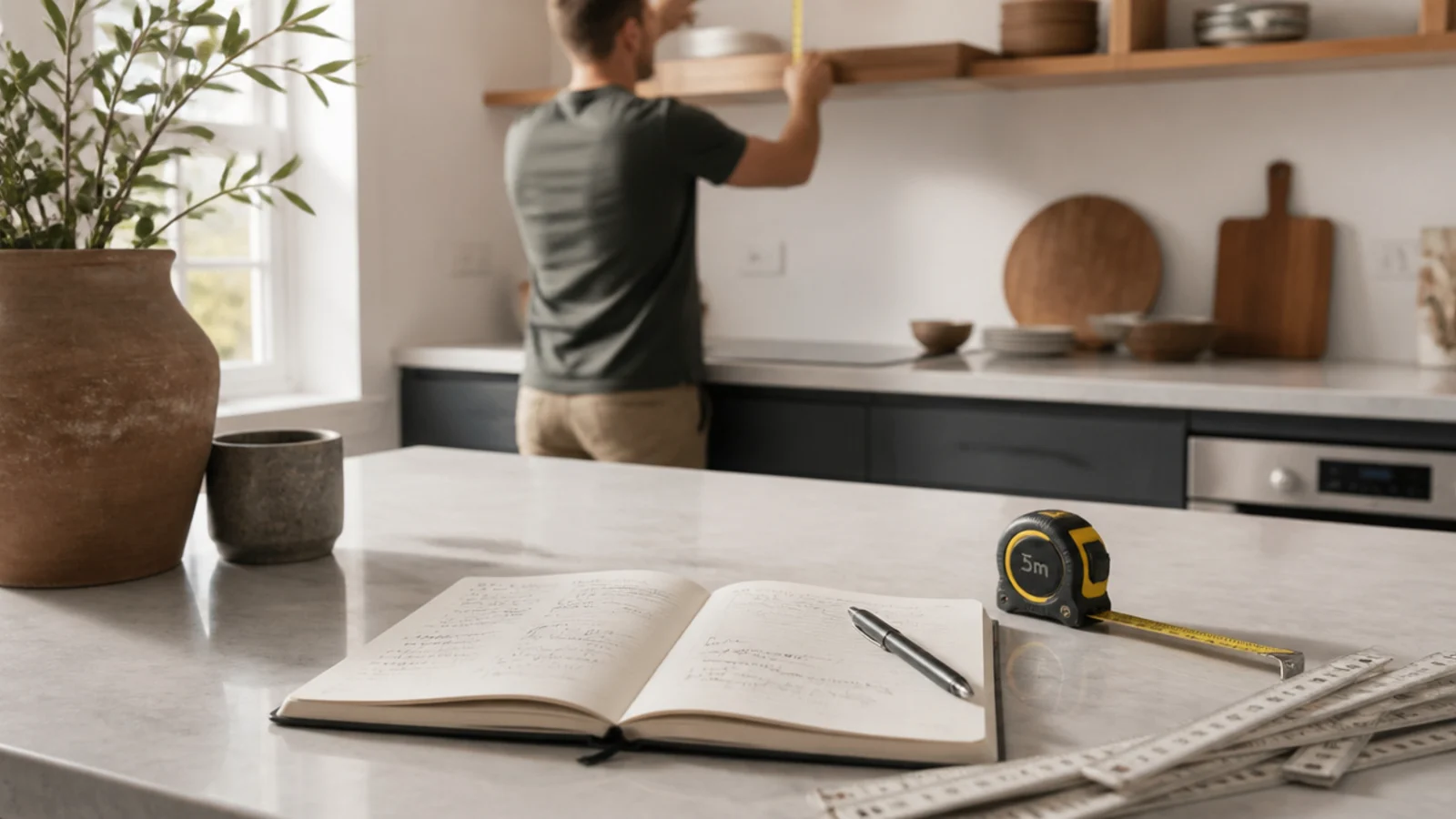
Before you start: tools and the one habit that prevents errors
A 25 ft tape measure handles any room. A laser measure is faster and reaches across spaces a tape sags in, and most are accurate to about an eighth of an inch over a room-sized distance — well within what matters for ordering materials.
The habit that prevents nearly every error is writing each measurement down at the moment you take it, in inches, before moving on. Measurements held in your head get transposed, and a transposed 148 and 184 is 36 inches of wall you either paint twice or not at all.
Measure at floor level, not at waist height, for anything to do with flooring. Baseboards, bowed walls and built-ins all sit at the bottom, and the floor is what you are covering.
Check that a room is actually square before treating it as a rectangle. Measure both diagonals: in a true rectangle they are equal. If they differ by more than an inch or so, the room is a trapezoid, and multiplying length by width will report an area the room does not have.
For a room you will come back to, sketch it and label the sketch rather than keeping a list of numbers. A list tells you the room has a 12 and a 14 in it; a sketch tells you which wall is which.
How to check the answer before you spend money
Every square footage calculation should end with a sanity check, because the expensive mistakes are order-of-magnitude ones — a decimal in the wrong place or a length recorded in inches and used as feet.
Compare your result against the band the space should fall in. A secondary bedroom that comes out at 600 square feet, or a whole house at 400, is wrong in a way that no amount of careful arithmetic will reveal.
The two useful national reference points: the median new US single-family home completed in 2025 was 2,142 square feet, and the average US apartment in 2025 was 910 square feet. If a whole-house figure is far outside that range, find out why before acting on it.
Then check the arithmetic a second way. If you multiplied 12.33 ft by 8.83 ft to get 108.9 square feet, confirm it by multiplying the original inches — 148 × 106 = 15,688 — and dividing by 144. Two routes to the same number is a real check; re-reading the same calculation is not.
| Space | Typical range |
|---|---|
| Secondary bedroom | 100 – 150 sq ft |
| Primary bedroom | 200 – 350 sq ft |
| Full bathroom | 35 – 100 sq ft |
| Kitchen | 100 – 200 sq ft |
| Living room | 200 – 400 sq ft |
| Two-car garage | 400 – 576 sq ft |
| Average US apartment (2025) | 910 sq ft |
| Median new US home, completed (2025) | 2,142 sq ft |
Common units and conversions
| Convert from | To get | Multiply by |
|---|---|---|
| Square inches | Square feet | ÷ 144 |
| Square feet | Square yards | ÷ 9 |
| Square feet | Square meters | ÷ 10.764 |
| Square feet | Acres | ÷ 43,560 |
| Acres | Square feet | × 43,560 |
Calculators that use these techniques
Frequently asked questions
How do you calculate square feet?+
How do you measure square footage of a house?+
How do you estimate square footage without measuring every room?+
What is the easiest way to figure out square footage?+
How do you calculate square footage of a room?+
How many square feet is a 12x12 room?+
Do you include closets and hallways in square footage?+
How do you calculate square footage with feet and inches?+
How much extra should I add for waste?+
Related guides
Ready to calculate?
Use the calculator