Exterior wall square footage calculator
Work out the exterior wall area of a house for siding, paint or insulation. Multiply the perimeter by the wall height, add the gable triangles, and deduct only the large openings. A 3,000 square foot house has roughly 2,000 square feet of exterior wall on one storey, but about 2,800 to 3,100 on two — the taller walls more than offset the smaller footprint.
Exterior Wall Calculator
Walls plus gables plus dormers
For a single-story rectangular house, exterior wall area = perimeter × wall height. A 40 × 30 ft house with 9 ft walls has a perimeter of 140 ft × 9 ft = 1,260 sq ft of wall.
Add gable triangles for a pitched roof. A 30-ft-wide gable end with a 7/12 pitch has a peak height of (30 ÷ 2) × (7 ÷ 12) = 8.75 ft. Triangle area = (30 × 8.75) ÷ 2 = 131 sq ft per gable. Two gables = 262 sq ft to add.
Dormers, bays, and bump-outs each get measured as their own additional wall section. Eave overhangs do not get sided but are included if you're painting.
What to subtract
For siding and stucco, subtract garage doors and any opening larger than 25 sq ft. For paint, subtract all door and window openings (you only paint the trim around them, calculated separately as linear feet).
A standard double garage door is 16 × 7 = 112 sq ft. A standard window is 3 × 5 = 15 sq ft. A typical single-story 2,000 sq ft house with a garage has 100-150 sq ft of openings to subtract.
What 'exterior square footage' actually means
Exterior square footage is the surface area of all outside walls of a building — different from house square footage (interior livable space) and from siding area (which subtracts windows and doors). The right number depends on what you're measuring for.
For siding orders: perimeter × wall height, minus large window and door openings.
For exterior paint: perimeter × wall height, minus windows and doors over 10 sq ft.
For insulation: perimeter × wall height, minus only window areas (insulation goes around door frames).
For exterior cleaning/power washing: perimeter × wall height, including everything.
For curb appeal: gross perimeter × wall height including all features (the visual size).
Worked example: a 40 × 30 ft two-story house has 140 ft perimeter × 16 ft total height = 2,240 sq ft of gross exterior wall. Add gable triangles (2 × 90 sq ft = 180 sq ft). Total exterior = 2,420 sq ft.
Stories, eaves, and gable math
Different house styles have very different exterior square footage even with the same floor plan:
Single-story (1,500 sq ft footprint): perimeter (150 ft) × 8 ft wall = 1,200 sq ft, plus 2 gables (~180 sq ft) = 1,380 sq ft exterior.
Two-story (same 1,500 sq ft footprint): perimeter (150 ft) × 16 ft total height = 2,400 sq ft, plus 2 gables = 2,580 sq ft exterior.
Split-level: typically 70% more exterior area than equivalent two-story.
1.5-story with dormers: add 50-100 sq ft per dormer.
Houses with covered porches, attached garages, and bonus rooms have additional exterior wall area for each attached structure.
Eave overhangs and rake overhangs add 10% to exterior surface area for typical residential roofs. Modern minimalist designs with no overhangs (or 'flat-roof' houses) have less.
Exterior wall area by house footprint and storey count
Exterior wall area is perimeter times wall height, and the thing that trips people up is that it has almost nothing to do with the house's floor area. A long, narrow house has far more exterior wall than a square house of identical square footage, because perimeter grows with shape, not just size.
Take a 1,200 sq ft footprint. Built as 30 × 40 ft, the perimeter is 140 ft. Built as 20 × 60 ft — the same 1,200 sq ft — the perimeter is 160 ft, which is 14% more siding, paint and house wrap for the same house size. Compact footprints are cheaper to clad, and that is why builders like them.
Wall height per storey is usually 9 ft for the framing plus floor structure, so a two-storey house runs about 18 ft from grade to the top plate. The table uses 9 ft per storey. Add gable ends separately: they are triangles, not part of the rectangular wall area.
Worked example — a 36 × 50 ft two-storey house. Perimeter is 2 × (36 + 50) = 172 ft. At 18 ft of wall height that is 3,096 sq ft of gross exterior wall. Deduct the openings (21 sq ft per door, 15 sq ft per window) and add the two gable ends, and you have the real figure to order against.
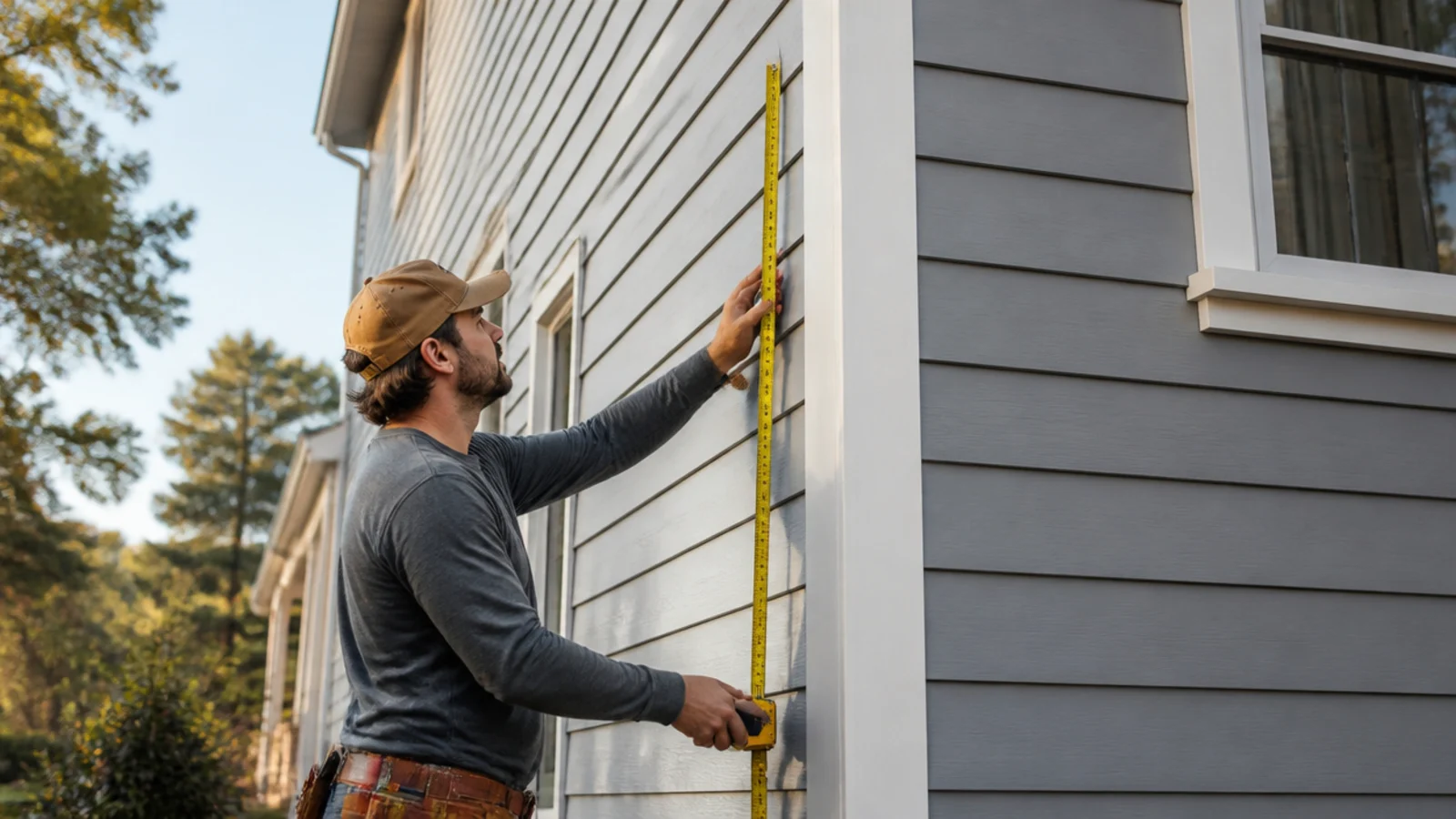
Measure at grade, walking the foundation with the tape, and record each side separately rather than assuming the house is a perfect rectangle. Bump-outs, bays and attached garages all change the perimeter, and a garage that shares a wall with the house has one fewer exterior side than you would count from the outside.
| Footprint | Floor area | Perimeter | 1 storey | 2 storey |
|---|---|---|---|---|
| 30 × 40 ft | 1,200 sq ft | 140 ft | 1,260 sq ft | 2,520 sq ft |
| 30 × 50 ft | 1,500 sq ft | 160 ft | 1,440 sq ft | 2,880 sq ft |
| 36 × 50 ft | 1,800 sq ft | 172 ft | 1,548 sq ft | 3,096 sq ft |
| 40 × 50 ft | 2,000 sq ft | 180 ft | 1,620 sq ft | 3,240 sq ft |
| 40 × 60 ft | 2,400 sq ft | 200 ft | 1,800 sq ft | 3,600 sq ft |
Painting, washing, and sealing the exterior
Each exterior treatment has different square-foot requirements:
Exterior paint: 1 gallon covers ~275 sq ft per coat on smooth siding, ~200 sq ft on rough/textured. Two coats for new paint, one coat for recoating same color. A 2,400 sq ft house exterior: 2,400 × 2 ÷ 275 = 17.5 gallons. Buy 18-20 gallons.
Power washing service: $0.10-0.40 per sq ft depending on whether mildew/stain removal is included. A 2,400 sq ft house: $240-960.
Pressure washing the deck and walkway: typically priced separately, $0.20-0.50 per sq ft.
Exterior wood sealer (decks, fences, doors): 1 gallon covers ~150-250 sq ft on rough wood. Apply every 2-3 years.
House washing chemicals (sodium hypochlorite solution for mildew): $20-40 per gallon, covers ~300 sq ft when sprayed.
Soffit and fascia are not part of the wall area
Exterior square footage usually means the walls, and a siding order built only from wall area comes up short in two specific places — both of them under the roof rather than on the wall.
The soffit is the underside of the roof overhang, and it is an area: eave length × overhang depth. On a 40 × 30 ft house with a 2 ft overhang along both long sides, that is 2 × 40 × 2 = 160 sq ft of soffit. It is a real material order, usually vented panel, and it is nowhere in the wall calculation because it is horizontal.
The fascia is the board closing the ends of the rafters along that same edge, and it is not an area at all — it is bought in linear feet. The same house needs 2 × 40 = 80 linear feet of fascia. Quoting it in square feet is a category error that produces a nonsense number.
Gable ends add a third piece. The overhang along a sloped roof edge is the rake, and rake soffit runs up the slope rather than horizontally, so its length is the rafter length rather than the wall width — the same pitch multiplier the roof calculation uses applies here too.
The practical rule when scoping an exterior job: walls in square feet, soffit in square feet, fascia and trim in linear feet, and each one counted separately. Three numbers, three orders, and none of them substitutes for another.
Pro tips
Measure each wall as a rectangle
Don't multiply perimeter by height for a multi-story house with split-levels. Walk the foundation, measure each wall length, and multiply each by its actual height.
Don't forget chimneys
Chimney chases that get sided or painted add 4 sides × height. A 4-ft × 4-ft chimney chase 8 ft tall adds 128 sq ft.
Order siding by the square
Siding is sold by the “square” (100 sq ft). For 1,260 sq ft of wall, you need 12.6 squares + waste = 14 squares of siding minimum.
Stucco and stone need underlayment
Stucco coverage estimates assume the area is wired and prepped. Stone veneer adds a corner-piece line item (counted in linear feet of outside corners, not square feet).