Linear Feet to Square Feet Calculator
Convert linear feet (length only) to square feet (area) by multiplying by the material's width. Built for carpet rolls, lumber, flooring planks, and any product sold by linear foot but used to cover a surface.
Square feet = linear feet × width. Enter your linear distance and the width of the material to get the area in square feet.
For carpet rolls use 12 ft (standard width). For lumber, use board width.
Why linear feet alone aren't enough
Linear feet measures distance along one dimension. Square feet measures area — two dimensions. You can't convert one to the other without knowing the width of the material because the two units describe fundamentally different things.
Think of it like this: 100 linear feet of a 6-inch-wide ribbon covers 50 square feet. The same 100 linear feet of 12-foot-wide carpet covers 1,200 square feet. Same length, completely different area. The width is what bridges the gap.
The good news is the math is dead simple once you have the width: square feet = linear feet × width (in feet). If your width is given in inches, divide by 12 first to get decimal feet.
Common scenarios
Carpet rolls. Carpet is sold by the linear foot but you measure the room in square feet. Standard carpet is 12 feet wide, so 1 linear foot = 12 sq ft. If your room is 240 sq ft, you need 240 ÷ 12 = 20 linear feet of carpet.
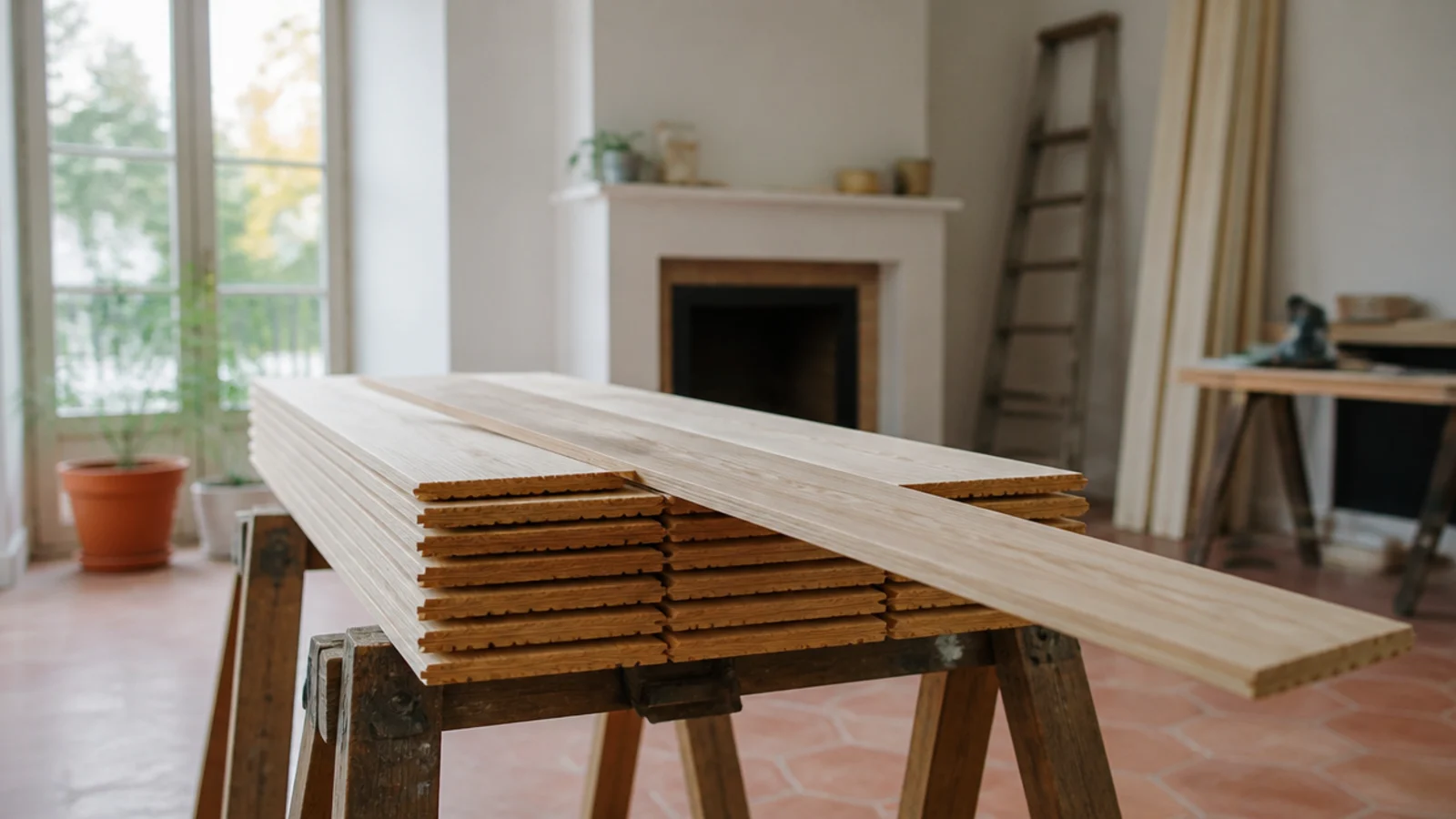
Hardwood and vinyl plank flooring. Boxes show the square footage they cover, but individual planks are described by linear feet. A 48-inch-long, 5-inch-wide plank is 4 linear feet covering 4 × (5/12) = 1.67 sq ft.
Lumber surface area. If you're estimating paint or stain for boards, multiply linear feet by the actual board width (not nominal — a "1×6" is actually 0.75 × 5.5 inches). 50 linear feet of 1×6 = 50 × 0.458 = 22.9 sq ft of surface to coat.
Fencing. Fence is priced by linear foot for the run, but you need square feet for stain or paint. A 100-linear-foot fence at 6 ft tall = 600 sq ft of fence surface (single side). Double it for both sides.
The two meanings of "linear foot" (don't confuse them)
Linear foot has two distinct meanings that get mixed up constantly, especially in construction quotes. Knowing which one applies to your project determines whether you multiply by width or by height.
Linear foot as a run. The distance along a single line — most common for fencing, baseboards, gutters, trim, and countertop edges. A 40-linear-foot countertop means 40 feet of countertop perimeter, regardless of how deep the counter is. To convert to square feet of surface, multiply by the depth (typically 25 inches / 2.083 ft for a kitchen counter).
Linear foot as a length of board. A 12-linear-foot 2×4 means a board that is 12 feet long. The board has a fixed actual width (1.5 inches for a 2×4) that's built into the product. To convert to square feet of surface (for staining or painting), multiply linear feet by the actual board width in feet.
Worked example: stain a privacy fence
You're staining a backyard privacy fence. The fence run is 120 linear feet around three sides of the yard. The fence is 6 ft tall, with 1×6 vertical pickets. You need to know how many gallons of stain to buy.
Step 1. Calculate fence surface area on one side: 120 linear ft × 6 ft tall = 720 sq ft per side.
Step 2. Decide whether you're staining both sides. Most homeowners stain only the side facing in. Some HOAs require both. Assume both for this example: 720 × 2 = 1,440 sq ft of stain surface.
Step 3. Account for picket gaps. Pickets are usually spaced with 1/4 to 1/2 inch gaps. A 5.5-inch picket with a 1/2-inch gap covers 5.5/6 = 91.7% of the surface. So the actual stainable area is 1,440 × 0.92 ≈ 1,325 sq ft. (Skip this adjustment for a solid fence with no gaps.)
Step 4. Divide by stain coverage. A gallon of semi-transparent fence stain covers about 150–250 sq ft on rough wood (one coat). At 200 sq ft per gallon, you need 1,325 / 200 = 6.6 gallons. Round up to 7 gallons, or buy a 5-gallon bucket plus 2 quarts.
Engineered hardwood and plank flooring math
Flooring is where linear-foot confusion costs people the most money. Boxes are sold by square footage (e.g., 22.5 sq ft per box), but individual planks are described by length × width. To match a quote in linear feet to a quote in square feet, do this:
Engineered hardwood, 5-inch wide planks. Each plank is typically 48 inches (4 ft) long and 5 inches (0.417 ft) wide. One plank = 4 × 0.417 = 1.67 sq ft. A box of 12 planks = 20 sq ft of coverage. 100 linear feet of plank (25 boards) = 100 × 0.417 = 41.7 sq ft.
Wider 7-inch planks. Same length (4 ft typical), wider face (7 inches = 0.583 ft). One plank = 4 × 0.583 = 2.33 sq ft. 100 linear feet of plank = 100 × 0.583 = 58.3 sq ft. Same number of boards, 40% more floor covered.
Why this trips people up. If a salesperson quotes "$8 per linear foot" without specifying plank width, that price could mean very different things. A 7-inch plank at $8/linear ft is $13.72 per sq ft. A 3.25-inch plank at the same $8/linear ft is $29.54 per sq ft. Always ask for the price per square foot — it's the only number that's comparable across products.
Quick reference
| Material | Typical width | 1 linear ft = |
|---|---|---|
| Standard carpet roll | 12 ft | 12 sq ft |
| Wide carpet roll | 15 ft | 15 sq ft |
| Vinyl sheet flooring | 12 ft | 12 sq ft |
| Hardwood plank (7″) | 0.583 ft | 0.58 sq ft |
| Hardwood plank (5″) | 0.417 ft | 0.42 sq ft |
| Hardwood plank (3.25″) | 0.271 ft | 0.27 sq ft |
| 1×6 lumber (actual 5.5″) | 0.458 ft | 0.46 sq ft |
| 1×8 lumber (actual 7.25″) | 0.604 ft | 0.60 sq ft |
| 6 ft tall fence | 6 ft | 6 sq ft |
| Kitchen countertop (25″ deep) | 2.083 ft | 2.08 sq ft |
| Standard gutter | 5–6" width | N/A (1D) |
Carpet: linear feet to square feet, in detail
Carpet is sold by the linear foot off a roll. The roll width depends on the manufacturer — North American mills standardize on 12 ft, but European and luxury mills also produce 13.5 ft (4 m) and 15 ft (4.6 m) rolls. The first question to ask a carpet vendor is always: "What width is this roll?"
The math for a single-room carpet order: divide the room's longest dimension into the room area, then verify that the room's shorter dimension is less than the roll width. If it is, you need (longest dimension in feet) × roll width of carpet. If it isn't, you'll need seams — which is its own complication.
Worked example. A 14 × 18 ft living room is 252 sq ft. The longer dimension is 18 ft, the shorter is 14 ft. Standard 12-ft carpet won't fit the 14 ft direction without a seam. With 12-ft carpet, you'd need two pieces (18 ft long × 12 ft wide = 216 sq ft + 18 ft × 2 ft strip = 36 sq ft = 252 sq ft total) plus a seam. With 15-ft carpet, one piece covers it (18 × 15 = 270 sq ft, with 18 sq ft of waste). Most contractors will pick 15-ft to avoid the seam, even though it wastes more material.
Add 10% for cuts and patterns. Standard waste is 5–10% for plain plush carpet, more for patterned carpet (which needs pattern matching across the room and at seams). Sculpted or Berber carpets can need 15% because of the directional pattern.
Hardwood and plank flooring
Hardwood, engineered wood, and vinyl plank flooring are usually sold by the carton, with each carton labeled in square feet. But individual planks are still described in linear feet — most commonly 36, 48, or 60 inches long.
Why this matters for layout. Plank length determines how staggered the joint pattern looks. Shorter planks (36") create busier, more uniform patterns. Longer planks (60"+) create cleaner, more contemporary visual flows. The wider the plank, the more dramatic the grain looks — and the more critical the subfloor flatness becomes (wide planks expose floor irregularities).
Calculating from board specs. If you find a sale on planks priced per linear foot rather than per carton, here's the math: linear feet × (plank width in inches ÷ 12) = square feet of coverage. So 1,000 linear feet of 5-inch-wide plank covers 1,000 × 0.417 = 417 sq ft. Add 10% waste for cuts at walls.
Lumber: linear vs board feet vs square feet
Lumber introduces a third unit — the board foot — which is neither linear nor square. A board foot is 144 cubic inches (1 ft × 1 ft × 1 inch thick). It's a volume measure used mostly for rough lumber and specialty woods. Most homeowners only encounter it in fine woodworking stores.
For everyday DIY, you'll see lumber priced in two ways: per piece (a 2×4×8 is one piece) or per linear foot. To calculate surface area for paint or stain, multiply linear feet by actual width (not nominal width).
The nominal vs actual trap. "Nominal" sizes are what the lumber is called: 1×4, 1×6, 2×4, 2×6. "Actual" sizes are smaller because lumber is sized green and dried before sale. Memorize: subtract 0.5 inches from each nominal dimension of 1× lumber, and 0.5 inches from each nominal dimension of 2× lumber too. So a 1×6 is actually 0.75 × 5.5 inches, and a 2×4 is actually 1.5 × 3.5 inches.
Painting or staining lumber. For visible surface area of trim, deck boards, or siding, use the actual width. 200 linear feet of 1×6 cedar deck boards has 200 × (5.5/12) = 91.7 sq ft of top surface to stain. Don't forget edges and bottoms if you're doing a full coat — that easily doubles the area to coat.
Fencing: a special case
Fence is the one material where linear feet usually IS what you order, because fence cost is dominated by posts and rails — not surface area. A 100-linear-foot fence costs roughly the same whether it's 4 ft tall or 6 ft tall (within a range).
But you DO need square feet when:
- ·Staining or painting. Fence stain coverage is usually 100–200 sq ft per gallon for rough cedar. A 6 ft × 100 linear ft fence has 600 sq ft per side. Both sides = 1,200 sq ft = 6–12 gallons of stain.
- ·Vinyl or composite panels. These are sold by the linear foot but priced higher because the manufacturer is essentially charging for the sq ft of plastic. A 6 ft tall vinyl fence at $30/linear foot is equivalent to $5/sq ft of vinyl.
- ·Privacy slats. Bamboo or reed privacy slats are sold by the roll, usually 8 ft tall × 25 ft long = 200 sq ft per roll. To cover 100 linear ft of fence: 100 × 8 = 800 sq ft = 4 rolls.
Fabric, upholstery, and ribbon
Fabric is often sold by the linear yard rather than linear foot — a yard is 3 feet, so multiply linear yards by 3 to get linear feet before applying the width formula. Fabric widths are standardized but vary: 45 inches (quilting cotton), 54 inches (upholstery), 60 inches (broadloom upholstery and heavy fabrics), 108 inches (sheeting).
Worked example. Reupholstering a sofa needs 12 yards of 54-inch fabric. Convert: 12 yards × 3 = 36 linear feet. Width: 54 ÷ 12 = 4.5 feet. Total: 36 × 4.5 = 162 sq ft of fabric.
Frequently asked
How do I convert linear feet to square feet?+
Can I convert linear feet to square feet directly?+
How wide is a standard carpet roll?+
How do I calculate square feet from linear feet of fence?+
How do I convert linear feet of lumber to square feet?+
What is the difference between linear feet and square feet?+
How many linear feet are in 100 square feet?+
How do I convert linear feet to square feet for a countertop?+
How many linear feet of baseboard for a 12x14 room?+
Why is hardwood flooring quoted in linear feet sometimes?+
Related calculators
Related guides
Linear and square measurements get mixed up more than any other pair. These guides cover the conversions and the mistakes that follow from confusing them.