Shower Square Footage Calculator
Measure shower walls and floor for tile, stone, or panel surround projects. A standard 60×30 shower tiled to 6 ft needs about 60 sq ft of wall tile, or 73 sq ft counting the floor.
Shower Tile Calculator
Three walls plus floor and curb
A standard alcove shower has three tiled walls, a floor, and sometimes a curb top. Measure each wall as length × height. Common shower wall heights are 6 ft (above tub), 7 ft (full height), or to the ceiling (typically 8 ft).
For a 60 in × 30 in shower with 6 ft walls: back wall (60 × 72) = 30 sq ft; two side walls (30 × 72) = 15 sq ft each = 30 sq ft. Floor (60 × 30) = 12.5 sq ft. Total = 72.5 sq ft, plus 15% waste = 84 sq ft of tile to order.
Niches, benches, and trim
A typical recessed niche is 12 × 24 in. Tile the niche back, sides, and bottom; subtract the niche opening from the wall area, then add the niche interior surfaces back. Most niches add 4-6 sq ft net to your wall tile order.
Shower benches add wall area on the front and top. A 24 in × 16 in bench top adds about 2.7 sq ft, plus the front face. Curbs need tile on the top and shower-side face.
Shower wall tile square footage
Shower walls are calculated separately from floor because the materials, waste factors, and waterproofing requirements differ. A standard shower has three tiled walls (or 4 with a tub surround).
Standard 36 × 36 inch shower stall: 3 walls × 36 inches wide × 78 inches tall (typical tile height) = 3 × 19.5 = 58.5 sq ft of wall tile. Add the niche cut-out back in (most niches are 12 × 18 inches recessed = roughly 1.5 sq ft).
Standard 60 × 32 inch alcove tub surround: front wall (60 × 60 in above tub) + 2 end walls (32 × 60 in each) = 25 + 26.6 = 51.7 sq ft of tile.
Walk-in 60 × 36 inch shower with curb: back wall (60 × 78) + 2 sides (36 × 78) = 32.5 + 38.9 = 71.4 sq ft.
Always add 15-20% waste for shower tile — niches, valve cuts, drain plates, and corner cuts all sacrifice material. 20% is safer for first-time DIY installs.
Floor tile and curb math
Shower floor tile typically uses smaller tiles (mosaic sheets, penny tiles, 2-inch squares) for grip and to fit the slope to the drain. Larger tiles (12-inch+) on shower floors are a code violation in many jurisdictions because of slip risk.
36 × 36 inch shower floor: 9 sq ft of floor tile. Add 15% waste for the drain cut and corner trim: 10.4 sq ft = 11 sq ft to order.
60 × 36 walk-in floor: 15 sq ft of floor + curb tile (the curb adds ~3-4 sq ft) = 19-20 sq ft total.
The curb wraps from floor up over the curb (typically 4-6 inches tall) and back down inside. Each linear foot of curb perimeter eats ~1 sq ft of small-format tile because of the wrap.
Shower tile area by enclosure size
A standard alcove shower is tiled on three walls, so the measurement you need is the linear run of those three walls times the tile height. For an enclosure that is W wide and D deep, that run is W + 2D — the back wall plus both returns.
Tile height is a decision, not a measurement. Six feet clears most showerheads and is the traditional stopping point. Tiling to the ceiling at eight feet costs about a third more material but removes the horizontal edge that collects soap film and eventually fails, which is why it has become the default in new work.
Worked example — a 36 × 36 in alcove tiled to 8 ft. Convert to feet: 3 ft wide, 3 ft deep, so the wall run is 3 + 3 + 3 = 9 linear ft. At 8 ft high that is 72 sq ft of wall tile. The pan adds 3 × 3 = 9 sq ft, usually in a different tile, so keep it as a separate line on the order.
Waste on a shower runs 15 to 20%, well above a flat floor. Every wall meets another wall at a corner cut, the niche needs its own cut pieces on five faces, and the valve and showerhead plates each cost a tile. On a mosaic pan, budget 20% — the sheets get cut into small odd shapes around the drain.
Two extras that never appear in the wall figure: the curb, which is tiled on three faces and typically adds 6 to 8 sq ft, and the niche, whose interior surfaces add another 4 to 6 sq ft. Both are visible detail work and worth ordering generously for.
| Enclosure | Wall run | Tile to 6 ft | Tile to 8 ft | Pan area |
|---|---|---|---|---|
| 32 × 32 in | 8.0 lin ft | 48 sq ft | 64 sq ft | 7.1 sq ft |
| 36 × 36 in | 9.0 lin ft | 54 sq ft | 72 sq ft | 9.0 sq ft |
| 48 × 36 in | 10.0 lin ft | 60 sq ft | 80 sq ft | 12.0 sq ft |
| 60 × 32 in (tub) | 10.3 lin ft | 62 sq ft | 83 sq ft | 13.3 sq ft |
| 60 × 36 in | 11.0 lin ft | 66 sq ft | 88 sq ft | 15.0 sq ft |
Beyond tile: pan, membrane, and grout
Shower waterproofing materials are calculated alongside tile square footage:
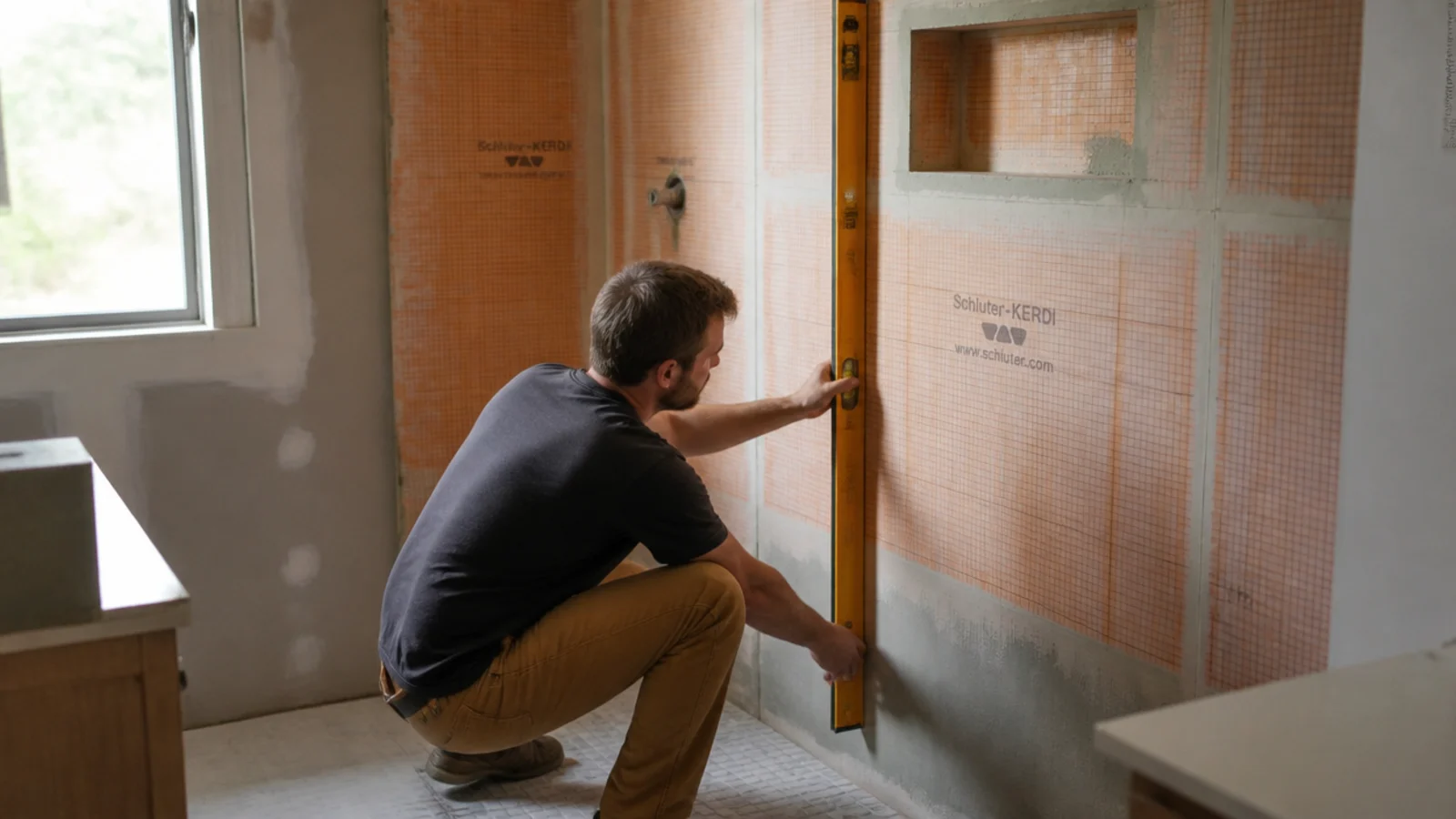
Shower pan / liner: 36 × 36 stall = 1 pan unit. Larger custom showers use sheet membrane (Schluter Kerdi or equivalent) at about $4-7 per sq ft of total surface (floor + walls + curb).
Cement backer board (HardieBacker, Durock) for walls: 1 sheet (3 × 5 ft = 15 sq ft) per 12-15 sq ft of wall (accounting for cuts). Standard 36 × 36 shower needs 4-5 sheets.
Thinset and grout: thinset at $0.50 per sq ft, grout at $0.30 per sq ft for typical 1/8-inch joints. Penny tile and mosaics use 2× normal grout because of the higher joint-to-tile ratio.
Sealer for natural stone and grout: $0.20 per sq ft, reapplied annually. Glass tile doesn't need sealer; porcelain doesn't either.
Pro tips
Use mosaic on the floor
Shower floors need small tiles (2 in or smaller) so grout lines provide drainage slope and slip resistance. Buy mosaic sheets and treat the floor as a separate tile order from the walls.
Plan accent strips before ordering
Decorative bands or accent strips have different square footage requirements. Calculate them separately to make sure you order enough of each tile type.
Schluter or bullnose for edges
Outside corners and shower curb edges need either bullnose tile or metal trim (Schluter). Bullnose adds linear feet to your tile order; metal trim is sold by the 8-ft stick.
Order from one lot
Shade variation between dye lots is most visible in small enclosed spaces like showers. Always order from a single lot, and buy 20% extra for future repairs.