Solar Panel Square Footage Calculator
Calculate available roof square footage for solar panels. Standard residential panels are 17.6 sq ft each (65 × 39 inches) and produce 350-450 watts.
Solar Roof Area Calculator
How much roof space per panel
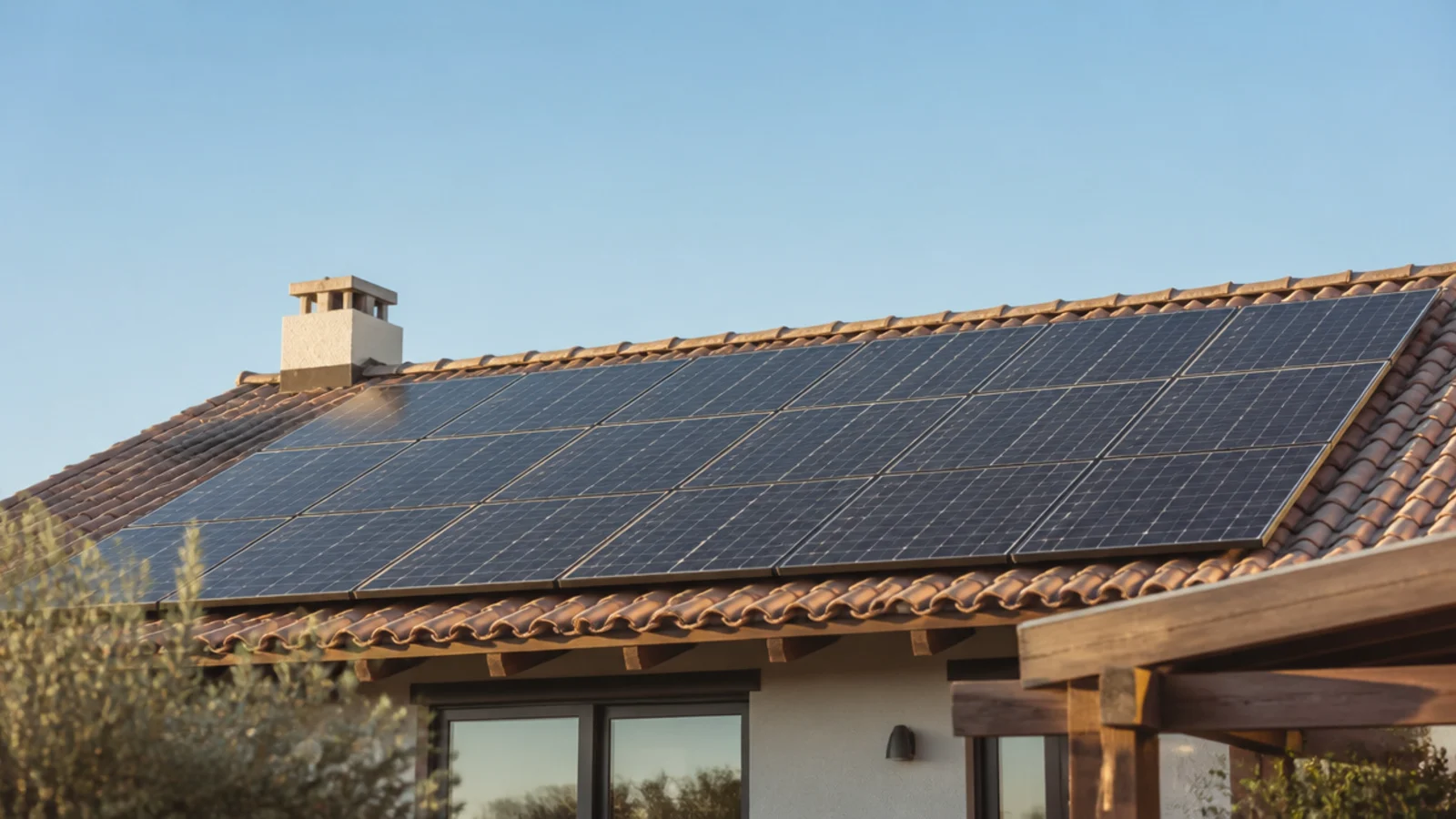
Standard residential solar panels are 65 × 39 inches = 17.6 sq ft per panel. Including the framing and rail spacing between panels, plan on ~20 sq ft per installed panel.
100 sq ft of usable roof space holds about 5 panels = ~1,750 watts (1.75 kW). 500 sq ft holds about 25 panels = ~9 kW. A typical 6 kW residential system needs around 350 sq ft of clear south-facing roof.
Roof area limitations
Fire codes ask for two different things and they are easy to confuse. One is a setback along the ridge — commonly 18 inches each side where the array covers a limited share of the roof, widening to 36 inches where it covers more. The other is a 36-inch clear access pathway from eave to ridge. Some jurisdictions add setbacks at valleys and dormers. Code editions and local amendments vary, so confirm both with your building department.
Shading from chimneys, vents, and adjacent buildings further reduces effective area. South-facing roof planes are most productive; east and west still produce well; north-facing roofs in the northern hemisphere are usually not viable.
How many panels fit on my roof
Standard residential solar panels are 65 × 39 inches, which is 17.6 sq ft of panel. That is the glass alone — with rail spacing and setbacks, plan on about 20 sq ft of roof per installed panel.
Most home installations use 20-30 panels, requiring 350-525 sq ft of usable roof area.
Not all roof area is usable: south-facing slopes are best (north-facing in southern hemisphere). East/west facing work but produce 15-20% less. North-facing slopes are usually skipped.
Shaded areas can't be used. A tree shading a roof for 2 hours/day kills the productivity of those panels.
Setbacks: commonly 18 inches each side of the ridge, widening to 36 inches where the array covers more of the roof, plus a 36-inch eave-to-ridge access pathway. With row spacing and obstructions, that is the 25% allowance the table below applies.
Panel watts and house energy needs
Modern residential panels produce 350-450 watts each. So 20 panels at 400W = 8 kW total system.
Average US household uses 10,500 kWh per year = 875 kWh per month = 29 kWh per day.
An 8 kW system in moderate climate produces about 11,000-13,000 kWh per year — enough to cover most household usage.
By region: Southern California or Arizona produces 1,500-1,700 kWh per kW per year. Pacific Northwest: 1,000-1,200. Northeast: 1,100-1,300. Florida: 1,400-1,500.
Worked example: 2,000 sq ft Texas home with $200/month electric bill. Annual usage ~12,000 kWh. Need 8-9 kW system. 20-23 panels at 400W each. That is 352-405 sq ft of panel, so with the 25% allowance you need roughly 440-510 sq ft of south-facing roof.
Roof area needed by system size
Solar sizing runs in the opposite direction to most calculations on this site: you usually start from the system size you want in kilowatts and work back to the roof area it needs. A typical residential panel today is about 65 by 39 inches — roughly 17.6 sq ft — and produces around 400 watts.
Divide your target system size by the panel wattage to get the panel count, then multiply by 17.6 for the raw panel area. That figure is not the roof area you need, because panels cannot be laid edge to edge across the whole roof.
Add about 25% for the realities of a roof: fire setbacks along ridges and eaves that most codes require, spacing between rows, and the areas shaded by vents, chimneys and dormers. The table shows both the raw panel area and the working roof area including that allowance.
Worked example — an 8 kW system. At 400 W per panel that is 20 panels. Panel area is 20 × 17.6 = 352 sq ft. Add 25% for setbacks and obstructions and you need roughly 440 sq ft of usable, well-oriented roof. On a simple gable house that is most of one south-facing slope.
Usable is the operative word, and it is why the raw roof square footage from a satellite measurement overstates capacity. Only planes with decent orientation count — in the northern hemisphere, south is best, east and west lose roughly 15 to 20%, and north-facing slopes are rarely worth the mounting. Measure each roof plane separately and total only the ones that qualify.
| System size | Panels at 400 W | Panel area | Roof area with 25% allowance |
|---|---|---|---|
| 4 kW | 10 panels | 176 sq ft | 220 sq ft |
| 6 kW | 15 panels | 264 sq ft | 330 sq ft |
| 8 kW | 20 panels | 352 sq ft | 440 sq ft |
| 10 kW | 25 panels | 440 sq ft | 550 sq ft |
| 12 kW | 30 panels | 528 sq ft | 660 sq ft |
Solar cost per sq ft and per watt
Solar panel installed cost: $2.50-4.00 per watt of capacity (2024). 8 kW system = $20,000-32,000 before tax credits and incentives.
Federal tax credit (Inflation Reduction Act): 30% of total system cost (extended through 2032). State and local incentives can add 10-30% more.
Effective cost after incentives: $14,000-22,000 for 8 kW system in typical state.
Payback period: 6-10 years in most US states. Faster (4-6 years) in states with high electric rates and good solar incentives.
Cost per sq ft of roof used: roughly $50-100 per sq ft of solar panel area. Doesn't include the rest of your roof, just the area occupied by panels.
Pro tips
Use roof slope, not floor area
A pitched roof has more surface area than its floor footprint. A 7/12 pitch roof has about 1.16× the area of the floor below it.
Account for setbacks early
Don't calculate “roof area × panel count” - first subtract code-required setbacks. The usable area is often 60-70% of the gross roof plane.
Solar production varies by orientation
A south-facing 6 kW system in Phoenix produces about 9,500 kWh/year. The same system facing east drops to ~7,500 kWh. Use a tool like PVWatts for precise estimates.
Get a site assessment
Solar installers offer free assessments that include shading analysis, roof condition, and electrical panel capacity. The square footage calc is a starting point only.