Building Square Footage Calculator
Calculate total building square footage by summing each floor's footprint. Includes guidance for distinguishing gross building area, rentable square footage, and usable area.
Building Area Calculator
Gross vs. rentable vs. usable
Gross Building Area (GBA) is measured to the exterior wall surface and includes all enclosed space - structural walls, mechanical rooms, stairwells, and elevator shafts. This is what most building square footage calculators report.
Rentable Square Footage (RSF) - used in commercial leasing - includes a tenant's usable space plus a pro-rata share of common areas (lobbies, hallways, restrooms). RSF is typically 85-92% of GBA.
Usable Square Footage (USF) is just the tenant's exclusive space, measured to the inside face of perimeter walls. USF is what you actually occupy.
Multi-story and irregular footprints
For a multi-story building, calculate each floor's area separately. A 60 × 40 ft footprint over 3 stories = 60 × 40 × 3 = 7,200 sq ft GBA. Basement and attic only count if they're finished and code-compliant heated space.
Irregular footprints (L-shapes, courtyard buildings, additions) need to be broken into rectangles. Use the multi-segment calculator above and add a segment for each rectangular section.
Gross vs net vs usable building area
Building square footage has multiple definitions, and the right one depends on what you're calculating for. The differences can be 15-30% between definitions of the same building.
Gross building area (GBA): everything within the exterior walls of all stories, including walls, columns, stairs, mechanical rooms. Used for total construction cost calculations.
Net usable area (NUA): GBA minus walls, columns, mechanical spaces, and elevator shafts. Typically 80-85% of GBA.
Rentable building area (RBA): commercial leasing standard. GBA minus elevator and stairwell penetrations, but including building common areas. Typically 90-95% of GBA.
Floor plate efficiency: NUA ÷ GBA. Modern office buildings target 80-85% efficiency; older buildings can be 70-75%.
Worked example: a 10,000 sq ft GBA office building has roughly 8,500 sq ft NUA, 9,200 sq ft RBA, and a floor plate efficiency of 85%.
Multi-story buildings and total square footage
Total building square footage is the sum of all stories, not just the footprint. Each floor is calculated separately to its own outline:
Single-story building: footprint = total sq ft.
Two-story matching: footprint × 2 = total sq ft (assuming both floors match exactly, which is rare).
Multi-story with varying floor plates: calculate each story separately. Many buildings have larger ground floors with smaller upper floors (commercial), or larger upper floors with smaller ground floors (residential with garages).
Mezzanines and partial floors: count actual square footage, not full floor.
Basement: included in GBA if heated/conditioned; excluded if not.
Penthouse, rooftop mechanical: included in GBA if enclosed and conditioned.
Footprint of common building sizes
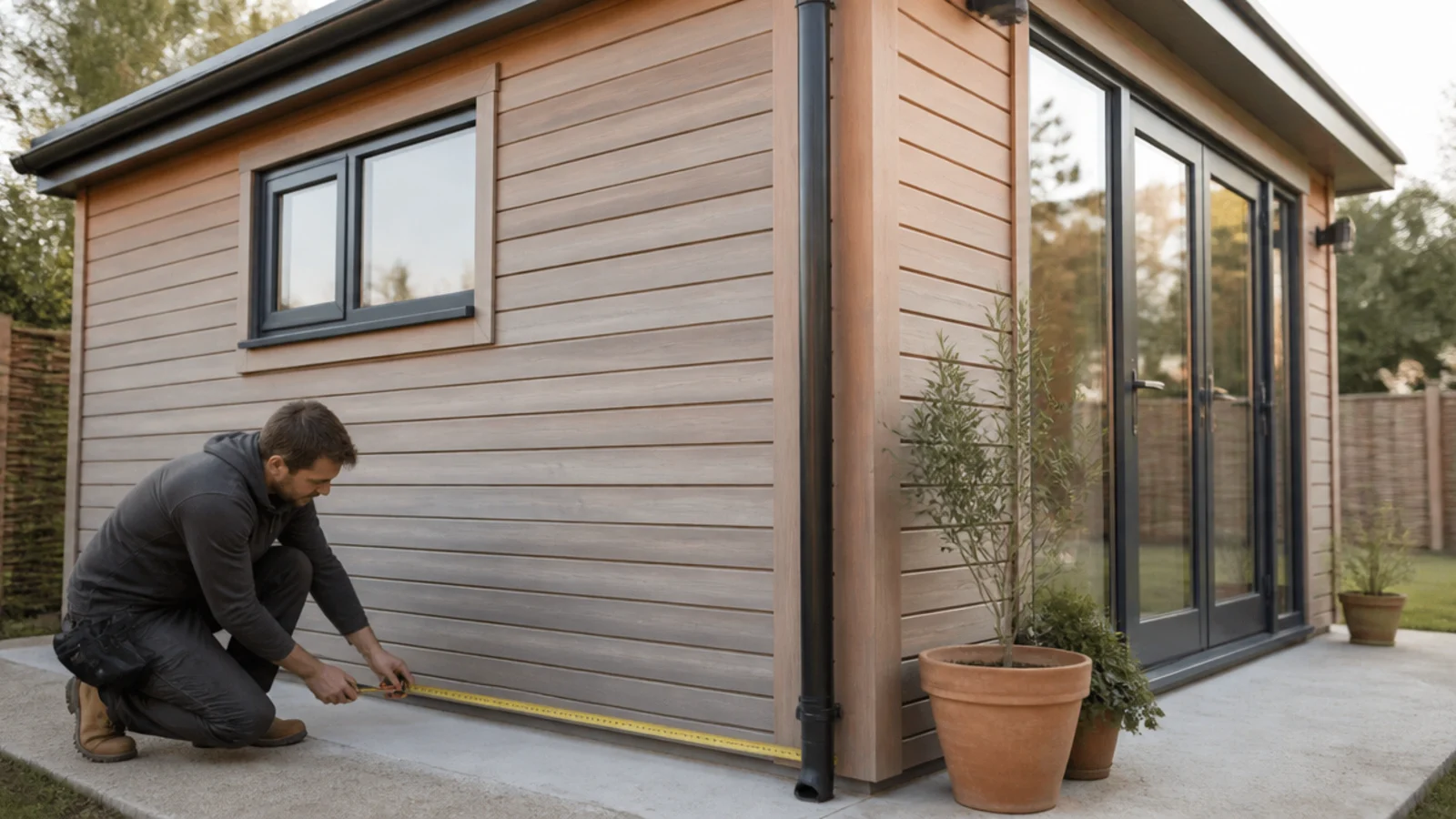
Outbuildings and light commercial structures come in standard sizes because they are framed on standard spacing and roofed with standard trusses. Knowing the footprint of each tells you the slab, the roof area and — importantly — whether you need a permit.
Permit thresholds are the reason to measure before you buy. Many US jurisdictions exempt accessory structures under 100 or 120 sq ft from a building permit, which is exactly why 10 × 10 and 8 × 12 sheds are so common: they sit just under the line. Check your local figure, because it varies by municipality and some areas set it at 200 sq ft.
Worked example — a 24 × 24 ft detached garage. Footprint is 576 sq ft. At 4 in of slab that is 576 × 0.333 ÷ 27 = 7.11 cubic yards of concrete, and on a 6/12 roof the covered area is 576 × 1.118 = 644 sq ft of roofing, or 6.4 squares before waste.
Footprint is not floor area when there is a loft or a second storey. A 30 × 40 pole barn is 1,200 sq ft of footprint, but with a half loft it has 1,800 sq ft of floor. Keep the two figures separate: the footprint drives the slab, the foundation and the site coverage limit, while floor area drives finishes and, in commercial work, occupancy calculations.
Site coverage is worth checking early. Many zoning codes cap the percentage of a lot that structures may cover, so a large shop on a small lot can fail on coverage even when it meets every setback. Add the new footprint to the house footprint and compare against the lot area before you order anything.
| Building size | Footprint | Typical use | Permit note |
|---|---|---|---|
| 8 × 10 ft | 80 sq ft | Garden shed | Usually under the permit threshold |
| 10 × 12 ft | 120 sq ft | Large shed, small studio | At or near the common 120 sq ft line |
| 12 × 20 ft | 240 sq ft | Single garage, workshop | Permit normally required |
| 20 × 20 ft | 400 sq ft | Two-car garage | Permit required |
| 24 × 24 ft | 576 sq ft | Two-car garage with storage | Permit required |
| 30 × 40 ft | 1,200 sq ft | Pole barn, small shop | Permit and often engineering |
| 40 × 60 ft | 2,400 sq ft | Light commercial / equipment | Permit and engineering |
Construction cost per square foot by building type
Building construction costs vary by use type, materials, and region:
Single-family residential (new): $150-300 per sq ft (NAHB 2024 average).
Custom luxury home: $300-600+ per sq ft.
Multi-family (apartments, condos): $130-250 per sq ft.
Light commercial (office, retail): $200-400 per sq ft.
Medical office buildings: $300-600 per sq ft (more mechanical systems).
Industrial / warehouse: $80-200 per sq ft (less interior finish).
Schools: $250-500 per sq ft (varies by district and design).
Hospitals: $500-1,000+ per sq ft (highest because of mechanical systems and code compliance).
These exclude land cost, site preparation, and permits. Always ask: does the per-square-foot quote include the foundation, mechanical/electrical/plumbing, finishes, or just shell?
Pro tips
Use the BOMA standard for commercial
BOMA (Building Owners and Managers Association) publishes the standard for measuring office space. Lenders and brokers expect BOMA-compliant numbers.
ANSI Z765 for residential
For homes, ANSI Z765 defines what counts as finished, heated square footage. Garages, unheated porches, and unfinished basements don't count.
Measure to the exterior face
For GBA, measure to the outside surface of the exterior wall. Wall thickness counts. For a 60 × 40 ft house with 6-in walls, that's 60.5 × 40.5 ft of GBA per floor.
Atriums count once
Multi-story atriums or open floor cutouts only count on the lowest floor. The void above the floor doesn't count toward upper-floor square footage.