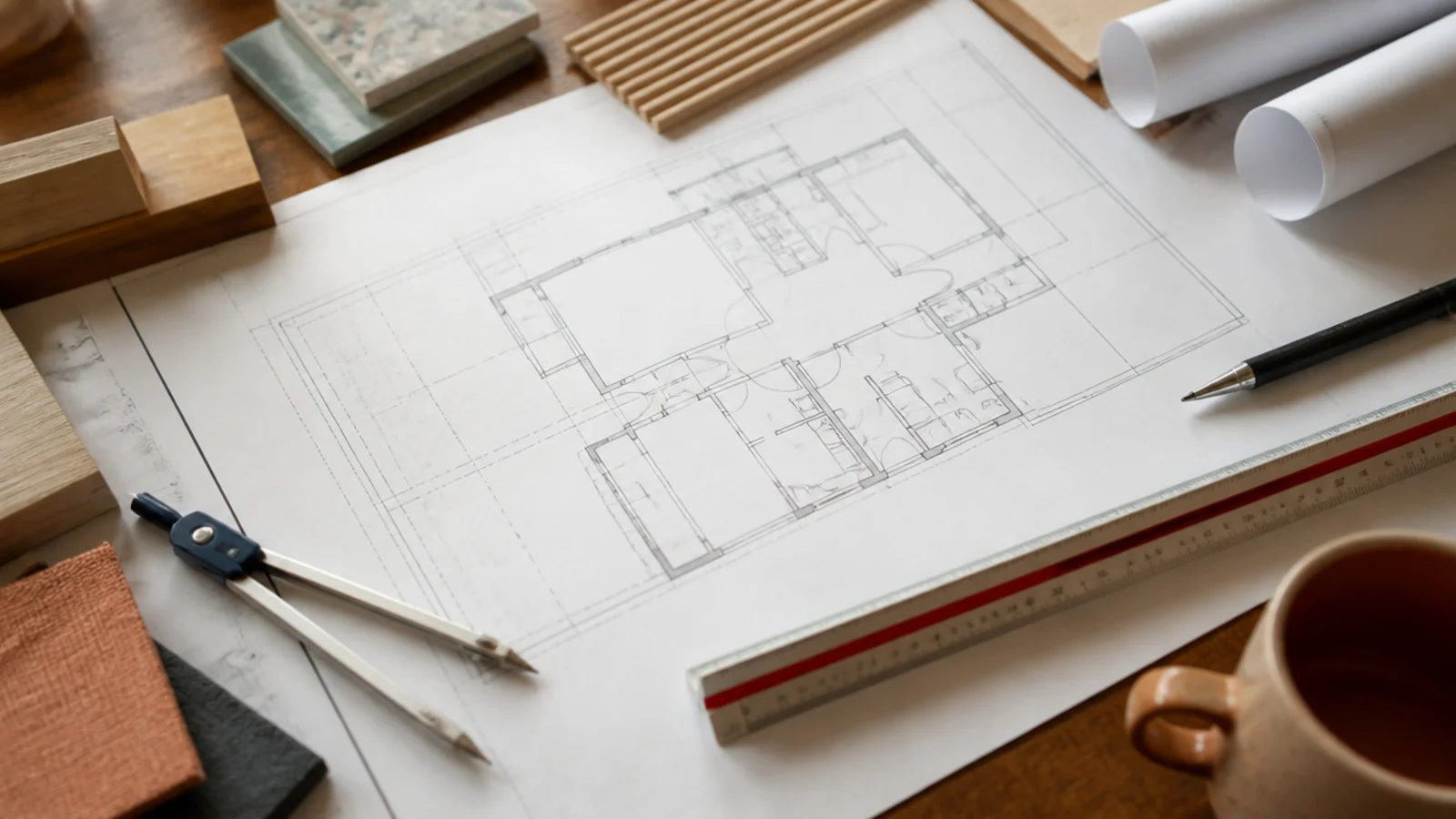
The shape formulas
Six formulas cover essentially every space you will measure in a building or on a lot. Everything more complicated is these six added together.
Rectangle and square are the same formula. Length × width, and for a square that is just the side squared. A 12 by 14 ft room is 168 square feet; a 15 ft square room is 225.
A triangle is half of the rectangle that would contain it: base × height ÷ 2. An 18 ft base with a 12 ft height is 108 square feet. Height means the perpendicular distance from the base to the opposite point, not the length of a sloping side — measuring the slope by mistake always over-reports.
When you cannot get a perpendicular height — a triangular lot corner, for instance — use Heron's formula instead. Half the perimeter is s, and the area is the square root of s(s−a)(s−b)(s−c). A 13-14-15 ft triangle has s = 21, giving exactly 84 square feet from three tape measurements and no right angle.
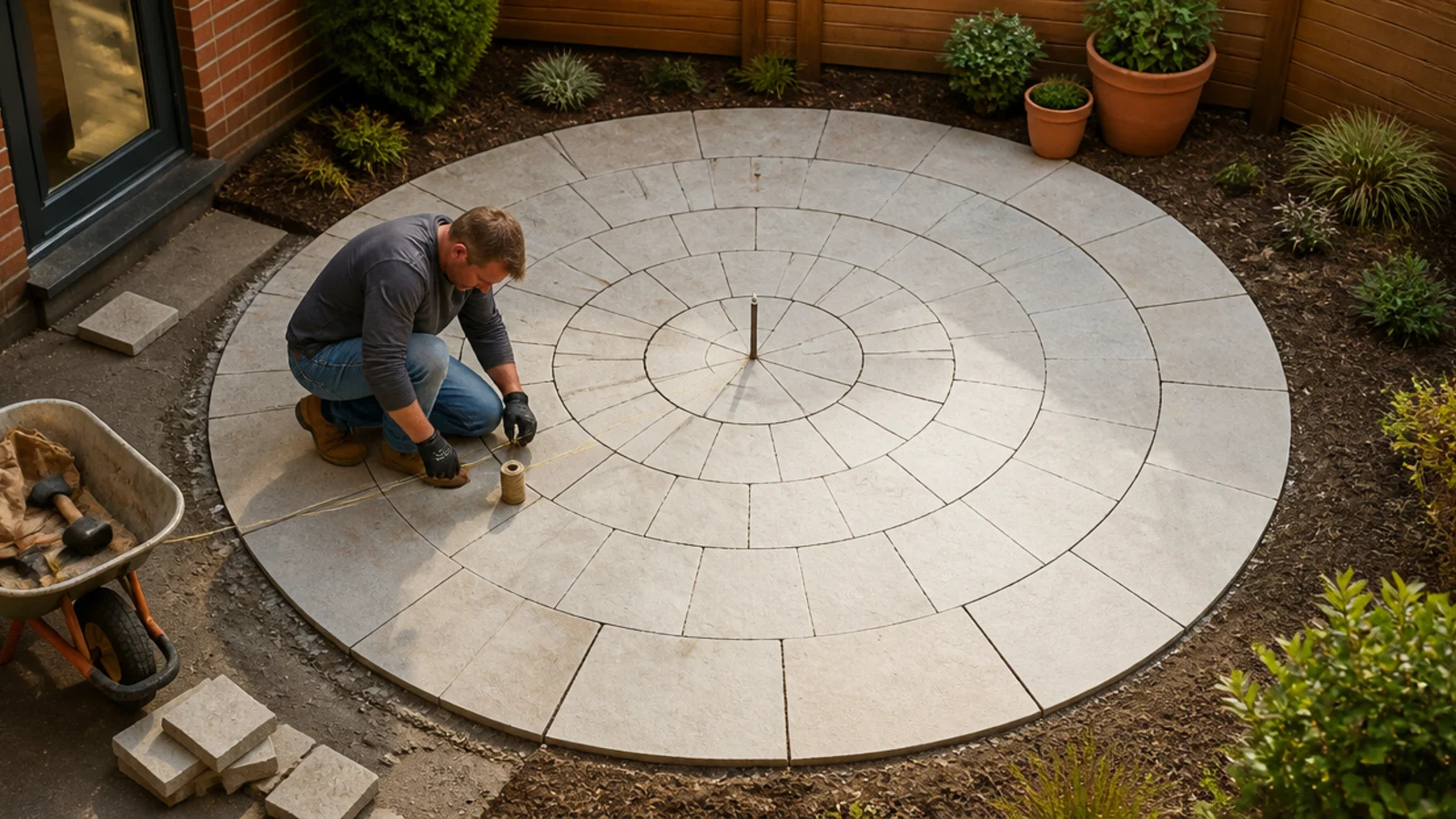
A circle is pi × radius². A 9 ft radius circle is 254.47 square feet. If you measured across rather than from the middle, halve the diameter first.
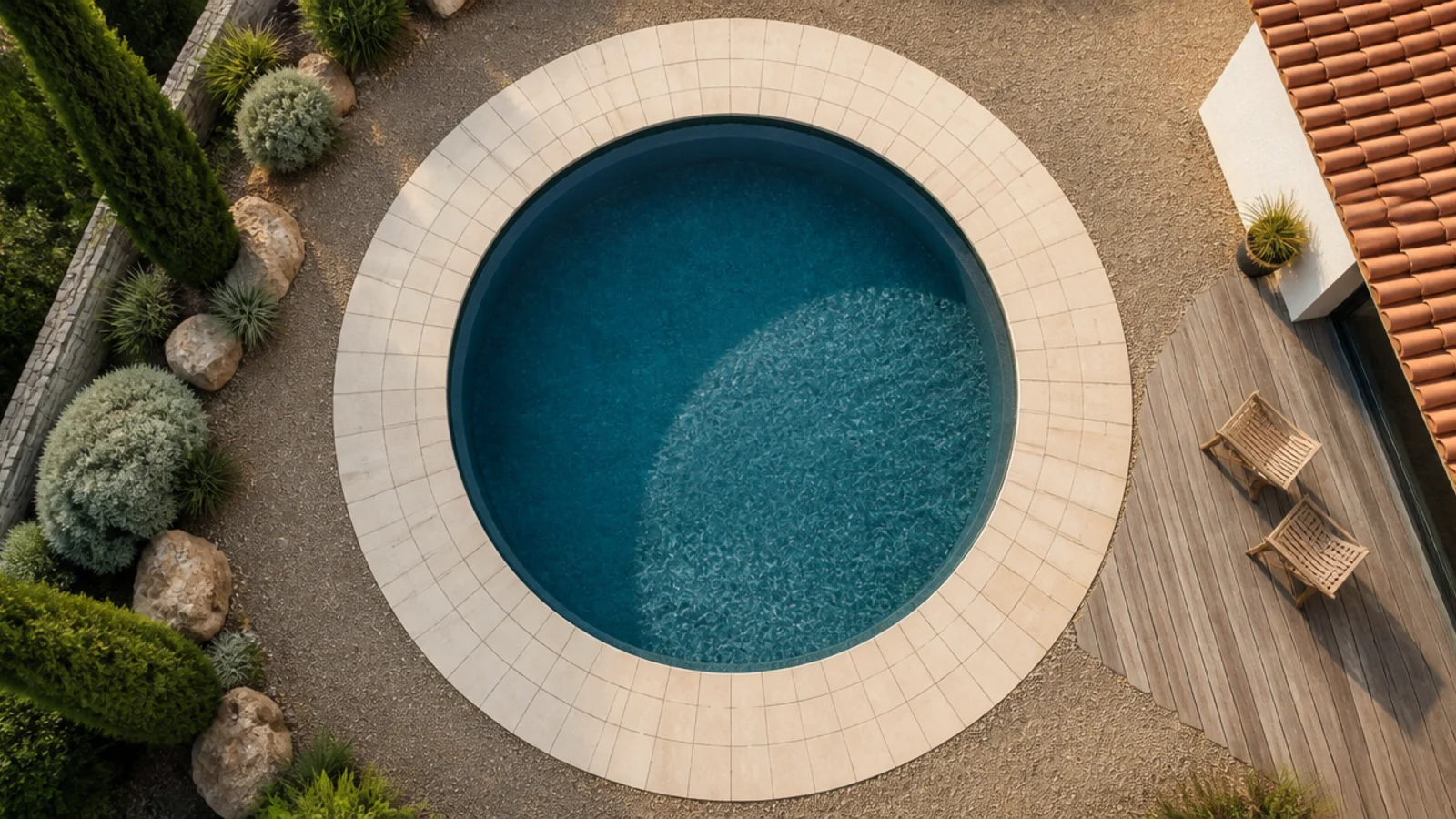
A ring, or annulus, is the outer circle minus the inner one: pi × (R² − r²). A 12 ft outer radius with an 8 ft inner radius is 251.33 square feet — the deck around a round pool, for example.
A trapezoid — a four-sided shape with two parallel sides, which is what most irregular lots turn out to be — is the average of the parallel sides times the distance between them. Sides of 14 and 20 ft, 10 ft apart, give 170 square feet.
| Shape | Formula | Example input | Area |
|---|---|---|---|
| Rectangle | length × width | 12 × 14 ft | 168 sq ft |
| Square | side² | 15 ft | 225 sq ft |
| Triangle | base × height ÷ 2 | 18 ft base, 12 ft high | 108 sq ft |
| Triangle (3 sides) | √(s(s−a)(s−b)(s−c)) | 13, 14, 15 ft | 84 sq ft |
| Circle | π × radius² | 9 ft radius | 254.47 sq ft |
| Ring (annulus) | π × (R² − r²) | 12 ft outer, 8 ft inner | 251.33 sq ft |
| Trapezoid | (a + b) ÷ 2 × height | 14 and 20 ft, 10 ft apart | 170 sq ft |
| Ellipse | π × a × b | 15 and 10 ft semi-axes | 471.24 sq ft |
Shapes that are not one shape
Most real rooms and lots are not on the list above, and the answer is always the same: split them.
An L-shaped room is two rectangles, or one big rectangle with a corner removed. Both give the same answer, and the subtraction method usually takes fewer measurements. A room inside a 20 by 30 ft envelope with a 10 by 12 ft corner missing is 600 − 120 = 480 square feet.
A border or surround — a patio edging, a walkway around a slab — is the outer rectangle minus the inner one. Outer dimensions minus twice the border width give the inner dimensions. A 20 by 10 ft patio with a 2 ft border is 200 − (16 × 6) = 104 square feet of border.
A room with a bay window is a rectangle plus a trapezoid. A room with a rounded end is a rectangle plus a half circle. In each case, measure the join line where the two shapes meet, because that measurement belongs to both pieces and getting it wrong distorts both.
Split at the corners, not at convenient-looking points. Every place a wall changes direction is a natural split line, and splitting there means every piece is a plain rectangle with two measurements.
Subtract, do not guess. When a shape has a piece missing, measure the missing piece and subtract it. Estimating the remainder by eye is where most irregular-area errors come from.
The conversion formulas
Square units do not convert at the same rate as linear units, and that catches people out constantly. A foot is 12 inches, but a square foot is 144 square inches, because both dimensions are converted.
Square inches to square feet: divide by 144. 1,440 square inches is 10 square feet.
Square feet to square yards: divide by 9. A 180 square foot room is 20 square yards — the unit carpet and sod are sold in.
Square feet to square meters: multiply by 0.09290304. That factor is exact, because 1 foot is defined as exactly 0.3048 metres. A 1,000 square foot apartment is 92.9 square meters.
Square meters to square feet: multiply by 10.7639. A 100 square meter apartment is 1,076.39 square feet.
Square feet to acres: divide by 43,560. Half an acre is 21,780 square feet.
| From | To | Operation | Example |
|---|---|---|---|
| Square inches | Square feet | ÷ 144 | 1,440 in² = 10 sq ft |
| Square feet | Square inches | × 144 | 10 sq ft = 1,440 in² |
| Square feet | Square yards | ÷ 9 | 180 sq ft = 20 sq yd |
| Square feet | Square meters | × 0.09290304 | 1,000 sq ft = 92.9 m² |
| Square meters | Square feet | × 10.7639 | 100 m² = 1,076.39 sq ft |
| Square feet | Acres | ÷ 43,560 | 21,780 sq ft = 0.5 acre |
| Acres | Square feet | × 43,560 | 1 acre = 43,560 sq ft |
Turning square footage into materials
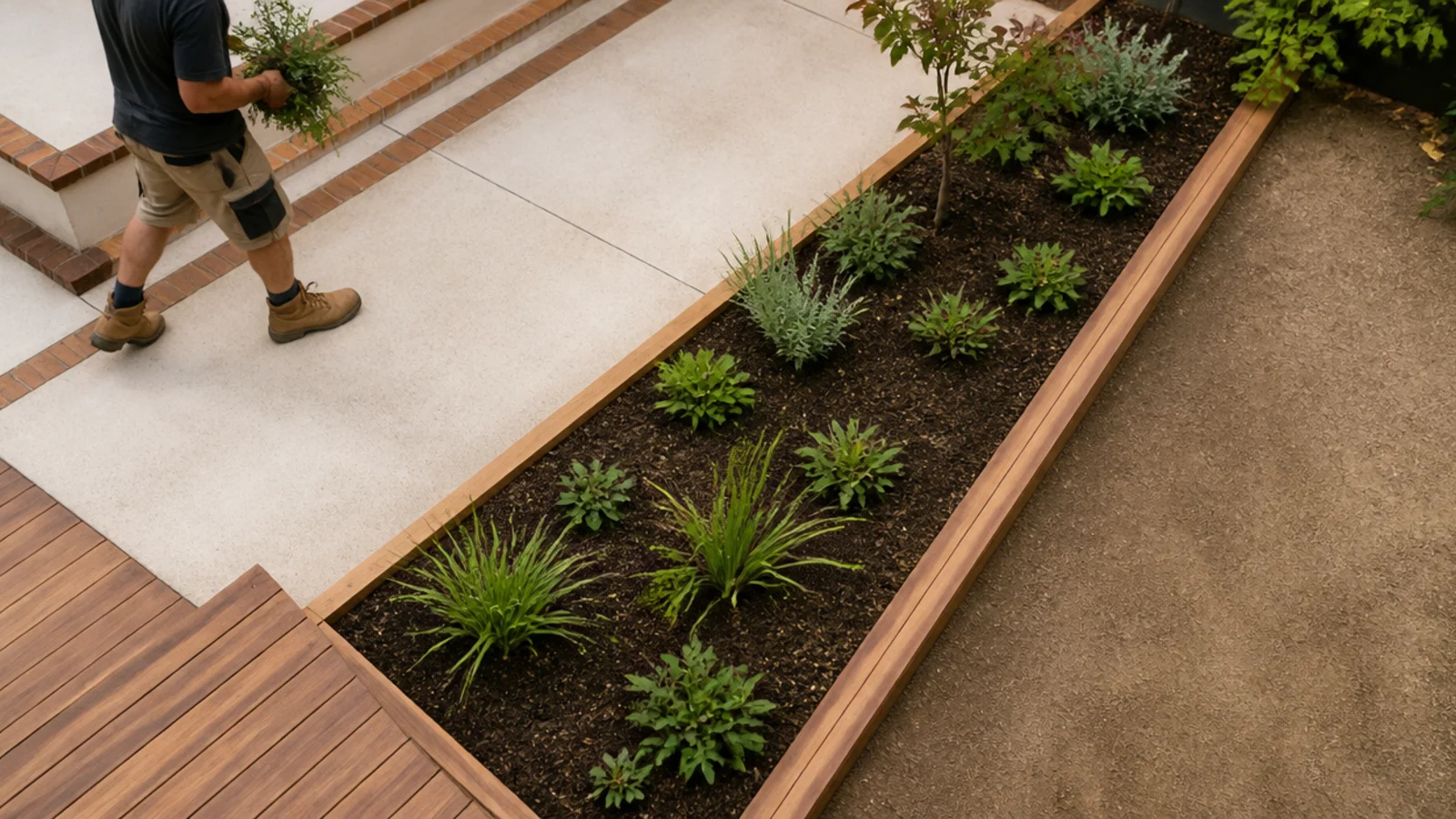
The area is rarely the answer you actually want. These are the formulas that turn it into a quantity to buy, and every one of them takes the area as its input.
Paint: gallons = area × coats ÷ 350. A 418 square foot room in two coats needs 2.39 gallons, so three. Primer covers less, around 200 to 300 square feet per gallon.
Drywall: sheets = area ÷ 32 for 4 by 8 ft sheets, or ÷ 48 for 4 by 12. 468 square feet of wall is 14.63 sheets, so 15 — and buy one spare.
Roofing: squares = roof area ÷ 100, and bundles = squares × 3 for standard shingles. A 1,789 square foot roof is 17.89 squares; rounded to 20 after waste, that is 60 bundles.
Tile and flooring: boxes = area × (1 + waste) ÷ coverage per box. 100 square feet at 10 percent waste is 110, and at 16 square feet per box that is 6.88 boxes, so seven.
Notice that every one of these rounds up, and several add a waste factor first. Materials are sold in whole units and offcuts are rarely reusable, so the arithmetic answer is a floor, never the order quantity.
The order of operations that keeps you out of trouble
The formulas are simple. The mistakes are almost always in the sequence, so this is the order to work in.
Measure in inches, not rounded feet. Convert once at the end by dividing the square inches by 144. Rounding each measurement to the nearest foot before multiplying compounds the error across every wall in a room.
Calculate gross area first and write it down. Do the deductions as a separate step, so when a supplier's number differs you can tell whether you disagree about the space or about the deductions.
Apply the waste factor after the deductions, not before. A 10 percent waste factor applied to the gross area quietly buys material for openings you already removed.
Round up at the very end, once. Rounding at each step accumulates: three roundings of 0.4 sheets each is more than a whole sheet of error by the time you reach the till.
Then sanity-check against something you know. A bedroom is normally 100 to 250 square feet, an interior wall 80 to 160, a two-car garage around 400 to 576. If your answer is outside the expected band, re-measure before ordering.
Three sides do not always make a triangle
Heron's formula takes three side lengths and returns an area, which makes it look as though any three numbers describe a triangle. They do not, and the formula's own arithmetic is what tells you so.
The test is the triangle inequality: the sum of any two sides has to be greater than the third. Sides of 13, 14 and 15 pass comfortably and give the 84 sq ft worked above. Sides of 2, 3 and 9 do not — 2 plus 3 is 5, which cannot reach across 9 — and no shape exists with those measurements.
Run the failing set through Heron anyway and watch what happens. The semi-perimeter is (2 + 3 + 9) ÷ 2 = 7, so the three bracketed terms are 7 − 2 = 5, 7 − 3 = 4 and 7 − 9 = −2. The product is 7 × 5 × 4 × −2 = −280, and there is no square root of a negative number to take. A calculator that returns nothing, or an error, is not broken; it is telling you the measurements are wrong.
Near-misses are worth knowing about too, because they pass the test and still signal a mistake. Sides of 5, 5 and 9.99 are technically a triangle, but the two short sides have to lie almost flat against the long one, and the area collapses to 1.12 sq ft. A real room that measures like that is far more likely to have a transposed digit than to be a sliver.
So when a three-sided measurement produces no answer, re-measure the longest side first. It is the one most likely to have been taken across a diagonal, or to have picked up an alcove that the other two did not.