The steps, in order
The short version — each step is explained in full below.
- Measure the building footprint
Measure the length and width of the house at ground level, including any overhang, and multiply them. A 40 by 40 ft footprint is 1,600 square feet. This is the flat area the roof covers, not the roof area itself.
- Find the roof pitch
Pitch is written as rise over run, such as 6/12, meaning the roof rises 6 inches for every 12 inches of horizontal run. Measure it in the attic against a rafter with a level and a tape, or from a ladder at the gable end.
- Apply the pitch multiplier
Multiply the footprint by the multiplier for your pitch. A 6/12 pitch has a multiplier of 1.118, so 1,600 square feet of footprint becomes 1,789 square feet of actual roof surface.
- Convert to squares and add waste
Divide by 100 for squares: 1,789 becomes 17.89 squares. Add 10 percent for a simple gable roof or 15 percent for hips and valleys, then round up to a whole square.
- Convert squares to bundles
Standard three-tab and architectural shingles come three bundles to the square. Twenty squares needs 60 bundles. Check the wrapper, because some heavyweight and designer shingles run four or five bundles per square.
Quick answer
One roofing square equals 100 square feet. It is a supplier convention, not a geometric unit, and it exists because shingles, underlayment and labour are all priced in hundreds of square feet.
To convert: squares = roof area in square feet ÷ 100. To go the other way: square feet = squares × 100. A 24-square roof is 2,400 square feet of roof surface.
The number that trips people up is not the conversion, it is which area you divide. Squares measure the sloped roof surface, not the footprint of the house underneath it. On anything steeper than flat, the roof is larger than the building it covers.
Why the footprint is not the roof area
A roof is a slope, and the steeper it is, the more surface it has over the same footprint. Measuring the house from the ground and calling that the roof area is the single most common estimating error, and it always under-orders.
The correction is a pitch multiplier, which comes straight from the Pythagorean theorem. For a pitch of rise over 12, the multiplier is the square root of one plus the rise divided by twelve, squared. A 6/12 roof works out to 1.118, so its surface is 11.8 percent larger than the footprint.
That is not a rounding difference. On a 1,600 square foot footprint, the gap between assuming a flat roof and correctly applying a 6/12 pitch is 189 square feet, close to two whole squares of shingles. At a 12/12 pitch the roof is 41 percent larger than the footprint.
Include the overhang in the footprint measurement. Eaves typically project 12 to 24 inches past the wall, and that area is roofed like everything else. Measuring to the wall rather than the drip edge quietly removes a strip of roof from every side.
| Pitch | Multiplier | Roof area | Squares |
|---|---|---|---|
| 3/12 | 1.031 | 1,649 sq ft | 16.5 |
| 4/12 | 1.054 | 1,687 sq ft | 16.9 |
| 5/12 | 1.083 | 1,733 sq ft | 17.3 |
| 6/12 | 1.118 | 1,789 sq ft | 17.9 |
| 7/12 | 1.158 | 1,852 sq ft | 18.5 |
| 8/12 | 1.202 | 1,923 sq ft | 19.2 |
| 10/12 | 1.302 | 2,083 sq ft | 20.8 |
| 12/12 | 1.414 | 2,263 sq ft | 22.6 |
Worked example: a 40 by 40 house at 6/12
Take a simple gable roof over a 40 by 40 ft footprint, measured to the drip edge, at a 6/12 pitch.
Footprint is 40 × 40 = 1,600 square feet. Apply the 6/12 multiplier: 1,600 × 1.118 = 1,789 square feet of roof surface. Divide by 100 and the roof is 17.89 squares.
Now add waste. A straight gable with two rectangular planes is the easiest case, so 10 percent is enough: 1,789 × 1.10 = 1,968 square feet, or 19.68 squares. Round up to 20 squares, because suppliers sell whole bundles and you want the extra on the truck rather than a second delivery.
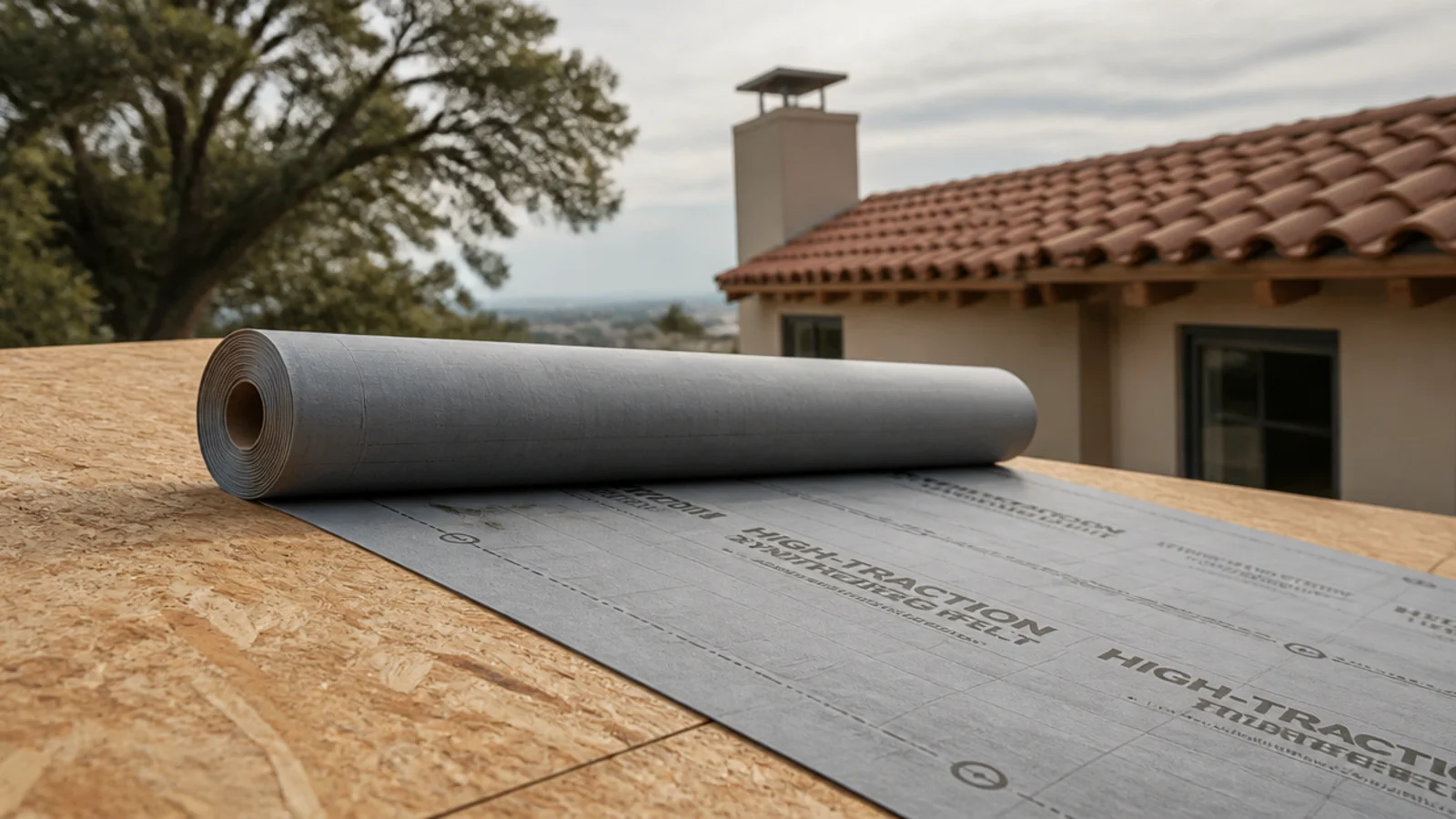
Twenty squares at three bundles per square is 60 bundles. Underlayment follows separately: a synthetic roll typically covers 10 squares, so this roof takes two rolls. Fifteen-pound felt covers about four squares per roll, which would be five rolls for the same job.
One check worth doing before ordering: multiply back. Sixty bundles at 33.3 square feet each is 1,998 square feet, comfortably over the 1,789 the roof actually needs, with the difference absorbed by starter course, ridge cap and cuts.
Squares are always the sloped surface. If a number came off a plan view, a satellite measurement or a tape at ground level, it is a footprint and still needs the pitch multiplier applied.
Waste factors, and where the extra actually goes
Waste on a roof is not spillage. It is the material consumed by cuts at hips, valleys, rakes and penetrations, plus the starter course along the eaves and the cap shingles along the ridge, which are cut from full shingles on most jobs.
A simple gable roof, two planes and nothing else, runs about 10 percent. Add a hip roof, dormers, multiple valleys or a chimney and 15 percent is realistic. Complex roofs with several intersecting planes can justify more, and that is a judgement call your roofer should make on site rather than a figure to guess at.
Valleys are the expensive part. Every shingle course meeting a valley gets cut on an angle, and the offcut is usually too small to reuse. Two long valleys on an otherwise simple roof can push waste from 10 to 15 percent by themselves.
Order the whole job in one delivery. Asphalt shingles are batch-coloured like paint, and a second order weeks later can arrive visibly different — a problem on a roof that will be looked at from the street for the next 25 years.
Squares in an estimate, and how to read one
Because squares are the pricing unit, a roofing estimate reads almost entirely in them, and understanding the line items lets you compare two quotes properly.
The material line is squares of shingles plus squares of underlayment. Labour is usually quoted per square too, and tear-off is priced per square of existing roofing, per layer — a roof with two existing layers costs roughly twice as much to strip as one.
Linear items sit alongside the squares and are measured separately: ridge cap, drip edge, valley flashing and starter strip are all quoted by the linear foot. If a quote gives you only a square count and a total, ask how those linear items were counted, because they are where two estimates most often diverge.
When comparing quotes, check that both are working from the same roof area. A contractor who measured the pitch on site and one who pulled a satellite footprint can be two squares apart before either has quoted a price, and the cheaper number is usually the wrong one.
Below 4:12 the pitch stops being just a multiplier
Everywhere else on this page the pitch is arithmetic: it tells you how much bigger the roof is than the footprint. Below about 4:12 it also starts telling you what you are allowed to put on it, and that is the one place where a shallow roof costs more rather than less.
The multipliers make the trap obvious. A 2:12 roof is only 1.4 percent larger than its footprint and a 4:12 is 5.4 percent — against 11.8 percent at 6:12. On a 1,600 sq ft footprint that is 1,622 sq ft at 2:12 and 1,687 at 4:12. The area barely moves, so a low-slope roof looks like the cheap one.
The International Residential Code sets a floor for asphalt shingles at 2:12 — below that they are not permitted at all, because water moves too slowly across the surface and wind-driven rain can track back under the laps. Between 2:12 and 4:12 shingles are allowed but require a double layer of underlayment, so the material under the shingles roughly doubles on precisely the roofs whose shingle count barely rose.
That is the reversal worth planning around. Going from a 6:12 to a 2:12 saves about 10 percent of the shingle area and adds a whole second underlayment across the entire deck. Anything under 2:12 is a different product category — membrane rather than shingles — and a different trade.
Code editions and local amendments vary, and a manufacturer can set a stricter limit than the code for its own product without voiding anything. Confirm both the adopted code edition where you are and the shingle manufacturer's own instructions before ordering for a roof under 4:12.